
Table of Contents
- 1. What Exactly is RBD Palm Olein?
2. Understanding Cloud Point (CP): The Key to Palm Olein Grades
3. A Deep Dive into RBD Palm Olein CP8
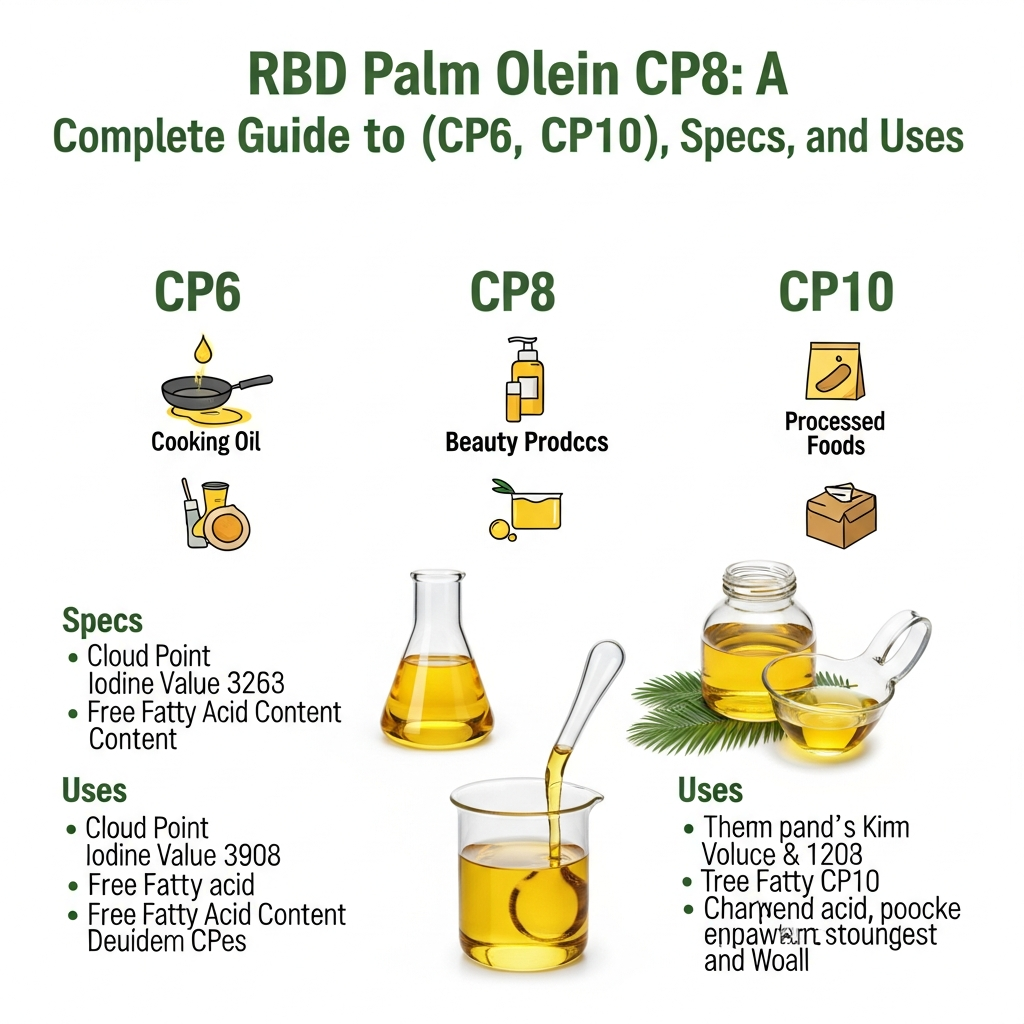
4. Comparing Grades: RBD Palm Olein CP6 vs. CP8 vs. CP10
5. Technical Specifications of RBD Palm Olein CP8
6. Common Uses and Applications of RBD Palm Olein CP8
7. Health, Nutrition, and Sustainability Concerns
8. How to Choose the Right Palm Olein Grade for Your Needs
Navigating the world of edible oils can be complex, especially with technical terms like RBD Palm Olein CP8. Whether you’re in the food manufacturing industry, a distributor, or simply curious, understanding this versatile cooking oil is crucial. As one of the most widely used vegetable oils globally, it originates from the versatile Oil Palm Fruit Bunch and is prized for its stability and cost-effectiveness.
This ultimate guide will break down everything you need to know about RBD Palm Olein, focusing on the popular CP8 grade while also comparing it with CP6 and CP10. We’ll explore its specifications, uses, and the critical factors that set these grades apart.
1. What Exactly is RBD Palm Olein?
First, let’s decipher the name. “RBD” stands for Refined, Bleached, and Deodorized. This is a crucial purification process that Crude Palm Oil undergoes to make it suitable for consumption. The process removes impurities, free fatty acids (FFAs), colors, and odors, resulting in a stable, bland, and light-colored oil.
“Palm Olein” refers to the liquid fraction obtained from palm oil through a process called fractionation. The palm fruit is unique; after the oil is extracted from the flesh, the fruit’s nut, or Palm Kernel, is processed to produce Palm Kernel Oil. The broader milling process also yields valuable co-products. The leftover pulp becomes Palm Kernel Expeller, a key ingredient in animal feed, while the hard outer covering, the Palm Kernel Shell, serves as an efficient biomass fuel.
2. Understanding Cloud Point (CP): The Key to Palm Olein Grades
The “CP” in the product name stands for Cloud Point. This is the single most important specification that defines the grade of palm olein.
Cloud Point is the temperature at which the oil starts to become cloudy or hazy as it cools. A lower cloud point indicates that the oil will remain clear and liquid at lower temperatures, making it more suitable for colder climates or applications where clarity is essential.

3. A Deep Dive into RBD Palm Olein CP8
RBD Palm Olein CP8, with a cloud point of a maximum of 8°C, is often considered the “all-rounder” or standard premium grade. It strikes a perfect balance between performance and cost, making it a popular choice in many temperate regions worldwide.
Its improved cold stability compared to the standard CP10 means it is less likely to solidify in cooler weather, ensuring a free-flowing product for longer. This characteristic is particularly valuable for liquid cooking oils, industrial frying, and food production in countries that experience mild winters.
4. Comparing Grades: RBD Palm Olein CP6 vs. CP8 vs. CP10
Understanding the differences between the three main grades is key to making the right purchasing decision. The primary distinction is the cloud point, which is achieved through varying degrees of fractionation.
RBD Palm Olein CP10 (Standard Olein)
- Cloud Point: Max 10°C.
Characteristics: This is the most common and widely produced grade. It’s cost-effective but will start to cloud and solidify once temperatures drop below 10°C.
Best For: Tropical climates, industrial frying where temperature is controlled, and cost-sensitive markets.
RBD Palm Olein CP8 (The Balanced Choice)
- Cloud Point: Max 8°C.
Characteristics: Offers better cold stability than CP10 without the higher cost of CP6. The specifications for this grade make it a versatile and reliable option.
Best For: Temperate climates, branded bottled cooking oils, and general food manufacturing.
RBD Palm Olein CP6 (Super Olein)
- Cloud Point: Max 6°C.
Characteristics: This is the premium grade, also known as “Super Olein.” It undergoes double fractionation to achieve a very low cloud point, ensuring it stays liquid even in colder conditions.
Best For: Cold climates, salad dressings, mayonnaise, and applications requiring the highest clarity and cold stability.
5. Technical Specifications of RBD Palm Olein CP8
Beyond the cloud point, several other technical parameters define the quality of RBD Palm Olein CP8. Below is a table outlining the typical specifications that buyers and quality control teams look for.
| Parameter | Specification |
|---|---|
| Free Fatty Acids (FFA) (as % Palmitic) | 0.1% Max |
| Moisture & Impurities (M&I) | 0.1% Max |
| Iodine Value (Wijs) | 57 Min |
| Cloud Point (°C) | 8°C Max |
| Color (5.25″ Lovibond Cell) | 3 Red Max |
| Slip Melting Point (°C) | 24 Max |
6. Common Uses and Applications of RBD Palm Olein CP8
Thanks to its excellent heat stability, neutral taste, and balanced properties, this edible oil is a workhorse in the food industry. Its applications are vast and varied:
- Cooking and Frying: It’s one of the most popular oils for deep frying on both an industrial and household scale due to its high smoke point and resistance to oxidation. This leads to longer fry-life and less frequent oil changes.
Food Manufacturing: It is a key ingredient in instant noodles, potato chips, doughnuts, and other snack foods. Its neutral flavor profile ensures it doesn’t overpower the product’s taste.
Margarine and Shortening: While the solid stearin fraction is more common for this, olein can be blended to achieve specific textures and melting points in shortenings and margarines.
Confectionery: Used in some chocolates and candies as a fat, providing the right mouthfeel and preventing melting at room temperature.
7. Health, Nutrition, and Sustainability Concerns
Nutritionally, palm oil is naturally free of trans fats and is a rich source of Vitamin E (tocotrienols). However, like all oils, it should be consumed in moderation as part of a balanced diet. For more information on dietary fats, the World Health Organization (WHO) provides comprehensive guidelines.
The palm oil industry has faced significant scrutiny over environmental and social issues. In response, sustainable practices have become paramount. When sourcing palm olein, it’s crucial to look for suppliers committed to sustainability, often certified by the Roundtable on Sustainable Palm Oil (RSPO). This ensures the oil is produced responsibly without harming forests or communities. Additional scientific insights can be found at ScienceDirect.
8. How to Choose the Right Palm Olein Grade for Your Needs
Selecting the correct grade of RBD Palm Olein depends on three primary factors:
- Climate: Where will the product be sold or used? Colder regions demand a lower cloud point (CP6 or CP8), while tropical regions can easily use CP10.
Application: Is the oil for deep frying or for a salad dressing that needs to stay clear when refrigerated? The end-use dictates the required performance.
Cost: There is a premium for lower cloud points due to the extra processing. RBD Palm Olein CP8 offers a great middle-ground, but for cost-sensitive applications, CP10 might be sufficient. The Food and Agriculture Organization (FAO) of the UN provides market data that can influence purchasing decisions.
Makmur Amanah Sejahtera provides high-quality palm products such as Palm Kernel Expeller, Palm Kernel Shell, Crude Palm Oil, Palm Kernel Oil, etc. Kindly contact us at WhatsApp +6282140002198 or email us at admin@makmuramanah.co.id.Looking for High-Quality Palm Products?
 English
  Indonesian
  Chinese
  Arabic