
Table of Contents
- What Exactly is Empty Palm Fruit Bunch (EFB)?
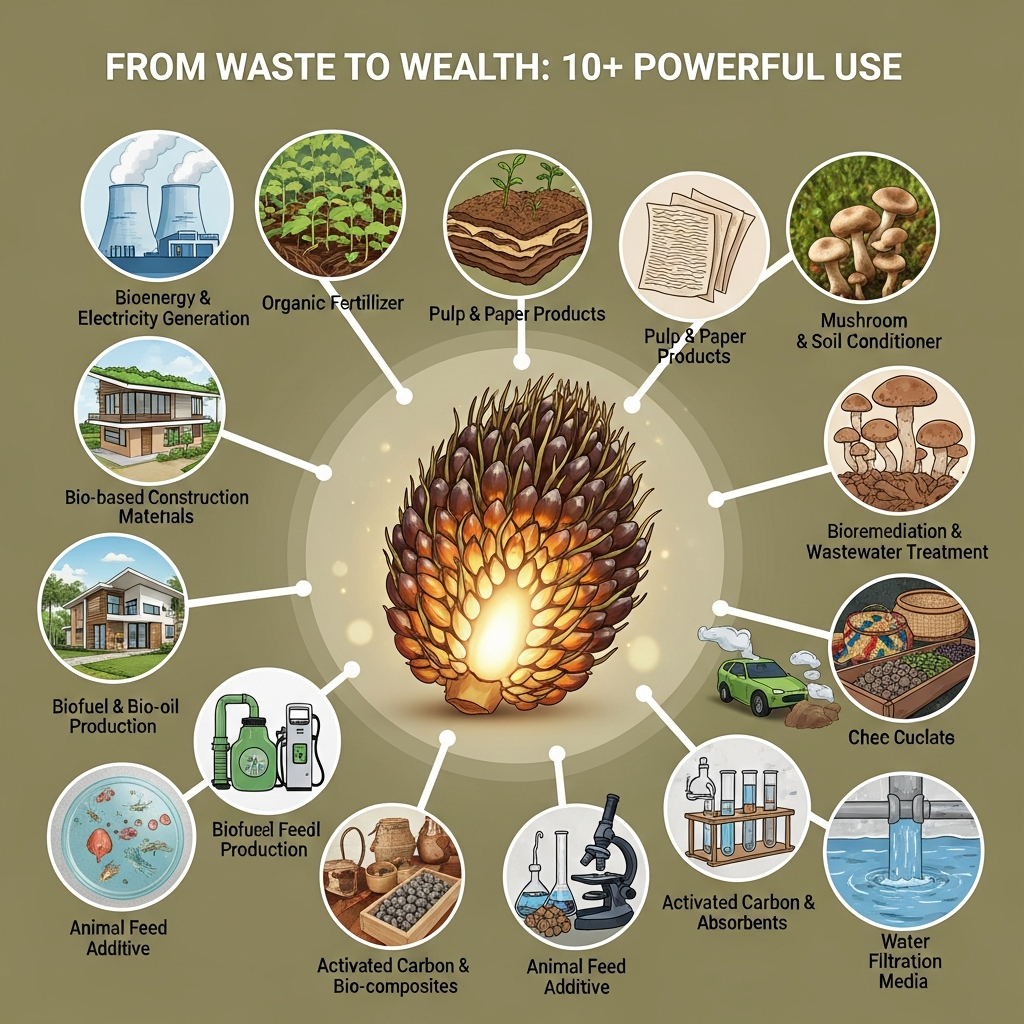
- 11 Powerful Uses for Empty Palm Fruit Bunch (EFB)
- 1. Biofuel and Bioenergy Generation
- 2. High-Quality Compost and Organic Fertilizer
- 3. Agricultural Mulching
- 4. Pulp and Paper Production
- 5. Medium-Density Fibreboard (MDF) and Particleboard
- 6. Ruminant Animal Feed
- 7. Activated Carbon for Filtration
- 8. Mushroom Cultivation Substrate
- 9. Bioplastics and Biocomposites
- 10. Sound and Heat Insulation Panels
- 11. Bio-oil Production via Pyrolysis
- Challenges and Future Outlook
- Conclusion: From Waste to a Sustainable Resource
- Contact Us for Palm Products
The palm oil industry is a global powerhouse, but it generates a colossal amount of biomass waste. For every ton of Crude Palm Oil produced, about 1.2 tons of empty palm fruit bunch (EFB) are left behind. This is the part of the Oil Palm Fruit Bunch that remains after the fruitlets are removed. Traditionally seen as a disposal problem, this fibrous material is now being recognized for what it truly is: a valuable resource. This article explores the many innovative and powerful uses for empty palm fruit bunch, transforming a challenge into a sustainable opportunity.
By harnessing the potential of EFB, producers can create new revenue streams, reduce their environmental footprint, and contribute to a more circular economy. This shift in perspective is crucial for the future of sustainable agriculture.
What Exactly is Empty Palm Fruit Bunch (EFB)?
Empty Palm Fruit Bunch is the biomass that remains after the palm fruits, which contain the valuable Palm Kernel, have been stripped off to extract oil. It’s a lignocellulosic material, rich in cellulose, hemicellulose, and lignin. In its raw form, EFB has high moisture content and a tough, fibrous structure, which historically made it difficult to manage.
However, modern technology has unlocked a wide array of processing methods—from shredding and pressing to pelletizing and pyrolysis. These advancements are key to unlocking the diverse and economically viable uses for empty palm fruit bunch that we see emerging today.

11 Powerful Uses for Empty Palm Fruit Bunch (EFB)
From energy to agriculture, the applications for EFB are expanding rapidly. Here are eleven proven uses that are making a significant impact.
1. Biofuel and Bioenergy Generation
One of the most significant uses for empty palm fruit bunch is in energy production. EFB can be processed into solid, liquid, and gaseous biofuels. It is often shredded and pressed to reduce moisture, then converted into high-density pellets or briquettes. These serve as a clean, renewable substitute for coal in industrial boilers, much like the energy derived from Palm Kernel Shell, significantly cutting carbon emissions. According to a study in the Energies journal, EFB pellets have excellent combustion properties.
2. High-Quality Compost and Organic Fertilizer
When composted, EFB decomposes into a nutrient-rich organic fertilizer. It improves soil structure, enhances water retention, and replenishes essential nutrients like potassium. This reduces the need for chemical fertilizers, promoting healthier soil and preventing nutrient runoff into waterways, a principle supported by organizations like the UN’s Food and Agriculture Organization (FAO).
3. Agricultural Mulching
Shredded EFB serves as an excellent mulching material for plantations and farms. Spreading it around the base of plants helps suppress weed growth, conserve soil moisture by reducing evaporation, and regulate soil temperature. As the mulch slowly decomposes, it adds valuable organic matter back into the soil.
4. Pulp and Paper Production
The high cellulose content in EFB makes it a viable alternative fiber source for the pulp and paper industry. Using EFB reduces the logging of forests for virgin pulp. While challenges in processing remain, ongoing research is refining the techniques to produce high-quality, eco-friendly paper from this agricultural residue.
5. Medium-Density Fibreboard (MDF) and Particleboard
Another of the key industrial uses for empty palm fruit bunch is in the manufacturing of composite wood products like MDF and particleboard. The fibers are bonded together with a resin under heat and pressure to create strong, versatile boards for furniture and construction, offering a sustainable alternative to traditional wood sources.
6. Ruminant Animal Feed
Through processes like fermentation and steam treatment, EFB can be broken down into a more digestible form suitable for ruminant animals like cattle and goats. While it serves as a good source of roughage, it is often combined with nutrient-rich feed like Palm Kernel Expeller to create a more balanced and cost-effective component of animal feed.
7. Activated Carbon for Filtration
EFB can be converted into activated carbon through a process of carbonization and activation. The resulting material has a highly porous structure, making it effective for water and air filtration, purification, and decolorization processes in various industries. This application is detailed in materials science resources like this article from Materials Letters.
8. Mushroom Cultivation Substrate
The sterile, fibrous nature of processed EFB makes it an ideal substrate for growing mushrooms, particularly oyster mushrooms. It provides the necessary nutrients and physical support for mycelial growth, turning waste biomass into a source of food. This is a popular use in many parts of Southeast Asia.
9. Bioplastics and Biocomposites
Researchers are actively exploring EFB fibers as reinforcement in bioplastics and biocomposites. These materials can be used to produce everything from automotive interior parts to biodegradable packaging, reducing reliance on petroleum-based plastics. The potential of this application is highlighted in journals like the Journal of Applied Polymer Science.
10. Sound and Heat Insulation Panels
The fibrous structure of EFB provides natural thermal and acoustic insulation properties. When pressed into panels, it can be used as an eco-friendly building material to insulate walls and ceilings, improving energy efficiency and reducing noise pollution.
11. Bio-oil Production via Pyrolysis
Pyrolysis is a process of heating biomass in the absence of oxygen to produce bio-oil, biochar, and syngas. Bio-oil can be refined into transportation fuels and chemicals, similar to how Palm Kernel Oil serves as a valuable oil product. Biochar can be used as a soil amendment, making this one of the most advanced uses for empty palm fruit bunch.

Challenges and Future Outlook
Despite its vast potential, utilizing EFB is not without challenges. High moisture content, transportation logistics from remote plantations, and the capital investment required for processing facilities are significant hurdles. However, as technology improves and the demand for sustainable solutions grows, the economic feasibility of these applications continues to increase.
The future for EFB is bright. The global push towards a circular economy and carbon neutrality positions EFB as a key player. Continued research and investment will undoubtedly uncover even more innovative uses for empty palm fruit bunch, solidifying its role as a valuable commodity.
Conclusion: From Waste to a Sustainable Resource
Empty Palm Fruit Bunch is a prime example of the “waste to wealth” philosophy. What was once an environmental burden is now a feedstock for green energy, sustainable materials, and agricultural innovation. By embracing the diverse uses for this abundant resource, the palm oil industry can move towards a more sustainable and profitable future, proving that environmental responsibility and economic growth can go hand in hand.
Your Trusted Partner for Palm Products
Looking for High-Quality Palm Products?
Makmur Amanah Sejahtera provides high-quality palm products such as Palm Kernel Expeller, Palm Kernel Shell, Crude Palm Oil, Palm Kernel Oil, etc. Kindly contact us at WhatsApp +6282140002198 or email us at admin@makmuramanah.co.id.
 English
  Indonesian
  Chinese
  Arabic