
- What Exactly is RBD Palm Olein?
- Understanding the “CP” Number: What Cloud Point Means for RBD Palm Olein
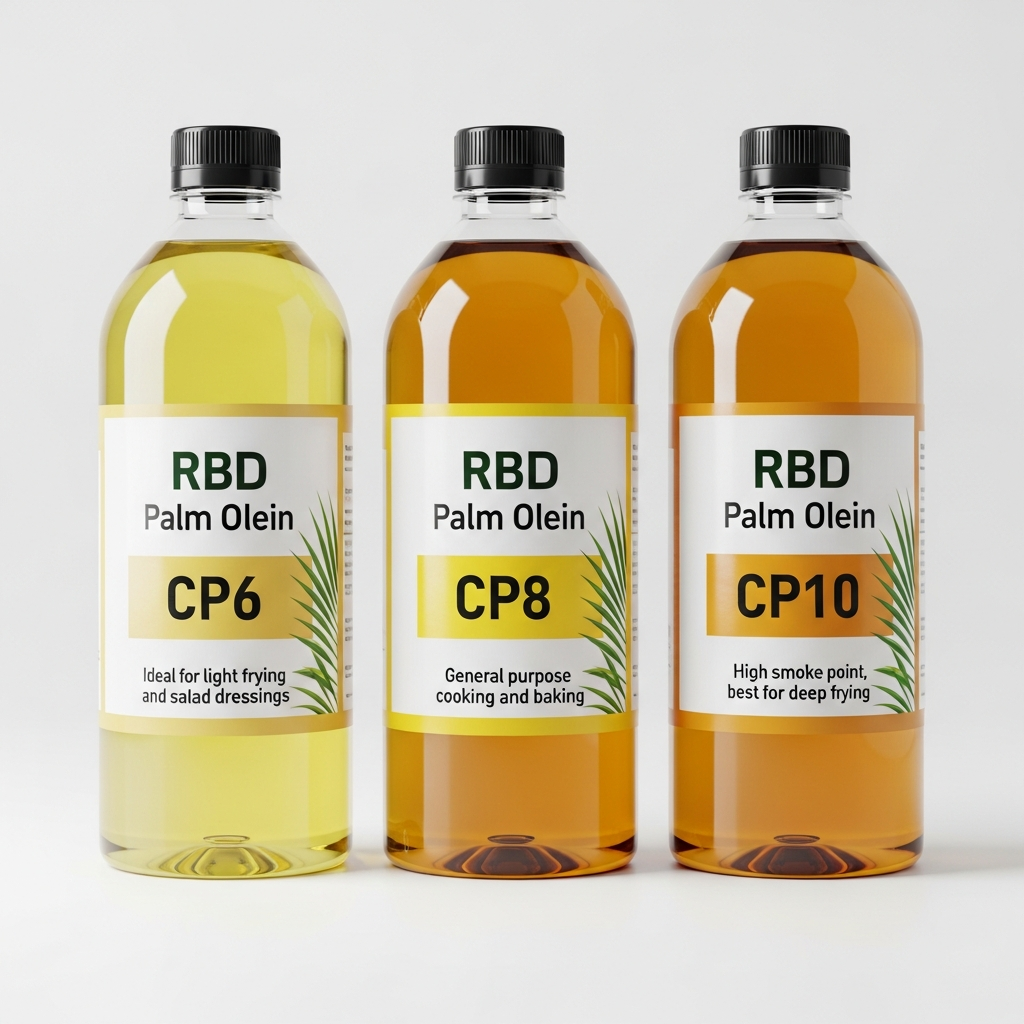
- The 3 Key Grades of RBD Palm Olein: CP10 vs. CP8 vs. CP6
- At-a-Glance: Comparing CP6, CP8, and CP10 RBD Palm Olein
- Which RBD Palm Olein is Right for Your Application?
- Sourcing High-Quality Palm Products
- Final Thoughts on RBD Palm Olein Grades
If you’ve ever looked into the world of edible oils, you’ve likely encountered RBD Palm Olein. It’s one of the most widely used cooking oils globally, found in everything from instant noodles to confectionary. But delving deeper, you’ll see terms like CP10, CP8, and CP6. What do they mean? And how do you know which one is right for you?
Understanding the differences between these grades is crucial for food manufacturers, distributors, and even consumers looking for the best quality oil. The choice directly impacts product appearance, stability, and suitability for different climates. This guide breaks down everything you need to know about these key grades of RBD Palm Olein.

What Exactly is RBD Palm Olein?
First, let’s define what we’re talking about. The name “RBD Palm Olein” might sound technical, but it simply describes the product’s journey from Crude Palm Oil to a purified, stable cooking oil. Each part of the name tells a story.
- RBD stands for Refined, Bleached, and Deodorized. This is a purification process that removes impurities, color pigments, and unwanted odors and flavors, resulting in a bland, neutral, and stable oil.
- Palm Olein refers to the liquid fraction obtained from palm oil after a process called fractionation. Crude palm oil contains both liquid (olein) and solid (stearin) parts. Fractionation separates these two, giving us the clear liquid cooking oil we know as olein. This oil is derived from the pulp of the Oil Palm Fruit Bunch, distinguishing it from Palm Kernel Oil, which is extracted from the fruit’s seed, or Palm Kernel.
This process makes RBD Palm Olein an incredibly versatile and cost-effective choice for cooking and food manufacturing. Its high smoke point and neutral taste make it ideal for deep-frying, while its stability extends the shelf life of products. For more on the role of oils in a diet, you can refer to information from the World Health Organization (WHO).
Understanding the “CP” Number: What Cloud Point Means for RBD Palm Olein
The key differentiator between CP6, CP8, and CP10 is the “CP” number, which stands for Cloud Point. The Cloud Point is the temperature at which the oil begins to look cloudy or hazy as it starts to solidify. This is a critical specification, especially for products sold in cooler climates.
A lower Cloud Point number means the oil can withstand colder temperatures before becoming cloudy. For example, CP6 will remain clear at a lower temperature than CP10. This is achieved through more intensive fractionation, which separates more of the solid fats from the liquid olein.
Why does this matter? For a consumer buying a bottle of cooking oil, clarity equals quality. An oil that looks cloudy on the shelf can be perceived as old or of poor quality, even though it’s a natural process. Therefore, the choice of RBD Palm Olein grade is vital for product presentation.
The 3 Key Grades of RBD Palm Olein: CP10 vs. CP8 vs. CP6
Now let’s break down each grade of RBD Palm Olein to understand its unique properties and applications.

CP10 RBD Palm Olein: The Industry Standard
CP10 is the most common and widely produced grade of palm olein. It has a maximum Cloud Point of 10° Celsius (50° F). This means it will start to get cloudy if the ambient temperature drops to 10°C.
- Characteristics: It’s the most cost-effective option because it undergoes a single fractionation process. It is a reliable, all-purpose oil.
- Common Uses: Primarily used for general cooking and deep-frying in restaurants and homes, especially in tropical and warmer climates where clouding is not an issue. It’s also a key ingredient in margarines, shortenings, and other food products.
CP8 RBD Palm Olein: The Versatile Mid-Grade
CP8, also known as Super Olein, is a higher quality grade with a maximum Cloud Point of 8° Celsius (46.4° F). To achieve this lower cloud point, the oil typically goes through a double fractionation process.
- Characteristics: CP8 offers better cold stability than CP10, keeping it clearer at lower temperatures. This makes it a more versatile option for a wider range of climates. The extra processing makes it slightly more expensive.
- Common Uses: Often sold as bottled cooking oil for temperate climates. It’s also preferred for making salad dressings and mayonnaise, where clarity is an aesthetic requirement. The science behind palm oil fractionation is well-documented in journals like those found on ScienceDirect.
CP6 RBD Palm Olein: The Premium Cold-Resistant Choice
CP6 is the premium grade of RBD Palm Olein, with a maximum Cloud Point of just 6° Celsius (42.8° F). It requires a more rigorous, multi-stage fractionation process to remove almost all solidifying fats, ensuring it remains liquid and clear even in very cool conditions.
- Characteristics: This is the highest clarity and most cold-stable grade of palm olein. Its extensive processing also makes it the most expensive of the three.
- Common Uses: Ideal for premium liquid cooking oils sold in cold climates. It is also used in specialized food applications, such as confectionery coatings and pharmaceutical products, where consistent liquidity and appearance are critical. Many food additive regulations, like those from the U.S. Food & Drug Administration (FDA), outline standards for such high-purity oils.
At-a-Glance: Comparing CP6, CP8, and CP10 RBD Palm Olein
Here is a simple table to help you visualize the key differences between these grades of RBD Palm Olein.
| Feature | CP10 | CP8 | CP6 |
|---|---|---|---|
| Cloud Point (Max) | 10°C | 8°C | 6°C |
| Cold Stability | Standard | Good | Excellent |
| Processing | Single Fractionation | Double Fractionation | Multi-stage Fractionation |
| Relative Cost | $ (Most Economical) | $$ | $$$ (Premium) |
| Common Use | General Frying (Warm Climates) | Bottled Oil (Temperate Climates) | Premium Bottled Oil (Cold Climates) |
Which RBD Palm Olein is Right for Your Application?
Choosing the right grade of RBD Palm Olein comes down to three primary factors:
- Climate and Geography: Where will the final product be sold and used? For markets in colder regions like Europe or North America, CP8 or CP6 is essential to prevent clouding on store shelves and in homes. For tropical regions, the more economical CP10 is perfectly suitable.
- Product Application: What are you using it for? For industrial deep-frying, where the oil is constantly heated, CP10 is sufficient. For a clear salad dressing or high-end bottled oil where appearance is paramount, CP8 or CP6 is the better choice.
- Cost Considerations: Budget is always a factor. The additional processing for lower cloud points increases the cost. You must balance the need for performance and appearance against the higher price of CP8 and CP6.
As the global demand for sustainable products grows, it’s also important to consider sourcing from suppliers certified by organizations like the Roundtable on Sustainable Palm Oil (RSPO).
Sourcing High-Quality Palm Products
Understanding the grades of RBD Palm Olein is key, but the oil palm is a source of numerous valuable materials. After oil extraction, the remaining fruit components are processed into products like Palm Kernel Expeller, a high-protein animal feed. Even the hard seed casing, the Palm Kernel Shell, is a popular and efficient biomass fuel.
Makmur Amanah Sejahtera provides high-quality palm products such as Palm Kernel Expeller, Palm Kernel Shell, Crude Palm Oil, Palm Kernel Oil, etc. Kindly contact us at WhatsApp +6282140002198 or email us at admin@makmuramanah.co.id.Looking for High-Quality Palm Products?
Final Thoughts on RBD Palm Olein Grades
While CP6, CP8, and CP10 are all types of high-quality RBD Palm Olein, the key difference lies in their cold stability, determined by the Cloud Point. The “right” choice isn’t about one being universally better, but about which is most suitable for a specific application, climate, and budget.
From the cost-effective workhorse CP10 to the premium, cold-resistant CP6, each grade of RBD Palm Olein serves a vital role in the global food industry. By understanding these simple distinctions, you can make an informed decision to ensure your product performs and looks its best, no matter the weather.
 English
  Indonesian
  Chinese
  Arabic