
Table of Contents
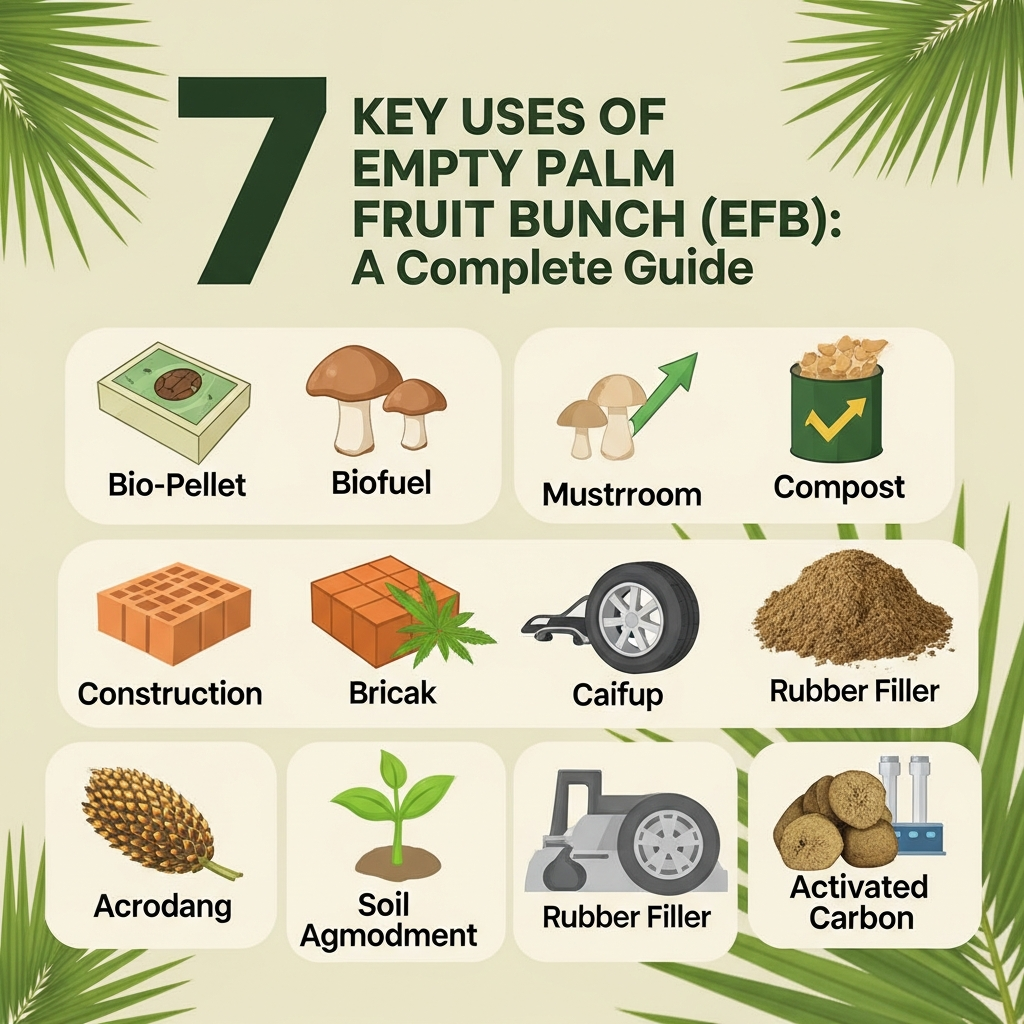
- 1. Biofuel: A Primary Use of Empty Palm Fruit Bunch2. Organic Compost and Soil Conditioner3. Pulp and Paper Production4. Medium Density Fibreboard (MDF) and Particleboard5. Biocomposites and Bioplastics6. Livestock Feed and Bedding7. Agricultural Mulching
The global palm oil industry, renowned for producing essentials like Crude Palm Oil, is a titan of modern agriculture. However, processing the fresh Oil Palm Fruit Bunch generates a staggering amount of biomass. For decades, Empty Palm Fruit Bunches (EFB) were considered waste—a costly disposal challenge for mills.
Fortunately, a global shift towards a circular economy has illuminated the immense value hidden within this byproduct. Understanding the diverse uses of Empty Palm Fruit Bunch is crucial for unlocking a more sustainable future. This guide explores the seven most impactful applications that are turning this “waste” into a highly sought-after resource.

1. Biofuel: A Primary Use of Empty Palm Fruit Bunch
One of the most significant uses of Empty Palm Fruit Bunch is in generating renewable energy. With a high calorific value, EFB is an outstanding biomass fuel. It is often converted into pellets or briquettes, which are denser, drier, and more uniform than raw EFB, making them perfect for transport and efficient combustion.
These biofuels serve as a clean substitute for fossil fuels like coal in industrial boilers, drastically cutting greenhouse gas emissions. In fact, many power plants near palm oil mills use EFB for co-firing, generating electricity for the mill and even supplying surplus power to the grid. This creates a self-sustaining energy model that reduces costs and environmental impact. While EFB is excellent for direct burning, other byproducts like Palm Kernel Shell are also prized for their high energy density. According to the International Renewable Energy Agency (IRENA), biomass like EFB is vital for global decarbonization.
2. Organic Compost and Soil Conditioner
The agricultural sector also benefits immensely from EFB’s role as a potent organic compost. Once shredded and composted, EFB transforms into a nutrient-dense material that significantly boosts soil health. It is particularly rich in potassium and other macronutrients derived from the palm fruit and Palm Kernel, which are essential for robust crop growth.
Utilizing EFB compost minimizes the reliance on chemical fertilizers, which can harm the environment. It also improves soil structure, enhances water retention, and fosters beneficial microbial activity, leading to healthier crops and more resilient farming ecosystems.
3. Pulp and Paper Production
The inherent fibrous quality of EFB makes it a prime candidate for the pulp and paper industry. With growing concerns over deforestation from traditional wood pulp sources, the uses of Empty Palm Fruit Bunch in this area offer a highly sustainable alternative.
EFB fibres are well-suited for producing various paper products, including printing paper, linerboard, and packaging. While adapting to the unique characteristics of palm fibres requires specialized technology, research in journals like Polymers confirms it is a commercially viable and eco-friendly substitute that helps preserve our forests.

4. Medium Density Fibreboard (MDF) and Particleboard
In another successful substitution for wood, EFB serves as a superior raw material for manufacturing Medium Density Fibreboard (MDF), particleboard, and other composite panels. The fibres are combined with a resin and hot-pressed to form strong, durable boards used widely in furniture, cabinetry, and construction.
This innovative use of Empty Palm Fruit Bunch not only creates a value-added product from agricultural residue but also provides a sustainable building material that is often more moisture-resistant than its wood-based counterparts.
5. Biocomposites and Bioplastics
As the world scrambles to combat plastic pollution, biocomposites and bioplastics offer a beacon of hope. EFB fibres are an excellent natural reinforcement in polymer composites. These advanced materials are being adopted by the automotive industry for lightweight interior parts and by consumer goods manufacturers for electronic casings.
These EFB-based biocomposites are lighter than fibreglass and, most importantly, are biodegradable. As highlighted by research on ScienceDirect, developing EFB polymers is a rapidly advancing field, representing one of the most modern uses of Empty Palm Fruit Bunch.
6. Livestock Feed and Bedding
While raw EFB is not highly digestible, processing can transform it into a viable roughage source for ruminants like cattle and goats. Techniques like fermentation or steam treatment break down its tough lignocellulosic structure, enhancing its nutritional value. This provides a cost-effective feed, especially during dry seasons.
It serves a different purpose than high-protein feeds like Palm Kernel Expeller, which is a byproduct of Palm Kernel Oil extraction. Additionally, the high absorbency of shredded EFB makes it an ideal bedding material for livestock, ensuring clean and dry enclosures.
7. Agricultural Mulching
Sometimes the simplest solution is the best. One of the most effective and direct uses of Empty Palm Fruit Bunch is as agricultural mulch, often applied directly back in the palm plantations. Spreading EFB around the base of palm trees conserves soil moisture by preventing evaporation—a critical benefit in tropical climates.
This mulch layer also suppresses weed growth, reducing the dependency on chemical herbicides. As the EFB slowly decomposes, it replenishes the soil with organic matter and nutrients, creating a closed-loop system that boosts soil fertility and tree health. This practice is a cornerstone of sustainable plantation management, endorsed by groups like the Roundtable on Sustainable Palm Oil (RSPO).
Your Source for High-Quality Palm Products
Looking for High-Quality Palm Products?
Makmur Amanah Sejahtera provides high-quality palm products such as Palm Kernel Expeller, Palm Kernel Shell, Crude Palm Oil, Palm Kernel Oil, etc. Kindly contact us at WhatsApp +6282140002198 or email us at admin@makmuramanah.co.id.
Conclusion: A Valuable Resource, Not Waste
Empty Palm Fruit Bunch has successfully evolved from a cumbersome byproduct into a coveted raw material. The seven key uses of Empty Palm Fruit Bunch detailed here—spanning renewable energy, sustainable agriculture, and eco-friendly manufacturing—underscore its incredible versatility and importance.
As industries worldwide continue to embrace sustainability and the principles of a circular economy, the demand and innovative applications for EFB are set to expand even further. Harnessing its full potential is not just an economic opportunity but a necessary step toward a greener, more resource-efficient planet.
 English
  Indonesian
  Chinese
  Arabic