
Table of Contents
- What Exactly is RBD Palm Olein?
A Deep Dive into RBD Palm Olein CP8 Specifications
The Critical Difference: RBD Palm Olein CP8 vs. CP10
Top Uses and Applications of RBD Palm Olein CP8
Why Choose RBD Palm Olein CP8? Key Benefits Explored
Market & Sustainability: A Responsible Choice
Conclusion: The Clear Choice for Quality
Frequently Asked Questions
In the vast world of edible oils, RBD Palm Olein CP8 stands out as a highly versatile and globally sought-after commodity. This premium cooking oil, derived from palm oil through a specific refining process, is the backbone of countless food products, from crispy snacks to everyday meals. Understanding its unique properties is key to unlocking its full potential in both industrial and household kitchens.
This guide provides a complete overview of RBD Palm Olein CP8, detailing its technical specifications, primary applications, and how it stacks up against its close counterpart, CP10. Whether you’re a food manufacturer, distributor, or a curious consumer, this article will equip you with all the essential knowledge for 2025.
What Exactly is RBD Palm Olein?
To fully appreciate RBD Palm Olein CP8, let’s break down its name. The term “RBD” stands for Refined, Bleached, and Deodorized. This three-step process transforms Crude Palm Oil into a stable, neutral-tasting oil with a consistent light-yellow color, making it suitable for a wide range of food applications.
- Refined: This initial step removes free fatty acids (FFAs) and impurities that could cause the oil to smoke or go rancid quickly.
Bleached: The oil is filtered through bleaching clay to remove color pigments, resulting in a clearer, more visually appealing product.
Deodorized: Steam is used to strip away any residual odors and tastes, ensuring the final oil does not interfere with the flavor of the food it’s used in.
The “Olein” part refers to the liquid fraction obtained from palm oil after a process called fractionation. During this process, the oil is cooled down, causing the solid fat (stearin) to crystallize and separate from the liquid fat (olein). This makes RBD Palm Olein a liquid at room temperature and ideal for frying and cooking.
A Deep Dive into RBD Palm Olein CP8 Specifications
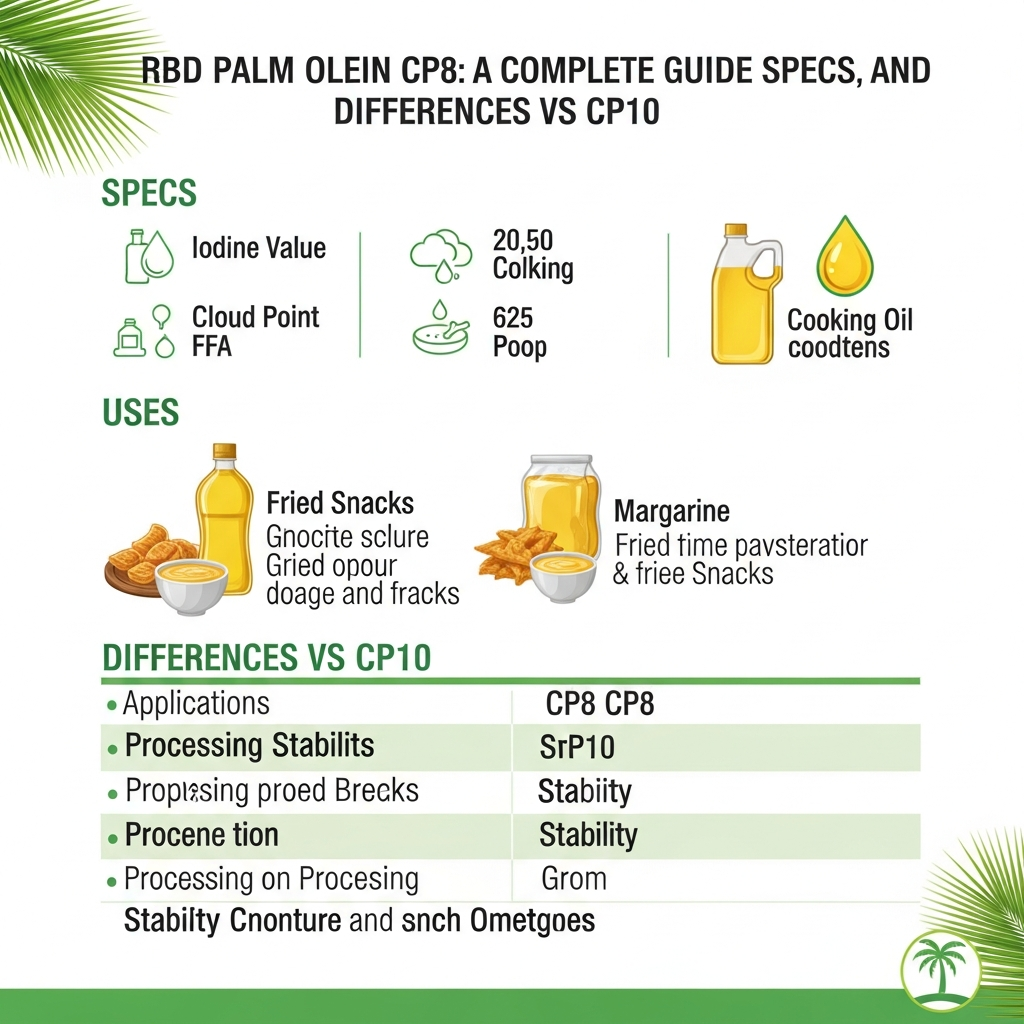
The quality and performance of RBD Palm Olein CP8 are defined by its technical specifications. These parameters are crucial for food manufacturers who rely on consistency and quality control. The “CP8” designation itself refers to its Cloud Point of a maximum of 8° Celsius.
Understanding the Cloud Point (CP) of RBD Palm Olein CP8
The Cloud Point is the most critical specification. It is the temperature at which the oil starts to become cloudy or hazy as it solidifies. For RBD Palm Olein CP8, this means it will remain clear and liquid in ambient temperatures down to 8°C, making it particularly suitable for temperate and cooler climates where other oils might solidify.

| Parameter | Typical Value |
|---|---|
| Cloud Point | 8°C Max |
| Iodine Value (IV) | 57 – 62 |
| Free Fatty Acids (FFA) (as % Palmitic) | 0.1% Max |
| Moisture & Impurities (M&I) | 0.1% Max |
| Color (5.25″ Lovibond Cell) | 3 Red Max |
| Smoke Point | ~235°C (455°F) |
The Critical Difference: RBD Palm Olein CP8 vs. CP10
While similar, RBD Palm Olein CP8 and CP10 are not interchangeable. The primary and most significant difference lies in their Cloud Point. CP10 has a cloud point of 10°C, meaning it will start to solidify at a higher temperature than CP8. This seemingly small 2-degree difference has major practical implications.
Which One Should You Choose?
The choice between RBD Palm Olein CP8 and CP10 often comes down to geography and climate. CP8 is considered a more premium product due to the extra processing required to achieve its lower cloud point. It is the preferred choice in regions with cooler seasons to prevent the oil from solidifying on store shelves or in the pantry. CP10 is perfectly suitable for tropical and hotter climates where ambient temperatures consistently stay above 10°C.
Top Uses and Applications of RBD Palm Olein CP8
The stability, neutral flavor, and high smoke point make RBD Palm Olein CP8 an incredibly versatile cooking oil. Its applications span across both industrial food production and home cooking.
- Industrial Frying: It is the oil of choice for large-scale frying of products like instant noodles, potato chips, doughnuts, and french fries. Its high resistance to oxidation ensures a longer fry life, making it cost-effective.
General Cooking: As a household cooking oil, it is excellent for sautéing, deep-frying, and general culinary uses due to its high smoke point of around 235°C (455°F).
Food Manufacturing: It is a key ingredient in margarine, shortening, ice cream, and non-dairy creamers, providing the necessary fat content and texture. For more details on oil processing, you can consult authoritative sources like the ScienceDirect journal on palm oil fractionation.
Confectionery: Its properties are ideal for creating coatings for candies and baked goods.

Why Choose RBD Palm Olein CP8? Key Benefits Explored
The widespread adoption of RBD Palm Olein CP8 is due to a combination of powerful benefits that appeal to both producers and consumers.
- High Stability: Its resistance to oxidation means a longer shelf life for both the oil and the products made with it.
Cost-Effectiveness: Palm oil is one of the most efficiently produced vegetable oils, making it an economically viable option for large-scale production. You can track commodity prices on platforms like the CME Group.
Neutral Flavor Profile: It does not overpower the natural flavors of food, allowing the intended taste of the ingredients to shine through.
Trans Fat-Free: As a non-hydrogenated oil, it is naturally free of trans fats, making it a healthier alternative to partially hydrogenated oils.
Market & Sustainability: A Responsible Choice
The palm oil industry has faced scrutiny over environmental and social issues. In response, a global movement towards sustainable production has gained significant momentum. When sourcing RBD Palm Olein CP8, it is crucial to look for certifications from organizations like the Roundtable on Sustainable Palm Oil (RSPO). The RSPO sets stringent criteria to minimize the negative impact of cultivation on the environment and communities.
Beyond the oil itself, sustainable practices cover all derivatives of the oil palm. The process begins with the Oil Palm Fruit Bunch, from which the fruit is pressed. The resulting Palm Kernel is then processed to produce Palm Kernel Oil, and the leftover meal becomes Palm Kernel Expeller, a valuable animal feed. Even the hard casing, the Palm Kernel Shell, is used as a clean biofuel. A truly sustainable approach ensures every part of the harvest is utilized responsibly.
By choosing certified sustainable palm oil, businesses and consumers can support responsible farming practices, help protect biodiversity, and ensure the fair treatment of workers. The Food and Agriculture Organization (FAO) of the United Nations also provides extensive data and resources on the global palm oil landscape.
Conclusion: The Clear Choice for Quality
In summary, RBD Palm Olein CP8 proves to be a superior cooking oil, valued for its low cloud point, high stability, and exceptional versatility. Its performance in both high-temperature industrial frying and everyday cooking makes it an indispensable ingredient in the global food supply chain.
Looking for High-Quality Palm Products?
Makmur Amanah Sejahtera provides high-quality palm products such as Palm Kernel Expeller, Palm Kernel Shell, Crude Palm Oil, Palm Kernel Oil, etc. Kindly contact us at WhatsApp +6282140002198 or email us at admin@makmuramanah.co.id.
Frequently Asked Questions
Is RBD Palm Olein CP8 healthy?
RBD Palm Olein CP8 is a balanced oil with saturated and unsaturated fats. It is naturally trans-fat-free and rich in Vitamin E. Like any cooking oil, it should be consumed in moderation as part of a balanced diet.
Can I reuse RBD Palm Olein CP8 for frying?
Yes, due to its high oxidative stability, it can be reused for frying more times than many other vegetable oils. However, it’s important to filter the oil after each use and avoid overheating it past its smoke point.
Why does my oil look cloudy?
If your RBD Palm Olein CP8 appears cloudy, it has likely been stored at a temperature below its 8°C cloud point. This is a natural process and does not affect the quality of the oil. Simply warming it gently will return it to a clear liquid state.
 English
  Indonesian
  Chinese
  Arabic