
Table of Contents
- 1. What Exactly is Palm Kernel Expeller (PKE)?
- 2. How is Palm Kernel Expeller (PKE) Produced?
- 3. Key Specifications of High-Quality Palm Kernel Expeller (PKE)
- 4. Primary Uses of Palm Kernel Expeller (PKE) in Modern Agriculture
- 5. Nutritional Profile: Benefits and Potential Drawbacks
- 6. The Global Market and Pricing for Palm Kernel Expeller (PKE)
- 7. Your Trusted PKE Supplier
- 8. Frequently Asked Questions (FAQ)
- 9. Conclusion: The Future of PKE
In the global search for sustainable and cost-effective animal feed ingredients, one name consistently emerges: Palm Kernel Expeller (PKE). This significant by-product of the palm oil industry has become a cornerstone in livestock nutrition, particularly for ruminants. But what exactly is it, and why is it so important? This guide provides a complete overview of its production, uses, specifications, and market dynamics.
What Exactly is Palm Kernel Expeller (PKE)?
Palm Kernel Expeller (PKE) is the solid residue left behind after the mechanical extraction of oil from the Palm Kernel (seed) of the oil palm fruit. It is a brownish, fibrous meal rich in protein, energy, and minerals. Unlike some other feed components that are grown as primary crops, PKE is a by-product, making it an efficient use of resources within the palm oil value chain.
Primarily utilized as a key ingredient in compound feeds for livestock, its high fiber and moderate protein content make it especially suitable for ruminant animals like cattle, sheep, and goats. The global trade of PKE is substantial, with major agricultural nations relying on it to supplement animal diets and manage feed costs.
How is Palm Kernel Expeller (PKE) Produced?
The creation of PKE is a straightforward mechanical process. It begins after the Oil Palm Fruit Bunch has been processed to produce Crude Palm Oil. The remaining nut is cracked to release the kernel, which then undergoes an extraction process.
- Crushing: The palm kernels are cracked and crushed to break them down into smaller fragments, increasing the surface area for oil extraction.
- Pressing: These fragments are then fed into a mechanical screw press (an expeller), which applies immense pressure to squeeze out the valuable Palm Kernel Oil.
- The Result: The solid, cake-like material that remains after pressing is the Palm Kernel Expeller (PKE). This material still contains a residual amount of oil (typically 8-12%), which contributes to its energy value as a feed ingredient.
It’s important to distinguish PKE from Palm Kernel Meal (PKM). While often used interchangeably, PKM can also refer to residue from solvent extraction, which results in a lower fat content compared to the mechanically pressed PKE.

Key Specifications of High-Quality Palm Kernel Expeller (PKE)
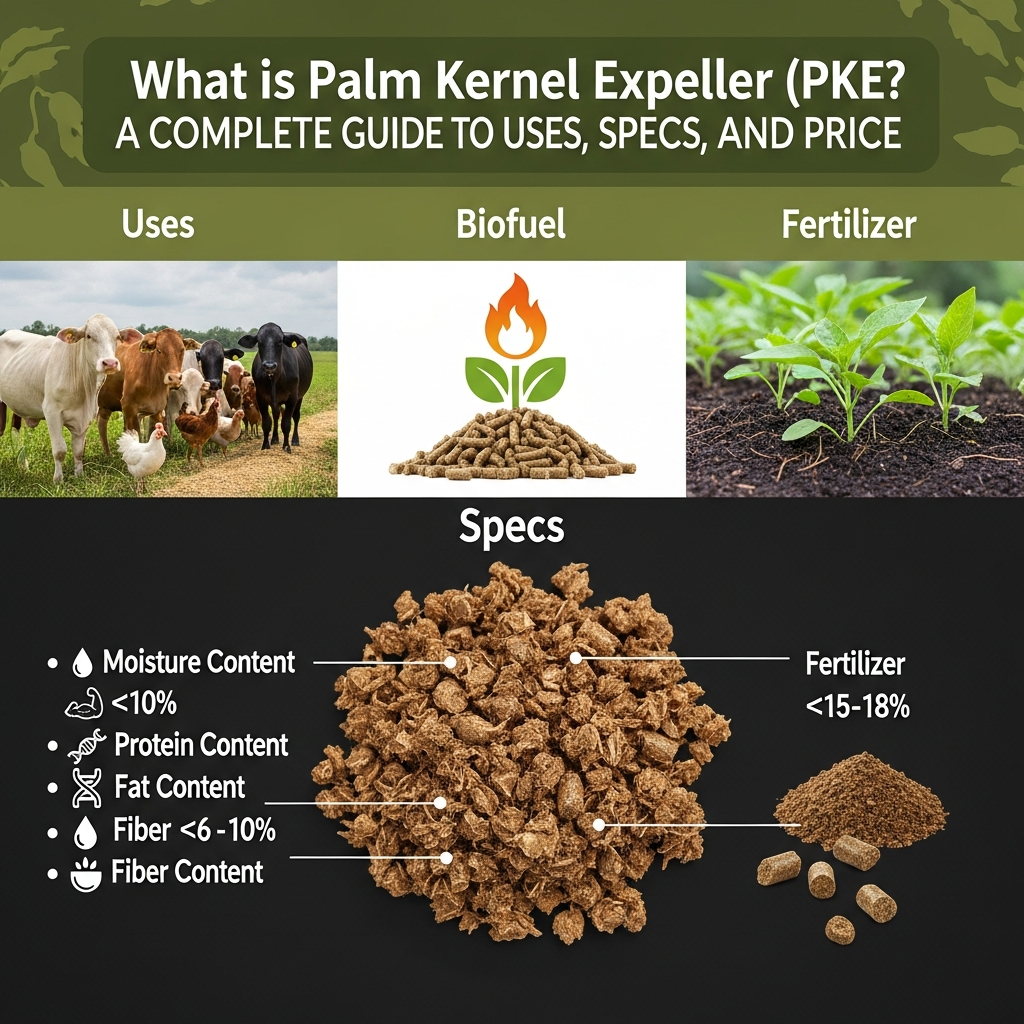
The quality of PKE is determined by its nutritional composition. Buyers and nutritionists look at several key metrics to ensure it meets the dietary needs of their livestock. While values can vary slightly based on the source and processing method, typical specifications are as follows:
| Nutrient | Typical Range |
|---|---|
| Crude Protein | 14-18% |
| Crude Fat / Oil | 8-12% |
| Crude Fiber | 15-20% |
| Moisture | < 12% |
| Ash | 3-5% |
| Shell Content | < 5% |
High moisture content (>12%) can lead to mold growth and mycotoxin contamination, reducing shelf life and posing a health risk to animals. For more detailed classifications of feed ingredients like PKE, authoritative sources like the Food and Agriculture Organization (FAO) provide comprehensive databases.
Primary Uses of Palm Kernel Expeller (PKE) in Modern Agriculture
The versatility and cost-effectiveness of Palm Kernel Expeller (PKE) make it a popular choice in various agricultural applications.
Dairy and Beef Cattle Feed
This is the largest market for PKE. Its high fiber content is beneficial for the digestive health of ruminants, promoting healthy rumen function. The combination of protein and energy supports both milk production in dairy cows and weight gain in beef cattle. It is often mixed with other feedstuffs like grass, silage, or grains to create a balanced diet.

Feed for Other Livestock
While dominant in cattle diets, PKE is also used for sheep, goats, and to a lesser extent, swine and poultry. Its use in non-ruminant (monogastric) diets is limited due to the high fiber content, which they cannot digest as efficiently. The grittiness from residual Palm Kernel Shell fragments can also reduce palatability for pickier eaters.
A Source for Biofuel
Beyond animal feed, PKE is increasingly being used as a biomass feedstock for generating heat and power. Its high calorific value makes it a viable, renewable alternative to fossil fuels in industrial boilers, contributing to the circular economy.
Nutritional Profile: Benefits and Potential Drawbacks
Like any feed ingredient, Palm Kernel Expeller (PKE) has a unique set of advantages and disadvantages that farmers and nutritionists must balance.
- Benefits:
- Cost-Effective: Generally cheaper than other protein sources like soybean meal.
- High Energy: The residual oil provides a good source of energy.
- Good for Ruminants: The high digestible fiber content supports rumen health.
- Drawbacks:
- Lower Protein Quality: The amino acid profile is less balanced than soybean meal, particularly low in lysine.
- Palatability Issues: Can be gritty and less palatable to some animals.
- High Copper Content: Can pose a toxicity risk for sheep, which are highly sensitive to copper. Formulation must be managed carefully.
Scientific studies, such as those published in journals like Animal Feed Science and Technology, continuously explore how to best incorporate PKE into diets to maximize its benefits while mitigating risks.
The Global Market and Pricing for Palm Kernel Expeller (PKE)
The PKE market is a global affair. Indonesia and Malaysia are the world’s largest producers, a direct result of their dominance in the palm oil industry. On the other side of the trade, major importing countries include New Zealand (for its massive dairy industry), the European Union, and South Korea.
The price of PKE is volatile and influenced by several factors:
- The market price of crude palm oil and palm kernel oil.
- The price of competing feed ingredients like soybean meal and corn.
- Global freight and shipping costs.
- Import tariffs and agricultural policies in buying countries.
Traders and buyers can track these trends on commodity market platforms. For instance, market analysis from sources like IndexMundi can provide valuable historical price data.
Your Trusted PKE Supplier
Looking for High-Quality Palm Products?
Makmur Amanah Sejahtera provides high-quality palm products such as Palm Kernel Expeller, Palm Kernel Shell, Crude Palm Oil, Palm Kernel Oil, etc. Kindly contact us at WhatsApp +6282140002198 or email us at admin@makmuramanah.co.id.
Frequently Asked Questions (FAQ)
Is Palm Kernel Expeller (PKE) a sustainable product?
This is a complex question tied to the broader sustainability debate around palm oil. As a by-product, PKE improves the resource efficiency of the palm oil industry. However, its sustainability is linked to the practices of the plantation it comes from. To ensure responsible sourcing, buyers should look for PKE certified by organizations like the Roundtable on Sustainable Palm Oil (RSPO).
How should I store Palm Kernel Expeller (PKE)?
PKE should be stored in a cool, dry, and well-ventilated area away from direct sunlight. It should be kept on pallets or in silos to prevent moisture absorption from the ground, which can lead to clumping, mold, and spoilage.
What is the main difference between PKE and Copra Meal?
Both are by-products of oil extraction and used in animal feed, but they come from different plants. PKE comes from the kernel of the oil palm fruit, while Copra Meal is the residue from extracting oil from dried coconut flesh. They have different nutritional profiles, with Copra Meal generally having a higher protein content.
Conclusion: The Future of PKE
Palm Kernel Expeller (PKE) is more than just a by-product; it is a vital component of the global feed supply chain. Its ability to provide an affordable source of protein, fiber, and energy makes it an indispensable tool for livestock farmers aiming to optimize nutrition and manage costs. As the world’s population grows, the demand for efficient and sustainable feed sources will only increase, cementing the role of PKE in agriculture for years to come.
 English
  Indonesian
  Chinese
  Arabic