
Table of Contents
- From a Mountain of Waste to a Goldmine of Opportunity
- 1. Biofuel and Bioenergy Generation
- 2. High-Potassium Organic Compost
- 3. Natural Mulching Material
- 4. Sustainable Pulp and Paper Production
- 5. Eco-Friendly Composite Boards
- 6. Alternative Animal Feed
- 7. Mushroom Cultivation Substrate
- 8. Erosion Control Mats
- 9. Industrial Oil Absorbent
- 10. Bioplastics and Biopolymers
- 11. Activated Carbon Production
- 12. Syngas Production via Gasification
- Conclusion: The Future is Circular
From a Mountain of Waste to a Goldmine of Opportunity
The global palm oil industry is a titan of agriculture, but it produces an enormous amount of biomass waste. For every ton of Crude Palm Oil produced, about 1.1 tons of the Oil Palm Fruit Bunch (often called empty fruit bunch or EFB) are left behind. For decades, this was seen as a disposal problem. Today, however, innovative thinking is transforming this challenge into a remarkable opportunity, revealing powerful and sustainable uses for empty palm fruit bunches that create value.
Instead of being burned or left to rot, EFB is now recognized as a valuable raw material. Its high fiber and nutrient content make it a versatile resource for a circular economy. Exploring these applications is not just an environmental necessity; it’s a smart economic strategy that turns agricultural byproducts into profitable revenue streams.
This article dives deep into the most impactful and proven uses for empty palm fruit bunches, showcasing how we can shift from a linear “take-make-dispose” model to a regenerative one. From generating green energy to creating eco-friendly materials, the potential of EFB is just beginning to be fully realized.

1. Biofuel and Bioenergy Generation
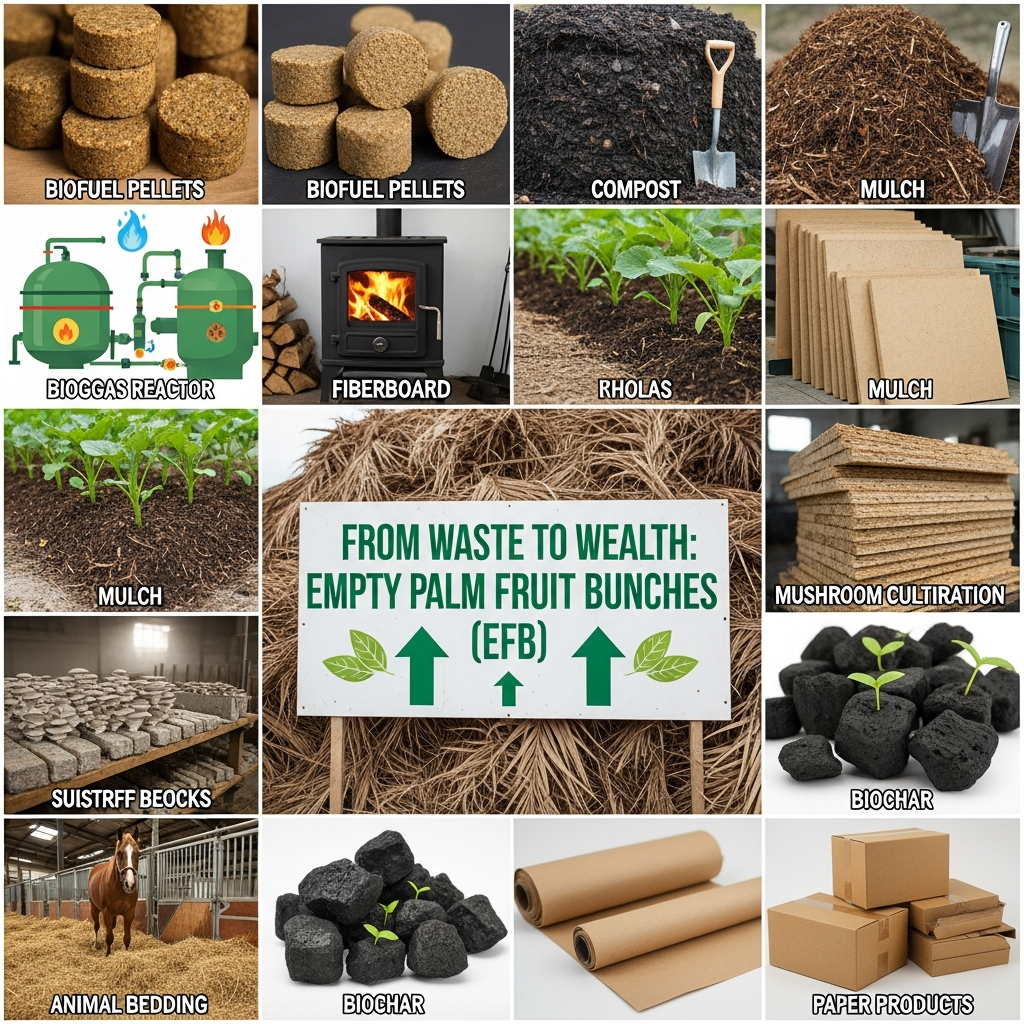
One of the most significant uses for empty palm fruit bunches is in energy production. The high calorific value of dried EFB makes it an excellent source of renewable energy. It can be processed into solid fuels like pellets and briquettes, which offer a cleaner alternative to coal for industrial boilers, similar to other biomass resources like the Palm Kernel Shell.
These biofuels are denser, have lower moisture content, and are easier to transport than raw EFB. According to the International Renewable Energy Agency (IRENA), biomass like EFB is crucial for decarbonizing the industrial heat sector, reducing greenhouse gas emissions and dependence on fossil fuels.
2. High-Potassium Organic Compost
EFB is rich in organic matter and essential plant nutrients, particularly potassium. When composted, it decomposes into a dark, nutrient-dense fertilizer that dramatically improves soil health. This compost enhances soil structure, increases water retention, and provides a slow release of nutrients to crops.
This is one of the most direct and beneficial uses for empty palm fruit bunches within the plantation itself, creating a closed-loop system. Farmers can reduce their reliance on synthetic chemical fertilizers, cutting costs and minimizing the environmental pollution associated with fertilizer runoff. Scientific studies have consistently shown that EFB compost significantly boosts crop yields.
3. Natural Mulching Material
In its raw, shredded form, EFB serves as an excellent mulching material for oil palm plantations and other agricultural fields. Spreading EFB around the base of plants helps suppress weed growth, which reduces the need for herbicides.
Furthermore, the mulch layer acts as a protective blanket, conserving soil moisture by reducing evaporation under the hot sun. As it slowly decomposes, it releases valuable organic matter and nutrients back into the soil, contributing to long-term fertility. This simple application is one of the smartest uses for empty palm fruit bunches in modern agriculture.
4. Sustainable Pulp and Paper Production
The high lignocellulosic fiber content in EFB makes it a viable, non-wood alternative for producing pulp and paper. This helps alleviate pressure on natural forests, which are the traditional source of paper pulp. The process involves turning EFB fiber into pulp that can be used for various paper products, from writing paper to cardboard packaging.
While the technology is still evolving, the potential to create a tree-free paper source is one of the most exciting environmental uses for empty palm fruit bunches. It represents a significant step towards a more sustainable paper industry.
5. Eco-Friendly Composite Boards
EFB fibers can be combined with natural or synthetic resins and compressed under high pressure and heat to create composite boards. These include medium-density fiberboard (MDF), particleboard, and other building materials. These boards are strong, durable, and can be used for furniture, flooring, and interior construction.
This application locks carbon into a long-lasting product, preventing it from being released into the atmosphere. It provides a sustainable alternative to wood-based panels, further reducing deforestation.

6. Alternative Animal Feed
While raw EFB has low digestibility, it can be processed to become a valuable feed ingredient for ruminant livestock like cattle and goats. Treatments such as steam processing or fermentation with specific microorganisms break down the tough fibers, making the nutrients more accessible.
This converted EFB can supplement traditional animal fodder, much like other palm-based feeds such as Palm Kernel Expeller, which is derived from the Palm Kernel itself. This adds another revenue stream for palm oil producers and contributes to food security by expanding the range of available animal feed sources.
7. Mushroom Cultivation Substrate
The organic composition of EFB makes it an ideal substrate for growing edible mushrooms, such as oyster mushrooms. The bunches are first shredded and sterilized, then inoculated with mushroom spawn. The EFB provides the necessary nutrients for the mycelium to grow and eventually produce mushrooms.
This is a fantastic example of upcycling, turning a low-value byproduct into a high-value food product. This innovative food production method is one of the most profitable uses for empty palm fruit bunches, especially in Southeast Asia, providing local income and a nutritious food source.
8. Erosion Control Mats
The strong, long fibers of EFB can be woven or pressed into biodegradable mats. These mats are used to stabilize soil on slopes, riverbanks, and construction sites to prevent erosion. They hold the soil in place while allowing vegetation to grow through them.
Once the plants establish a strong root system, the EFB mat naturally decomposes, adding organic matter to the soil. This eco-friendly solution is a stark contrast to synthetic geotextiles made from plastic.
9. Industrial Oil Absorbent
Due to its porous and fibrous nature, EFB can be processed into a highly effective absorbent material. It can be used to clean up oil spills on both land and water. The EFB fibers soak up the oil, which can then be collected and disposed of safely.
This is a low-cost, biodegradable alternative to synthetic absorbents. Research publications have highlighted its effectiveness, making it one of the most practical industrial uses for empty palm fruit bunches.
10. Bioplastics and Biopolymers
The cellulose extracted from EFB fibers can be used as a feedstock for producing bioplastics. These plastics are biodegradable, meaning they can be broken down by natural processes, unlike petroleum-based plastics that persist in the environment for centuries. This emerging technology holds the promise of tackling plastic pollution at its source.
11. Activated Carbon Production
Through a process of pyrolysis, EFB can be converted into activated carbon. This highly porous material has a vast surface area, making it excellent for filtration and purification. Activated carbon from EFB can be used in water treatment filters, air purifiers, and various industrial processes to remove impurities.
12. Syngas Production via Gasification
Gasification is a process that converts carbon-based materials like EFB into a mixture of gases known as syngas (synthesis gas). This syngas can be burned to generate electricity or used as a feedstock to produce liquid fuels and valuable chemicals, as noted by agencies like the U.S. Department of Energy. It’s a highly efficient method of extracting energy from biomass.
Conclusion: The Future is Circular
The days of viewing empty palm fruit bunches as mere waste are over. The diverse and powerful uses for empty palm fruit bunches demonstrate a clear path toward a more sustainable and profitable palm oil industry. By embracing these circular economy principles, we can reduce waste, create new value chains from byproducts, and add value to every part of the palm fruit, from primary oils like CPO and Palm Kernel Oil to the solid residues.
From powering factories to building furniture and cleaning up oil spills, EFB is a testament to the incredible potential hidden within agricultural byproducts. As technology continues to advance, we can expect even more innovative applications to emerge, solidifying EFB’s role as a key resource for a greener future.
Makmur Amanah Sejahtera provides high-quality palm products such as Palm Kernel Expeller, Palm Kernel Shell, Crude Palm Oil, Palm Kernel Oil, etc. Kindly contact us at WhatsApp +6282140002198 or email us at admin@makmuramanah.co.id. For a visual look at this process, consider searching YouTube for “How EFB is turned into biofuel pellets.”Looking for High-Quality Palm Products?
 English
  Indonesian
  Chinese
  Arabic