
Table of Contents
- What Exactly is Palm Kernel Expeller (PKE)?
- The Nutritional Profile of Palm Kernel Expeller (PKE)
- 5 Key Benefits of Using Palm Kernel Expeller (PKE) in Animal Feed
- Primary Uses of Palm Kernel Expeller (PKE) Across Different Livestock
- Potential Drawbacks of Palm Kernel Expeller (PKE)
- The Future of Palm Kernel Expeller (PKE) in the Global Feed Industry
- Conclusion: Why PKE is a Smart Choice
In the quest for sustainable and cost-effective animal nutrition, the global feed industry is constantly exploring alternative ingredients. One of the most prominent and valuable of these is Palm Kernel Expeller (PKE). This by-product of the palm oil industry has emerged as a crucial component in livestock diets, especially for ruminants, offering a powerful blend of affordability and nutritional value.
But what makes this feed ingredient so important? This guide will walk you through everything you need to know about PKE, from its origin and nutritional composition to its diverse applications and benefits in modern agriculture. We will explore why it’s a staple for farmers aiming to optimize costs without compromising animal health.
What Exactly is Palm Kernel Expeller (PKE)?
Palm Kernel Expeller (PKE) is a by-product of the palm oil industry, created during the extraction of oil from the Palm Kernel, which is the seed found inside the oil palm fruit. The primary products from this process are Crude Palm Oil (from the fruit’s flesh) and Palm Kernel Oil (from the kernel). After the kernel is crushed to extract the oil, the solid, protein-rich residue left behind is the Palm Kernel Expeller.
Often referred to as Palm Kernel Cake (PKC), its final composition depends heavily on the oil extraction method. The mechanical screw-press method, which produces PKE, results in a product with a residual oil content of 5-12%. This makes it a valuable source of energy and protein in animal feed formulations.
Its widespread availability, particularly in major palm oil-producing regions like Southeast Asia, has made it a go-to feed resource. This helps create a more circular economy by ensuring no part of the palm fruit goes to waste.

The Nutritional Profile of Palm Kernel Expeller (PKE)
Understanding the nutritional makeup of Palm Kernel Expeller (PKE) is key to appreciating its role in animal diets. While its exact composition can vary based on the oil extraction efficiency and shell content, it is generally recognized for its high fiber and moderate protein content.
Here is a typical nutritional breakdown:
- Crude Protein: 14-21%
- Crude Fibre: 16-18%
- Crude Fat/Oil: 5-12%
- Metabolizable Energy: 7-8 MJ/kg (for ruminants)
- Essential Minerals: A good source of phosphorus, magnesium, and iron.
Compared to other common feed ingredients like soybean meal, PKE has lower protein but significantly higher fiber. This high fiber content is particularly beneficial for ruminant animals like cattle, sheep, and goats, as their digestive systems are well-equipped to break it down for energy. For more detailed analysis, you can review its composition on feed encyclopedias like Feedipedia.
5 Key Benefits of Using Palm Kernel Expeller (PKE) in Animal Feed
The adoption of Palm Kernel Expeller (PKE) in feed formulations is driven by several compelling advantages for farmers and the feed industry alike.
1. Exceptional Cost-Effectiveness
PKE is often more affordable than traditional protein sources like soybean meal or corn. This allows farmers to reduce feed costs, which can account for up to 70% of total production expenses, thereby improving profitability.
2. High Sustainability
As a by-product, PKE utilizes a resource that would otherwise be discarded. Its use promotes a circular economy within the palm oil industry, reducing waste and making livestock farming more environmentally friendly. This approach ensures that every part of the harvest, from the Oil Palm Fruit Bunch to the Palm Kernel Shell, has value.
3. Good Source of Energy and Fiber
The residual oil in PKE provides a dense source of energy, while its high fiber content supports healthy digestion in ruminants. This fiber promotes rumen function and is essential for milk fat production in dairy cows.
4. Reduces Dependency on Traditional Crops
By incorporating PKE into feed, farmers can reduce their reliance on crops like soy and corn, which face fluctuating prices and supply chain vulnerabilities. This diversification helps stabilize feed availability and cost.
5. Palatability and Versatility
While it has a unique taste, most livestock, especially cattle, adapt to it well. Its versatility allows it to be included in various feed formats, including pellets, mashes, and total mixed rations (TMR).
Primary Uses of Palm Kernel Expeller (PKE) Across Different Livestock
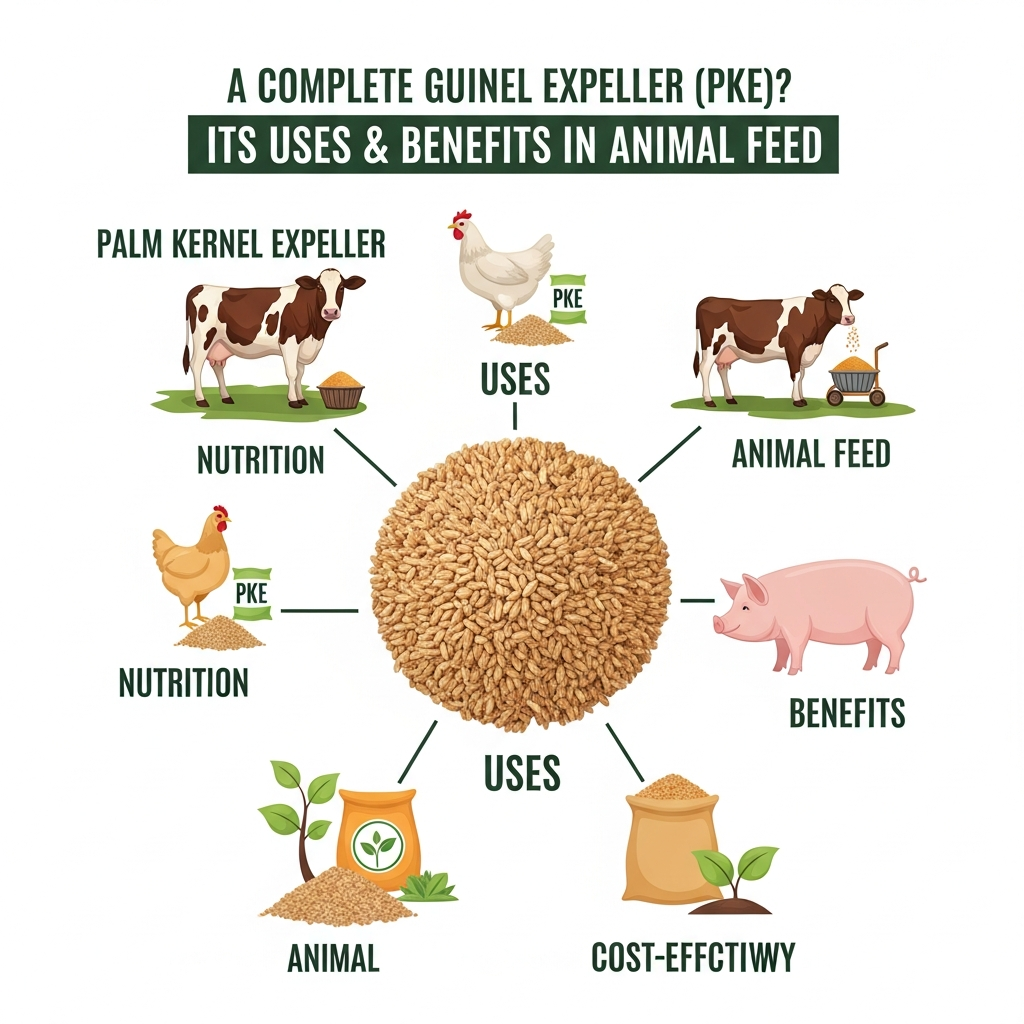
The unique nutritional profile of PKE makes it suitable for a range of animals, although inclusion rates vary significantly.
Cattle (Dairy and Beef)
Ruminants are the largest consumers of PKE. Its high fiber content is ideal for their digestive systems. In dairy cows, it’s valued for maintaining milk fat levels, while in beef cattle, it serves as an excellent energy and protein source for growth. Inclusion rates can be as high as 50% of the feed concentrate, as supported by research from institutions like the Journal of the Saudi Society of Agricultural Sciences.
Poultry
The use of PKE in poultry feed is more limited due to its high fiber, which monogastric animals like chickens cannot digest easily. However, at lower inclusion rates (typically under 10%) and often with enzyme supplementation, it can be a cost-effective ingredient. Research continues to find ways to improve its digestibility for poultry.
Swine
Similar to poultry, pigs can only tolerate limited amounts of Palm Kernel Expeller (PKE) in their diet. It is more commonly used for sows and finisher pigs rather than young piglets, whose digestive systems are less developed.
Aquaculture
PKE is increasingly being used as a plant-based protein source in fish feed, reducing the reliance on more expensive fishmeal. It is particularly suitable for herbivorous fish species. Studies published in journals like Animals (MDPI) highlight its potential in sustainable aquaculture.

Potential Drawbacks of Palm Kernel Expeller (PKE)
Despite its benefits, there are a few factors to consider when incorporating PKE into animal feed:
- Variability in Quality: The nutritional content can vary depending on the oil extraction process and the amount of shell fragments remaining. Sourcing from a reliable supplier is crucial for consistency.
- Palatability Issues: Some animals may find the gritty texture of PKE unpalatable at first. It is often introduced gradually and mixed with more palatable ingredients like molasses.
- Mycotoxin Contamination: Like many feed ingredients, PKE can be susceptible to mold and mycotoxins if not stored correctly in a dry, cool environment.
- Copper Content: PKE can have high copper levels, which is a concern for sheep as they are highly sensitive to copper toxicity. Feed for sheep should be formulated carefully to manage this. For more on this, check authoritative sources like the MSD Veterinary Manual.
The Future of Palm Kernel Expeller (PKE) in the Global Feed Industry
The role of PKE is set to expand as the world seeks more sustainable food production systems. Ongoing research is focused on enhancing its nutritional value through methods like fermentation and enzyme treatment. These innovations aim to break down the complex fibers, making PKE more digestible for non-ruminant animals and unlocking its full potential.
As a core component of a waste-reducing, circular agricultural model, PKE stands out. It represents a smart, resource-efficient solution to feed a growing global population, ensuring that by-products from one industry become valuable inputs for another.
Conclusion: Why PKE is a Smart Choice
In summary, PKE is far more than just a by-product. It is a cost-effective, sustainable, and nutritionally valuable feed ingredient that plays a vital role in modern livestock farming. Its high fiber and energy content make it particularly indispensable for cattle, but its applications are growing across other species.
By understanding its benefits and managing its limitations, farmers and feed producers can leverage PKE to lower costs, improve sustainability, and maintain healthy, productive animals. It truly is a cornerstone of efficient and responsible animal nutrition for 2025 and beyond.
Makmur Amanah Sejahtera provides high-quality palm products such as Palm Kernel Expeller, Palm Kernel Shell, Crude Palm Oil, Palm Kernel Oil, etc. Kindly contact us at WhatsApp +6282140002198 or email us at admin@makmuramanah.co.id.Looking for High-Quality Palm Products?
 English
  Indonesian
  Chinese
  Arabic