
Table of Contents
Table of Contents
Navigating the world of edible oils can be complex, especially with technical terms like “CP8” and “CP10.” If you’re in the food industry, you know that choosing the right cooking oil is crucial for product quality. This guide provides a definitive breakdown of RBD Palm Olein CP8 vs CP10 vs CP6, helping you understand their key differences and select the perfect option for your needs. These oils originate from the versatile Oil Palm Fruit Bunch, the source of many valuable palm products.
RBD Palm Olein is one of the most popular vegetable oils globally, prized for its versatility and stability. However, not all palm olein is created equal. The “CP” value is a critical factor that determines its performance, particularly in different climates and applications. Let’s dive in.
What is RBD Palm Olein?
First, let’s break down the name. RBD stands for Refined, Bleached, and Deodorized. This is the process that raw Crude Palm Oil undergoes to become a stable, neutral-flavored, and light-colored cooking oil. While the flesh of the palm fruit gives us CPO, the stone or Palm Kernel is also processed to produce Palm Kernel Oil and valuable biomass byproducts like Palm Kernel Expeller and Palm Kernel Shell.
Palm Olein is the liquid fraction obtained from the fractionation of palm oil. This process separates the liquid (olein) from the solid (stearin) parts. The result is an oil that remains liquid at room temperature and is excellent for frying, cooking, and as an ingredient in many food products. The sustainability of palm oil is a significant consideration, with organizations like the Roundtable on Sustainable Palm Oil (RSPO) working to certify sustainable production practices.

Understanding the “CP” Number: Cloud Point Explained
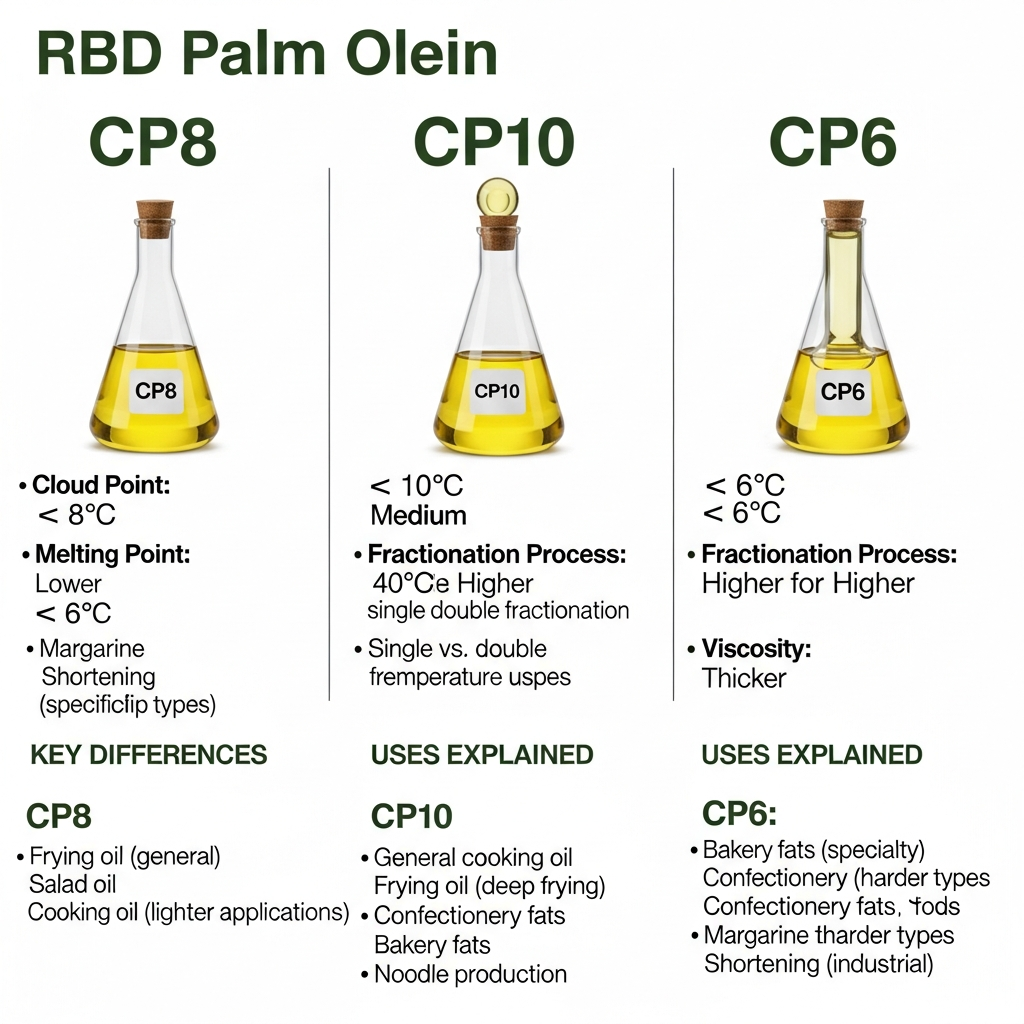
The “CP” in CP6, CP8, and CP10 stands for Cloud Point. This is the most critical differentiator between these grades of palm olein. The Cloud Point is the temperature at which the oil starts to become cloudy or hazy as it cools.
A lower Cloud Point means the oil can withstand colder temperatures before solidifying. This property is vital for products sold in temperate climates or those that require refrigeration. According to a study in the Journal of Food Science and Technology, controlling the cloud point is essential for maintaining the visual appeal and stability of liquid oils.
RBD Palm Olein CP8 vs CP10 vs CP6: A Head-to-Head Comparison
Understanding the nuances of RBD Palm Olein CP8 vs CP10 vs CP6 comes down to their Cloud Point and resulting applications. Each grade is produced through a specific level of fractionation to achieve its desired characteristics.
RBD Palm Olein CP6 (Super Olein)
CP6, often called “Super Olein,” is the highest grade. It undergoes more intensive fractionation, resulting in the lowest Cloud Point.
- Cloud Point: Maximum 6°C
- Key Feature: Superior cold stability. It remains clear and liquid even in cooler conditions, making it a premium choice for bottling and salad oils in temperate regions.
- Appearance: Very clear and light in color.
RBD Palm Olein CP8
CP8 is a high-quality grade that offers an excellent balance between performance and cost. It is a popular choice for a wide variety of applications.
- Cloud Point: Maximum 8°C
- Key Feature: Good cold stability, suitable for many climates. It’s often used for high-quality frying applications where both stability and clarity are important.
- Appearance: Clear and light yellow.
RBD Palm Olein CP10
CP10 is the most common and widely traded grade of RBD Palm Olein. It is cost-effective and highly versatile, especially in warmer climates where cold stability is less of a concern.
- Cloud Point: Maximum 10°C
- Key Feature: The industry standard for general cooking and frying. It offers great thermal stability at a competitive price.
- Appearance: Clear golden yellow.
Key Differences at a Glance: CP6 vs CP8 vs CP10
This table summarizes the core differences in the RBD Palm Olein CP8 vs CP10 vs CP6 debate, helping you make a quick and informed decision.
| Property | RBD Palm Olein CP6 (Super Olein) | RBD Palm Olein CP8 | RBD Palm Olein CP10 |
|---|---|---|---|
| Cloud Point (Max) | 6°C | 8°C | 10°C |
| Cold Stability | Excellent | Very Good | Standard |
| Common Use | Salad oils, bottling, temperate climates | Premium frying, cooking oils | General frying, cooking, industrial use |
| Cost | Highest | Moderate | Most Economical |
Applications and Uses: Which Palm Olein is Right for You?
Choosing the right grade depends entirely on your product and market. The World Health Organization (WHO) notes the importance of fat in our diets, and palm oil is a significant source globally. The choice of CP grade affects the final product’s texture, appearance, and shelf life.
RBD Palm Olein CP6 is ideal for:
- Salad Dressings: Its ability to stay liquid when refrigerated prevents solidification.
- Bottled Cooking Oil for Cold Climates: Ensures the product remains aesthetically pleasing on shelves and in pantries.
- Mayonnaise Production: Provides a stable emulsion without clouding.
RBD Palm Olein CP8 is the choice for:
- High-Quality Frying: Used for producing premium snacks like potato chips and noodles where a clean taste and appearance are key.
- General Bottling: A great, all-purpose cooking oil for a wide range of climates.
RBD Palm Olein CP10 is perfect for:
- Industrial Frying: The go-to choice for large-scale food production of instant noodles, fried snacks, and fast food due to its high heat stability and cost-effectiveness.
- General Cooking in Tropical Regions: Where ambient temperatures are high, cloud point is not a concern.
- Ingredient in Margarine and Shortening: Blended with other fats to achieve specific textures.

Frequently Asked Questions (FAQ)
Q1: Is there a nutritional difference between CP6, CP8, and CP10?
No, the nutritional profiles are nearly identical. The primary difference is physical (cloud point), not nutritional. The fractionation process only separates fats with different melting points.
Q2: Can I substitute CP10 for CP8 in my recipe?
It depends on the application. For deep frying in a warm environment, yes. However, if your product needs to withstand cooler temperatures without clouding (like a bottled oil for sale in Europe), substituting CP10 for CP8 would negatively impact quality.
Q3: Why is RBD Palm Olein so popular in the food industry?
It offers high stability against oxidation, a neutral taste that doesn’t interfere with food flavors, and is highly cost-effective. Its versatility is unmatched, from frying to baking, as highlighted by industry resources like FoodNavigator.
Q4: For general home cooking, what’s the verdict on RBD Palm Olein CP8 vs CP10 vs CP6?
For most home cooks, especially in warmer climates, CP10 is perfectly suitable and economical. If you live in a cooler region where oils might cloud in the pantry, CP8 offers a better experience. CP6 is typically overkill for home use and is priced for premium commercial applications.
Conclusion: Making the Right Choice
The choice in the RBD Palm Olein CP8 vs CP10 vs CP6 debate is settled by understanding one key factor: the Cloud Point. Your selection must align with your product’s requirements and the climate of your target market. To summarize, CP6 (Super Olein) offers the best cold stability for premium applications, CP8 provides a versatile middle ground, and CP10 is the cost-effective workhorse for industrial frying and use in tropical regions. By matching the grade to the application, you ensure optimal product quality and customer satisfaction.
Your Trusted Palm Products Supplier
Looking for High-Quality Palm Products?
Makmur Amanah Sejahtera provides high-quality palm products such as Palm Kernel Expeller, Palm Kernel Shell, Crude Palm Oil, Palm Kernel Oil, etc. Kindly contact us at WhatsApp +6282140002198 or email us at admin@makmuramanah.co.id.
 English
  Indonesian
  Chinese
  Arabic