
Table of Contents
The palm oil industry, a powerhouse in the global economy, generates massive amounts of biomass waste alongside valuable commodities like Crude Palm Oil and Palm Kernel Oil. For decades, the primary byproduct, the Empty Palm Fruit Bunch (EFB), was seen as a disposal problem. However, a significant shift in perspective is turning this “waste” into a valuable resource, unlocking a wealth of sustainable opportunities. This guide explores the incredible potential of EFB, showcasing its diverse applications and profound benefits.
What is an Empty Palm Fruit Bunch (EFB)?
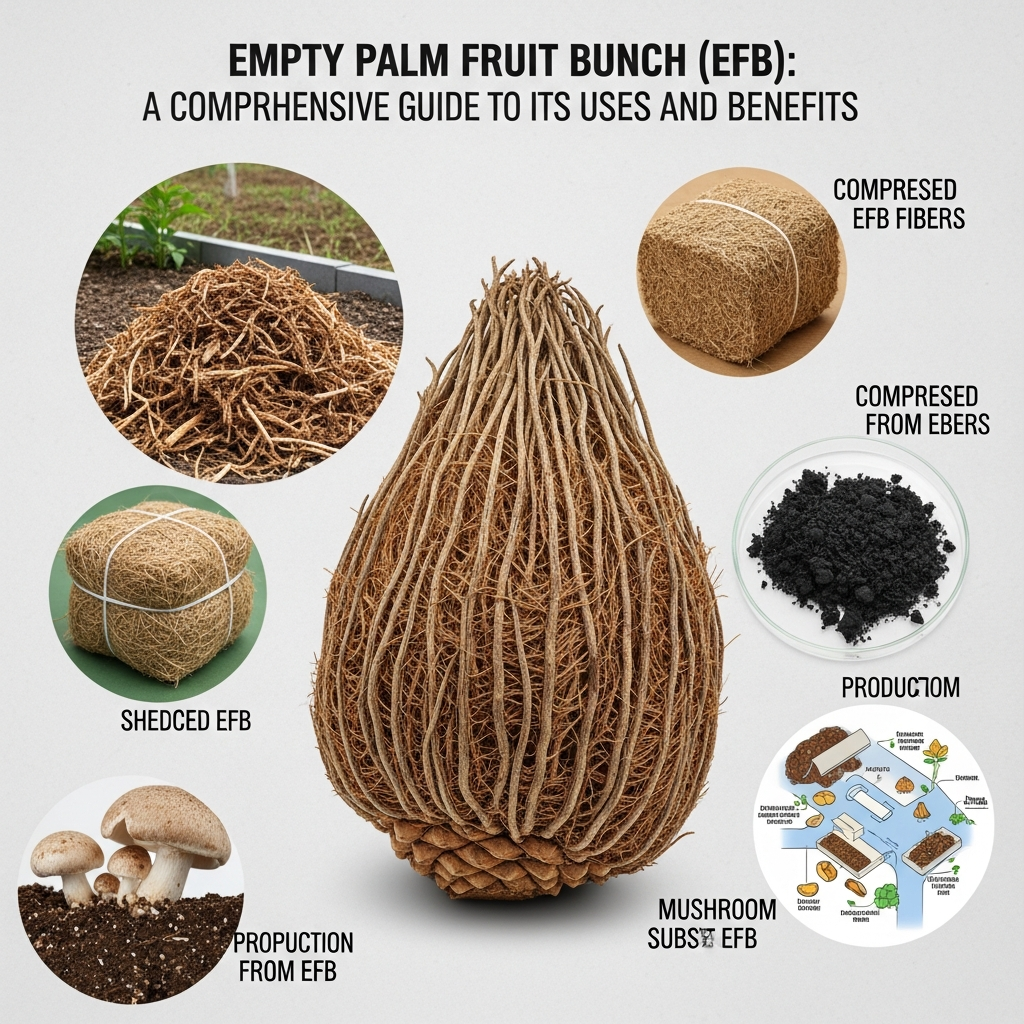
An Empty Palm Fruit Bunch is the fibrous residue left behind from the main Oil Palm Fruit Bunch after the fresh fruitlets and Palm Kernel are stripped away in the milling process. It is a lignocellulosic material, rich in cellulose, hemicellulose, and lignin. For every ton of crude palm oil produced, approximately 1.2 tons of EFB are generated, making it the most abundant solid waste from this industry.
Historically, these bunches were either incinerated, contributing to air pollution, or left to rot in plantations, releasing methane. Today, innovative technologies are transforming this abundant biomass into a cornerstone of the circular economy. The proper management of the Empty Palm Fruit Bunch is now crucial for enhancing the sustainability of palm oil production.

The Top 5 Revolutionary Uses for Empty Palm Fruit Bunch in 2025
As technology advances and the demand for sustainable solutions grows, the applications for EFB are expanding rapidly. Here are five of the most impactful uses for the Empty Palm Fruit Bunch today.
1. A Powerful Source of Renewable Energy
One of the most significant applications for EFB is in generating renewable energy. As a form of biomass, it serves as a powerful, carbon-neutral fuel source, often used alongside other byproducts like the Palm Kernel Shell. This process significantly reduces the reliance on fossil fuels in palm oil mills and can even supply power to national grids.
Methods of Energy Conversion:
- Direct Combustion: EFB is used as fuel in boilers to produce steam, which then drives turbines to generate electricity.
- Bio-pellets & Briquettes: The raw Empty Palm Fruit Bunch is processed to reduce moisture and increase density, creating efficient bio-pellets for clean energy combustion.
- Gasification: This process converts EFB into a combustible gas (syngas), which can be used to generate power with higher efficiency.
According to the International Renewable Energy Agency (IRENA), biomass like EFB is a critical component in the global transition to sustainable energy systems.
2. Sustainable Soil Management and Composting
The high organic content of the Empty Palm Fruit Bunch makes it an exceptional soil amendment. Instead of being a pollutant, it can be returned to the earth to enrich the very soil it came from, creating a closed-loop system.
When composted, EFB decomposes into a nutrient-rich, dark humus material. This compost improves soil structure, enhances water retention capacity, and provides essential nutrients like potassium. Applying EFB mulch or compost directly to plantations reduces the need for chemical fertilizers, cutting costs and minimizing environmental runoff. This practice aligns with sustainable agriculture principles outlined by organizations like the Food and Agriculture Organization (FAO).
3. Innovative Material for Pulp and Paper Production
The global demand for paper continues to rise, putting pressure on forest resources. The fiber from the Empty Palm Fruit Bunch presents a viable, eco-friendly alternative to wood for pulp production. Its lignocellulosic composition is well-suited for creating various paper products, from writing paper to packaging materials.
Utilizing EFB for paper reduces deforestation and repurposes a massive waste stream. While the technology is still being perfected, several companies are already pioneering EFB-based paper, demonstrating its commercial viability and significant environmental benefits. This supports the push for more sustainable materials, a cause championed by groups like the World Wildlife Fund (WWF).
[Suggestion: Embed a video here showing the process of turning Empty Palm Fruit Bunch into compost or bio-pellets.]
4. Advanced Bio-Based Products and Chemicals
Beyond basic uses, the Empty Palm Fruit Bunch is a feedstock for a new generation of green technologies. Scientists are unlocking its potential to create high-value, bio-based products that can replace petroleum-derived materials.
- Bio-composites: EFB fibers are being used to reinforce plastics, creating strong, lightweight materials for automotive interiors, furniture, and consumer goods.
- Bio-ethanol: The cellulose within EFB can be broken down through enzymatic hydrolysis and fermented to produce bio-ethanol, a renewable fuel.
- Biochemicals: EFB is a source for producing platform chemicals like xylitol, lactic acid, and furfural, which are building blocks for bioplastics, pharmaceuticals, and other industrial products. As detailed in numerous studies on platforms like ScienceDirect, the research in this field is rapidly advancing.
5. Eco-Friendly Building and Composite Materials
The construction industry is constantly seeking sustainable and cost-effective materials. The strong, fibrous nature of the Empty Palm Fruit Bunch makes it an excellent candidate for creating green building components.
EFB fibers can be combined with binders to produce medium-density fiberboard (MDF), particleboard, and insulation panels. These EFB-based boards are not only lighter than traditional wood-based products but also offer good thermal and acoustic insulation properties. This application transforms agricultural waste into durable goods, contributing to the development of sustainable building materials.
The Environmental and Economic Benefits of Utilizing EFB
The widespread adoption of Empty Palm Fruit Bunch technologies offers a powerful win-win scenario. It addresses critical environmental challenges while creating new economic value.
Environmental Wins:
- Waste Reduction: Turns millions of tons of waste into valuable products.
- Lower Emissions: Reduces methane from decomposition and CO2 from fossil fuels.
- Resource Conservation: Decreases the need for wood, chemical fertilizers, and petroleum.
Economic Wins:
- New Revenue Streams: Allows palm oil mills to profit from a former waste product.
- Cost Savings: Reduces waste disposal costs and expenditure on fuel and fertilizers.
- Job Creation: Creates green jobs in processing, logistics, and manufacturing.
Challenges and Future Outlook for EFB Utilization
Despite its immense potential, realizing the full value of the Empty Palm Fruit Bunch is not without challenges. Key hurdles include its high moisture content (which makes transportation and processing difficult), the logistics of collecting it from scattered mills, and the high initial investment required for processing facilities.
However, the future is bright. Continuous research is leading to more efficient processing technologies. As the global economy pivots towards sustainability and circularity, the demand for EFB-derived products will only grow. Government incentives and corporate sustainability goals are further driving investment in this promising sector.
Conclusion: From Waste to Wealth
The Empty Palm Fruit Bunch is a prime example of the waste-to-wealth philosophy. Once an environmental liability, it is now being recognized as a versatile and sustainable resource with applications spanning energy, agriculture, manufacturing, and beyond. By harnessing the power of EFB and other valuable byproducts like Palm Kernel Expeller, we can build more resilient supply chains, reduce our environmental footprint, and pave the way for a truly circular economy.
Looking for High-Quality Palm Products?
Makmur Amanah Sejahtera provides high-quality palm products such as Palm Kernel Expeller, Palm Kernel Shell, Crude Palm Oil, Palm Kernel Oil, etc. Kindly contact us at WhatsApp +6282140002198 or email us at admin@makmuramanah.co.id.
 English
  Indonesian
  Chinese
  Arabic