
Table of Contents
- What is an Empty Palm Fruit Bunch (EFB)?
- Top 7 Remarkable Uses of Empty Palm Fruit Bunch
- The Processing of Empty Palm Fruit Bunch: A Step-by-Step Overview
- Key Benefits of Utilizing the Empty Palm Fruit Bunch
- Challenges and Future Outlook for the Empty Palm Fruit Bunch
- Conclusion: The Future is Green with EFB
What is an Empty Palm Fruit Bunch (EFB)?
An Empty Palm Fruit Bunch (EFB) is a major biomass byproduct generated from the palm oil milling process. After the fresh Oil Palm Fruit Bunch is sterilized and the palm fruits are stripped off to extract Crude Palm Oil and the Palm Kernel, which itself is processed into Palm Kernel Oil, this fibrous, empty bunch is what remains. Historically considered waste, the EFB is now recognized as a valuable renewable resource with immense potential across various industries.
For every ton of crude palm oil produced, approximately 1.1 tons of Empty Palm Fruit Bunch are generated. This sheer volume presents both a significant waste management challenge and a massive opportunity for sustainable innovation. By harnessing the power of EFB, we can move towards a more circular economy.
This guide explores the incredible versatility of the Empty Palm Fruit Bunch, from its processing to its wide-ranging applications that contribute to a greener, more sustainable future.
Top 7 Remarkable Uses of Empty Palm Fruit Bunch
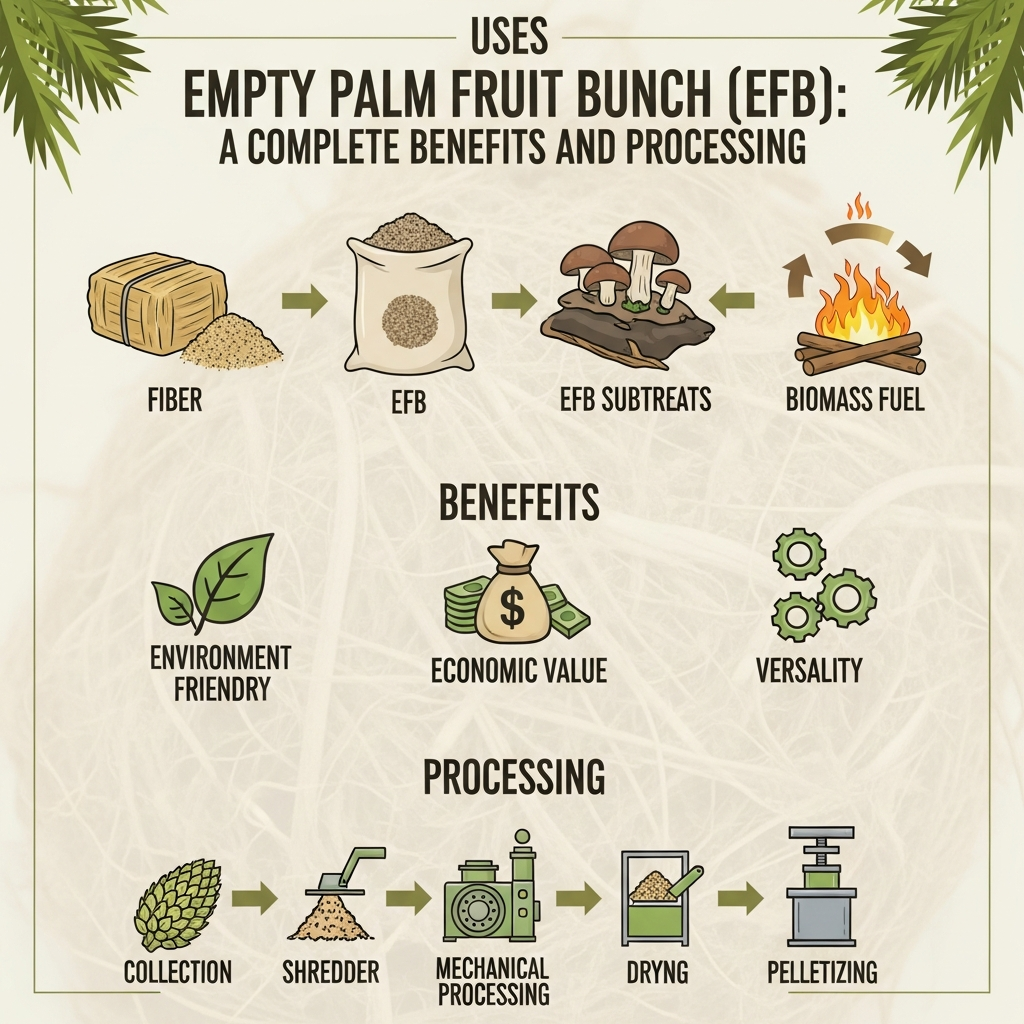
The applications for EFB are diverse and continuously expanding. Its high fiber and nutrient content make it an ideal raw material for numerous value-added products. Here are seven of the most impactful uses.
1. Biofuel and Renewable Energy Source
One of the most significant uses for an Empty Palm Fruit Bunch is as a solid biofuel. EFB can be burned directly in boilers to generate steam and electricity, powering the palm oil mills themselves or feeding into the public grid. It serves a similar energy purpose to other byproducts like the Palm Kernel Shell, which is also widely used as a solid biofuel. EFB can also be processed into pellets or briquettes, creating a denser, more transportable, and efficient energy source. This reduces reliance on fossil fuels and lowers the carbon footprint of the palm oil industry.
2. Soil Conditioning and Composting
The organic nature of EFB makes it a superb material for agriculture. When shredded and composted, the Empty Palm Fruit Bunch transforms into a nutrient-rich organic fertilizer. It improves soil structure, enhances water retention, and replenishes essential nutrients, leading to healthier crops and reduced needs for chemical fertilizers. You can learn more about its effects on soil in this study on EFB compost.
3. Pulp and Paper Production
The long, strong fibers within EFB are suitable for producing pulp, which is then used to manufacture paper and cardboard. This provides a sustainable alternative to traditional wood-based pulp, helping to reduce deforestation. The development of non-wood paper sources is a critical step towards more sustainable packaging and paper products.
4. Production of Bio-Based Chemicals
Through advanced biorefinery processes, the cellulose and hemicellulose in an Empty Palm Fruit Bunch can be broken down to produce valuable bio-based chemicals. These include bioethanol, a renewable fuel, as well as lactic acid and xylitol, which are used in the food, pharmaceutical, and cosmetic industries.
5. Manufacturing Medium-Density Fibreboard (MDF)
The strong fibers of EFB are an excellent raw material for producing Medium-Density Fibreboard (MDF) and particleboard. These engineered wood products are used widely in furniture and construction. Using EFB reduces the demand for virgin timber and repurposes a massive industrial byproduct into durable goods.
6. Animal Feed Production
While raw EFB has low digestibility, it can be processed into a nutritious component for animal feed. Through treatments like fermentation or steam processing, the tough fibers are broken down, making the nutrients more accessible for ruminant animals like cattle and goats. This process is similar to how other feed ingredients like Palm Kernel Expeller are used to boost livestock nutrition.
7. Mushroom Cultivation Substrate
The rich organic composition of a composted Empty Palm Fruit Bunch makes it an ideal substrate for growing mushrooms, particularly oyster mushrooms. This provides an additional revenue stream for farmers and contributes to local food security.
The Processing of Empty Palm Fruit Bunch: A Step-by-Step Overview
To unlock the potential of EFB, it must undergo several processing stages. The exact process varies depending on the intended final product.
Step 1: Collection and Shredding
Fresh EFB from the mill has high moisture content (around 60-70%) and is bulky. It is first collected and fed into a shredder or fiberizer. This machine tears the bunch apart, breaking it down into a loose, fibrous material, which is easier to handle and process further.
Step 2: Dewatering and Drying
The shredded EFB is then dewatered using a screw press to remove excess moisture. This is a crucial step, especially if the material is destined for biofuel, as lower moisture content leads to higher combustion efficiency. For more information on this technology, check this in-depth article on biomass processing.
Step 3: Further Processing
Depending on the end-use, the dried fiber undergoes further refinement:
- Pelletizing: The fiber is compressed under high pressure into dense pellets for biofuel.
- Composting: The material is arranged in long piles (windrows) and left to decompose naturally over several weeks.
- Pulping: The fiber is chemically or mechanically treated to separate it for paper production.
Key Benefits of Utilizing the Empty Palm Fruit Bunch
Harnessing the Empty Palm Fruit Bunch offers a trinity of compelling benefits that align with global sustainability goals.
Environmental Advantages
By treating EFB as a resource instead of waste, we significantly reduce landfill use and prevent the release of methane, a potent greenhouse gas, from decomposition. This practice is a cornerstone of the circular economy model, turning a linear waste stream into a circular, value-generating one.
Economic Advantages
Creating products from EFB opens up new revenue streams for the palm oil industry and related sectors. It stimulates local economies by creating jobs in processing, transportation, and manufacturing.
Agricultural Advantages
Using EFB compost improves farm productivity and soil health, reducing the long-term environmental impact of agriculture. This natural fertilizer helps close the nutrient loop, returning vital organic matter to the very soil that produced it.
Challenges and Future Outlook for the Empty Palm Fruit Bunch
Despite its immense potential, utilizing the Empty Palm Fruit Bunch is not without challenges. High moisture content makes transportation inefficient and costly, and the initial investment in processing equipment can be substantial. Furthermore, developing consistent quality standards for EFB-derived products is essential for market acceptance.
However, the future is bright. Ongoing research and technological advancements are making EFB processing more efficient and cost-effective. As the world pushes for more sustainable materials and renewable energy, the demand for products derived from the Empty Palm Fruit Bunch is set to soar, cementing its role as a key player in the bio-based economy.
This resource, once an overlooked byproduct, is now at the forefront of sustainable innovation. For more on this, read about its future potential in the energy sector.
Makmur Amanah Sejahtera provides high-quality palm products such as Palm Kernel Expeller, Palm Kernel Shell, Crude Palm Oil, Palm Kernel Oil, etc. Kindly contact us at WhatsApp +6282140002198 or email us at admin@makmuramanah.co.id. The Empty Palm Fruit Bunch is a powerful example of how industrial byproducts can be transformed into valuable assets. From generating clean energy and enriching soil to creating sustainable materials, its applications are a testament to the power of innovation in building a circular economy. As technology improves and awareness grows, EFB will play an increasingly vital role in reducing waste and fostering a more sustainable relationship with our planet.Looking for High-Quality Palm Products?
Conclusion: The Future is Green with EFB
 English
  Indonesian
  Chinese
  Arabic