

Challenges and the Future Outlook for EFB
Despite its potential, utilizing EFB is not without challenges. Its high moisture content and bulky nature make transportation expensive and inefficient. The initial investment in processing equipment can also be a barrier for smaller mills.
However, the future is bright. Ongoing research is focused on more efficient dewatering techniques and developing higher-value applications, such as the production of biofuels like bio-oil and cellulosic ethanol. As the world pushes for a more sustainable and circular economy, the humble Empty Palm Fruit Bunch (EFB) is poised to become an even more critical resource.
Conclusion: The Circular Economy Champion
The story of the Empty Palm Fruit Bunch (EFB) is a powerful testament to the potential of industrial symbiosis and sustainability. By viewing this byproduct as a resource rather than refuse, the palm oil industry can mitigate its environmental impact, create new revenue streams, and contribute significantly to the renewable energy and materials sectors. The journey from waste to wealth is not just possible; it’s essential for a greener future.
Your Partner in Sustainable Palm Products
Looking for High-Quality Palm Products?
Makmur Amanah Sejahtera provides high-quality palm products such as Palm Kernel Expeller, Palm Kernel Shell, Crude Palm Oil, Palm Kernel Oil, etc. Kindly contact us at WhatsApp +6282140002198 or email us at admin@makmuramanah.co.id.
- Collection & Shredding: EFB is collected directly from the mill. It is then shredded to break down the long fibers, making it easier to handle and process.Dewatering: The shredded EFB is pressed to remove excess water. Reducing the moisture content is critical for efficient combustion in power plants and for preventing rot during transport.Conversion: The treated EFB is then sent for its final application—be it combustion for energy, composting for fertilizer, or pulping for paper and composite materials, as explored in various research journals on biocomposites.
Challenges and the Future Outlook for EFB
Despite its potential, utilizing EFB is not without challenges. Its high moisture content and bulky nature make transportation expensive and inefficient. The initial investment in processing equipment can also be a barrier for smaller mills.
However, the future is bright. Ongoing research is focused on more efficient dewatering techniques and developing higher-value applications, such as the production of biofuels like bio-oil and cellulosic ethanol. As the world pushes for a more sustainable and circular economy, the humble Empty Palm Fruit Bunch (EFB) is poised to become an even more critical resource.
Conclusion: The Circular Economy Champion
The story of the Empty Palm Fruit Bunch (EFB) is a powerful testament to the potential of industrial symbiosis and sustainability. By viewing this byproduct as a resource rather than refuse, the palm oil industry can mitigate its environmental impact, create new revenue streams, and contribute significantly to the renewable energy and materials sectors. The journey from waste to wealth is not just possible; it’s essential for a greener future.
Your Partner in Sustainable Palm Products
Looking for High-Quality Palm Products?
Makmur Amanah Sejahtera provides high-quality palm products such as Palm Kernel Expeller, Palm Kernel Shell, Crude Palm Oil, Palm Kernel Oil, etc. Kindly contact us at WhatsApp +6282140002198 or email us at admin@makmuramanah.co.id.
Table of Contents
- What is an Empty Palm Fruit Bunch (EFB)?
The Environmental Cost of EFB Waste
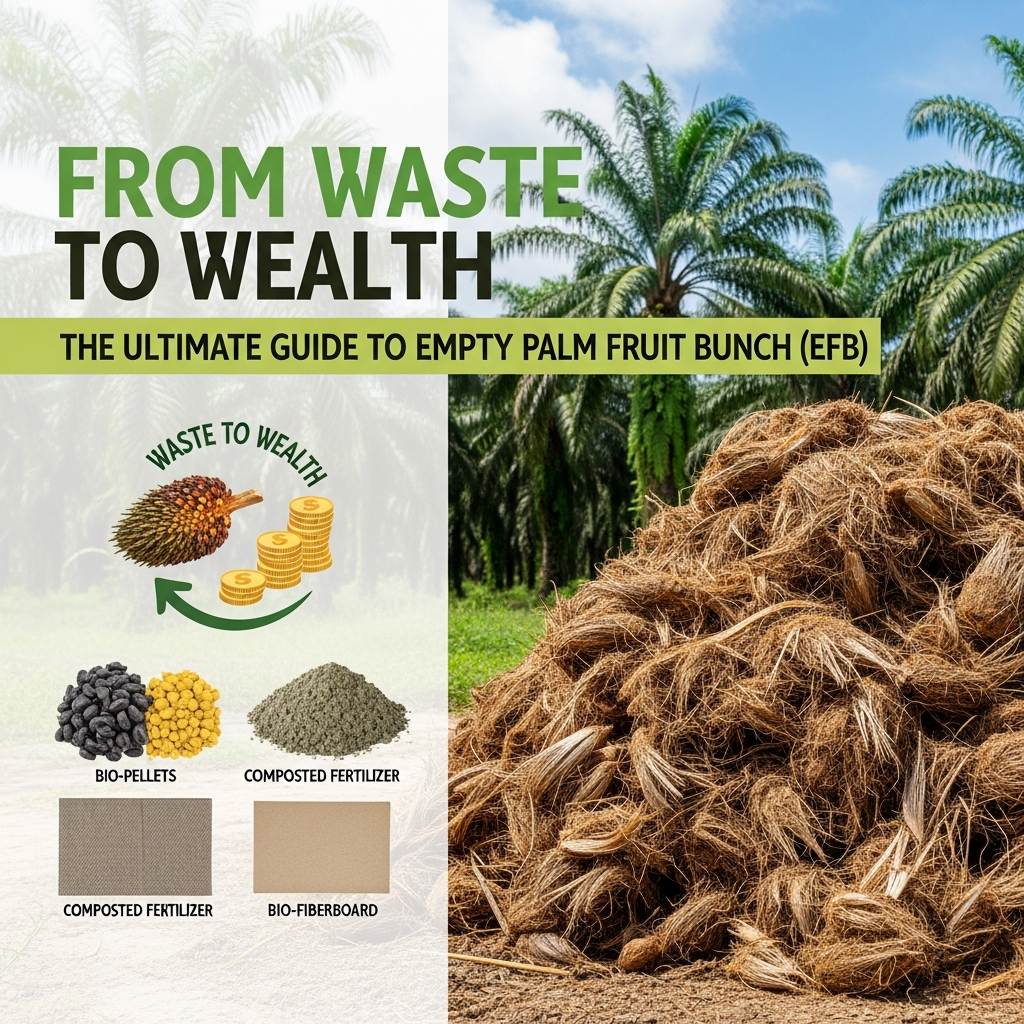
From Waste to Wealth: Key Applications of Empty Palm Fruit Bunch (EFB)
The Step-by-Step Process: From Raw EFB to Valuable Product
Challenges and the Future Outlook for EFB
Conclusion: The Circular Economy Champion
The global palm oil industry is a titan of agriculture, but with great production comes great responsibility, particularly concerning waste. For every ton of Crude Palm Oil produced, a significant amount of biomass is left behind. This article explores the incredible journey of the Oil Palm Fruit Bunch after its fruits are harvested, specifically focusing on the Empty Palm Fruit Bunch (EFB), transforming it from a challenging waste product into a valuable resource, truly embodying the principle of “waste to wealth.”
What is an Empty Palm Fruit Bunch (EFB)?
An Empty Palm Fruit Bunch (EFB) is the fibrous stalk that remains after the palm fruits have been stripped off for oil extraction. This lignocellulosic material is a primary byproduct of the palm oil milling process. Fresh EFB is bulky, has a very high moisture content (around 60-70%), and is tough and fibrous in nature.
EFB and Other Palm Co-Products
The EFB is just one part of the palm oil production ecosystem. Once the fruits are removed from the bunch, they are processed to extract CPO. The remaining nut contains the Palm Kernel, which is then crushed to produce Palm Kernel Oil. The solid residues from this process include the hard Palm Kernel Shell, a popular biofuel, and the nutrient-rich Palm Kernel Expeller, used as animal feed. Understanding these components highlights the industry’s potential for zero waste.
Historically, these bunches were often discarded or burned in the open, leading to significant environmental concerns. However, advancements in technology and a growing emphasis on sustainability have revealed the immense potential locked within every single Empty Palm Fruit Bunch (EFB).

The Environmental Cost of EFB Waste
Leaving EFB to decompose in open piles or landfills presents serious environmental problems. The anaerobic decomposition process releases vast quantities of methane, a greenhouse gas over 25 times more potent than carbon dioxide in trapping heat in the atmosphere. This practice contributes directly to global warming and local air pollution.
Furthermore, the sheer volume of this waste product creates logistical nightmares for mills, occupying large tracts of land that could be used more productively. According to the Environmental Protection Agency (EPA), managing agricultural waste sustainably is crucial for protecting our ecosystems.
From Waste to Wealth: Key Applications of Empty Palm Fruit Bunch (EFB)
The modern approach to the Empty Palm Fruit Bunch (EFB) is not as waste but as a co-product. Its versatility allows it to be a feedstock for numerous industries, driving the circular economy forward.
EFB as a Renewable Energy Source
One of the most prominent uses for EFB is in energy generation. Its high fiber content makes it an excellent biomass fuel. It can be processed into pellets or briquettes for easier transport and handling, or used directly in power plants to generate electricity and steam for the mill’s own operations, reducing reliance on fossil fuels. As detailed in a study published by MDPI, EFB is a promising candidate for biofuel production.
The Role of Empty Palm Fruit Bunch (EFB) in Agriculture
EFB can be returned to the earth to enrich it. By composting the bunches, a nutrient-rich organic fertilizer is created, which can be used in the palm plantations themselves. This process improves soil structure, enhances water retention, and reduces the need for chemical fertilizers. The Food and Agriculture Organization (FAO) highlights the benefits of organic fertilizers in sustainable farming systems.
EFB in Advanced Material Production
The fibers from an Empty Palm Fruit Bunch (EFB) are a valuable raw material. They can be processed into pulp for paper manufacturing, reducing the logging of natural forests. Additionally, these strong fibers are used to create medium-density fiberboard (MDF), particleboard, and innovative biocomposites used in automotive interiors and furniture.
The Step-by-Step Process: From Raw EFB to Valuable Product
Converting a raw Empty Palm Fruit Bunch (EFB) into a valuable commodity involves several key stages:
- Collection & Shredding: EFB is collected directly from the mill. It is then shredded to break down the long fibers, making it easier to handle and process.Dewatering: The shredded EFB is pressed to remove excess water. Reducing the moisture content is critical for efficient combustion in power plants and for preventing rot during transport.Conversion: The treated EFB is then sent for its final application—be it combustion for energy, composting for fertilizer, or pulping for paper and composite materials, as explored in various research journals on biocomposites.
Challenges and the Future Outlook for EFB
Despite its potential, utilizing EFB is not without challenges. Its high moisture content and bulky nature make transportation expensive and inefficient. The initial investment in processing equipment can also be a barrier for smaller mills.
However, the future is bright. Ongoing research is focused on more efficient dewatering techniques and developing higher-value applications, such as the production of biofuels like bio-oil and cellulosic ethanol. As the world pushes for a more sustainable and circular economy, the humble Empty Palm Fruit Bunch (EFB) is poised to become an even more critical resource.
Conclusion: The Circular Economy Champion
The story of the Empty Palm Fruit Bunch (EFB) is a powerful testament to the potential of industrial symbiosis and sustainability. By viewing this byproduct as a resource rather than refuse, the palm oil industry can mitigate its environmental impact, create new revenue streams, and contribute significantly to the renewable energy and materials sectors. The journey from waste to wealth is not just possible; it’s essential for a greener future.
Your Partner in Sustainable Palm Products
Looking for High-Quality Palm Products?
Makmur Amanah Sejahtera provides high-quality palm products such as Palm Kernel Expeller, Palm Kernel Shell, Crude Palm Oil, Palm Kernel Oil, etc. Kindly contact us at WhatsApp +6282140002198 or email us at admin@makmuramanah.co.id.
 English
  Indonesian
  Chinese
  Arabic