
Table of Contents
- What Is RBD Palm Olein CP6?
- Decoding the Name: RBD and CP6 Explained
- The 2025 Technical Specifications for RBD Palm Olein CP6
- Top 5 Uses of RBD Palm Olein CP6 in Global Industries
- Sustainability and Sourcing: Making an Informed Choice
- The Unbeatable Choice for 2025
- Frequently Asked Questions
What Is RBD Palm Olein CP6?
RBD Palm Olein CP6 is one of the most widely traded and versatile edible oils in the world. It is a refined, liquid fraction obtained from palm oil, which is extracted from the fruit of the oil palm tree. Its immense popularity stems from a winning combination of affordability, a neutral taste, and exceptional stability at high temperatures, making it a go-to choice for food manufacturers and culinary professionals globally.
This oil’s formal name tells its story. “RBD” signifies the purification process it undergoes, while “CP6” refers to its specific cloud point, a critical quality parameter. Understanding these details is key to appreciating why RBD Palm Olein CP6 is a cornerstone of the food industry, from fast-food chains to snack production.
Decoding the Name: RBD and CP6 Explained
The name “RBD Palm Olein CP6” might seem technical, but it’s a precise description of the product. Let’s break down each component to understand the quality and characteristics you can expect.
What “RBD” Means for Quality
The acronym RBD stands for Refined, Bleached, and Deodorized. This three-step process transforms Crude Palm Oil into a stable, pure, and neutral cooking oil.
- Refined: This initial stage removes free fatty acids (FFAs) and other impurities that can cause the oil to smoke or go rancid.
- Bleached: The oil is filtered through bleaching earth to remove natural pigments like carotenoids, resulting in a clear, light-golden appearance.
- Deodorized: Steam is used under a vacuum to strip away any residual odors and flavors, yielding a bland oil that won’t interfere with the taste of food.
The Importance of “CP6” (Cloud Point 6)
The “CP” stands for Cloud Point, which is the temperature at which the oil begins to solidify and appear cloudy. “CP6” means this specific grade of RBD Palm Olein has a cloud point of 6° Celsius (42.8°F). This is a crucial feature, ensuring the oil remains liquid and clear in temperate climates and during cooler months, which is vital for handling, transportation, and final product appearance.

The 2025 Technical Specifications for RBD Palm Olein CP6
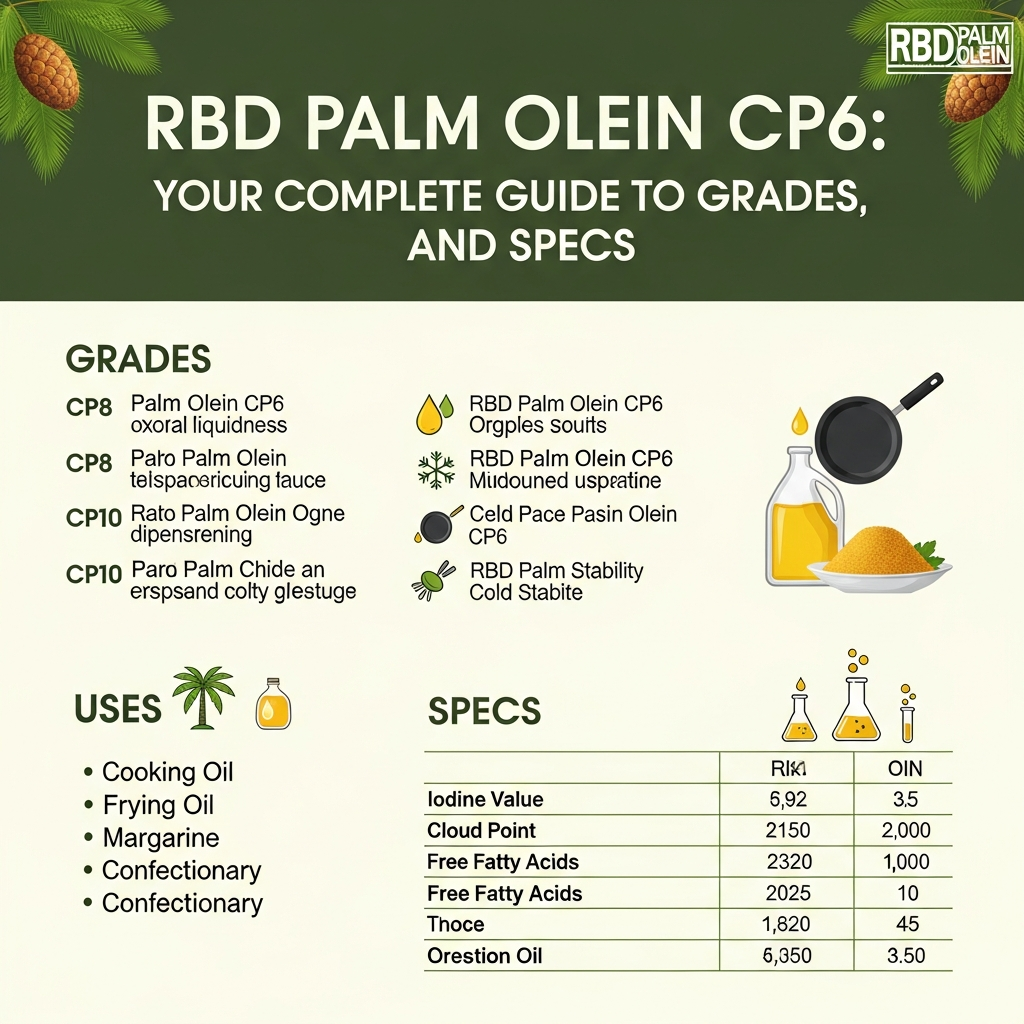
To ensure quality and consistency, RBD Palm Olein CP6 must meet specific international standards. These specifications are a guarantee of the oil’s purity and performance. Below is a table outlining the key technical parameters for premium-grade CP6 palm olein.
| Parameter | Specification |
|---|---|
| Free Fatty Acids (FFA) (as % Palmitic) | 0.1% Max |
| Moisture & Impurities (M&I) | 0.1% Max |
| Iodine Value (Wijs) | 56 Min |
| Slip Melting Point (°C) | 24 Max |
| Cloud Point (°C) | 6 Max |
| Color (5.25″ Lovibond Cell) | 3 Red Max |
Each parameter is critical. For instance, a low FFA value indicates the oil is fresh and less prone to smoking. The Iodine Value (IV) measures its degree of unsaturation, and a minimum of 56 is standard for RBD Palm Olein CP6. For a deeper dive into these testing methods, you can refer to the official procedures from the American Oil Chemists’ Society (AOCS), which sets the benchmark for the industry.
Top 5 Uses of RBD Palm Olein CP6 in Global Industries
The unique properties of RBD Palm Olein CP6 make it an indispensable ingredient across various sectors. Its stability, cost-effectiveness, and neutral profile are unmatched.
1. Deep Frying
This is the most common application. With a high smoke point (around 235°C or 455°F), it’s perfect for deep-frying everything from french fries and chicken to donuts. The oil remains stable under prolonged heat, delivering a crispy texture without imparting any unwanted flavor. The Food and Agriculture Organization (FAO) recognizes palm oil as a major contributor to the world’s oils and fats supply for cooking.
2. Instant Noodle Production
A key step in making instant noodles is flash-frying the noodle blocks. This process dehydrates them for a long shelf life. RBD Palm Olein CP6 is the preferred oil for this due to its efficiency and ability to produce a non-greasy final product.
3. Margarine and Shortening
While olein is the liquid fraction, it can be blended and hydrogenated with palm stearin (the solid fraction) to create margarines, shortenings, and other spreads. Its properties provide the desired consistency and mouthfeel in baked goods and confectionery.
4. Confectionery and Packaged Snacks
From chocolate coatings to potato chips, RBD Palm Olein CP6 is used extensively. It helps in creating a glossy finish on chocolates and provides the perfect crunch for snacks, all while extending shelf life due to its resistance to oxidation.
5. Non-Food Applications
Beyond the kitchen, it serves as a base raw material in the manufacturing of soaps, detergents, and cosmetics. It is also a significant feedstock for the production of biodiesel, highlighting its industrial versatility.

Sustainability and Sourcing: Making an Informed Choice
The conversation about palm oil is incomplete without addressing sustainability. The industry has faced scrutiny over environmental concerns like deforestation. In response, a global standard for sustainable palm oil production was established to protect ecosystems and communities.
True sustainability involves utilizing every part of the harvest. Beyond the oil, the process yields other valuable resources. The Palm Kernel is processed to create Palm Kernel Oil, a different type of oil with unique properties, and Palm Kernel Expeller, a protein-rich animal feed. Even the solid biomass, like the Palm Kernel Shell and Oil Palm Fruit Bunch, is repurposed as a clean, renewable energy source.
When sourcing RBD Palm Olein CP6, it is crucial to look for suppliers who are members of the Roundtable on Sustainable Palm Oil (RSPO). RSPO certification ensures that the palm oil is produced in a way that is environmentally responsible, socially beneficial, and economically viable. Choosing certified sustainable palm oil helps drive the industry toward positive change.
For a balanced perspective on dietary fats, including palm oil, the World Health Organization (WHO) provides comprehensive guidelines on fat consumption as part of a healthy diet.
The Unbeatable Choice for 2025
In summary, RBD Palm Olein CP6 remains an essential commodity for countless industries due to its exceptional stability, versatility, and cost-effectiveness. Its clear specifications, from a low cloud point to high oxidative stability, make it the gold standard for cooking, frying, and food manufacturing. By choosing sustainably sourced products, industries can continue to leverage its benefits responsibly.
Makmur Amanah Sejahtera provides high-quality palm products such as Palm Kernel Expeller, Palm Kernel Shell, Crude Palm Oil, Palm Kernel Oil, etc. Kindly contact us at WhatsApp +6282140002198 or email us at admin@makmuramanah.co.id. RBD Palm Oil is the base oil, which is semi-solid at room temperature. RBD Palm Olein is the liquid fraction obtained after the palm oil is crystallized and filtered. Olein remains liquid at higher temperatures, making it more suitable for cooking and frying. Like all fats, it should be consumed in moderation. It is naturally free of trans fats and is a good source of Vitamin E (tocotrienols). However, it is high in saturated fat. A balanced diet incorporates a variety of fats from different sources. CP6 (Cloud Point 6°C) offers a good balance. It stays liquid in most non-refrigerated conditions, making it suitable for a wider range of climates compared to CP8 or CP10, which cloud at higher temperatures (8°C and 10°C, respectively). This makes RBD Palm Olein CP6 more versatile for global logistics. It should be stored in a cool, dry place away from direct sunlight and strong odors. Proper storage ensures it maintains its quality and extends its shelf life significantly.Looking for High-Quality Palm Products?
Frequently Asked Questions
What is the difference between RBD Palm Oil and RBD Palm Olein?
Is RBD Palm Olein CP6 healthy?
Why is CP6 a popular grade over CP8 or CP10?
How should I store RBD Palm Olein CP6?
 English
  Indonesian
  Chinese
  Arabic