
Table of Contents
- What Are Empty Palm Fruit Bunches (EFB)?
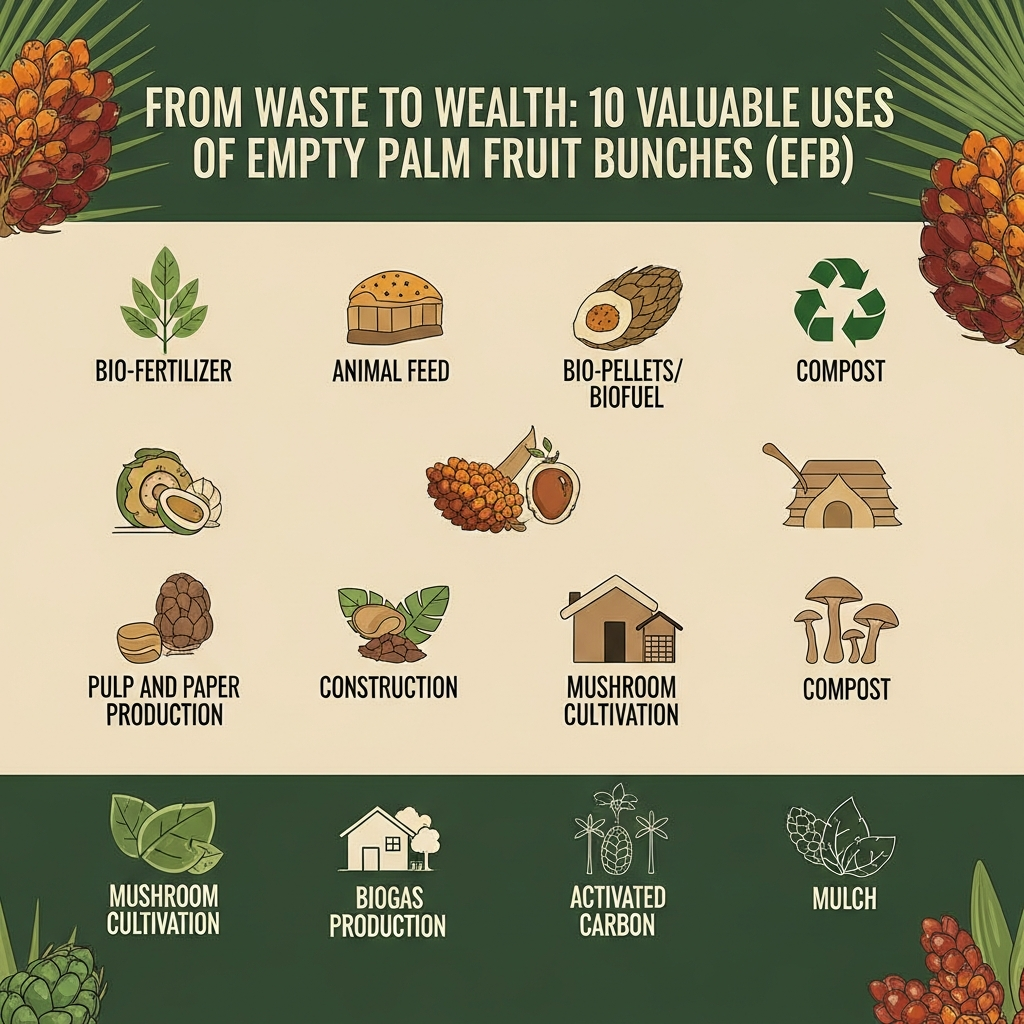
Top 10 Uses of Empty Palm Fruit Bunches
1. Biofuel and Renewable Energy
2. Organic Compost and Fertilizer
3. Pulp and Paper Production
4. Medium-Density Fibreboard (MDF)
5. Bio-Based Chemicals
6. Animal Feed Supplement
7. Mulching for Soil Health
8. Mushroom Cultivation Medium
9. Biochar and Activated Carbon
10. Erosion Control Mats
Your Partner in Sustainable Palm Products
Conclusion: The Future is Green
The palm oil industry, a titan of the global economy, has long faced scrutiny for its environmental impact. A significant challenge has been the colossal amount of waste generated from products like Crude Palm Oil. The most notable byproduct is the empty palm fruit bunch (EFB). But what if this waste could be transformed into a valuable resource? This article explores the proven uses of empty palm fruit bunches, turning a major environmental problem into a profitable and sustainable solution.

What Are Empty Palm Fruit Bunches (EFB)?
After the fresh Oil Palm Fruit Bunch is harvested and its fruitlets are stripped for oil extraction, the leftover bunch is called an Empty Palm Fruit Bunch (EFB). This process separates the valuable fruit from the fibrous stalk, which also contains the Palm Kernel. These bunches, composed of cellulose, hemicellulose, and lignin, were traditionally incinerated or left to decompose, releasing greenhouse gases. However, innovative technologies are unlocking their hidden potential, revealing numerous uses of empty palm fruit bunches.
Top 10 Uses of Empty Palm Fruit Bunches: From Waste to Wealth
From powering homes to feeding livestock, the applications for this humble biomass are expanding rapidly. Let’s delve into the top ten commercial and environmental uses of EFB that are making a significant impact across various industries.
1. Biofuel and Renewable Energy
One of the most promising uses of empty palm fruit bunches is in renewable energy. EFB can be processed into solid fuels like pellets and briquettes, similar to biomass from Palm Kernel Shell. These are burned in biomass power plants to generate electricity. This process is carbon-neutral, as the carbon dioxide released is equivalent to what the palm plant absorbed during its life. According to the International Renewable Energy Agency (IRENA), biomass is a critical component of the global energy transition.
2. Organic Compost and Fertilizer
EFB is rich in potassium and other essential nutrients, making it a fantastic raw material for organic compost. By composting EFB, plantations can create a closed-loop system, returning valuable nutrients to the soil. This reduces the need for chemical fertilizers, improves soil structure, and enhances water retention, leading to healthier crops. This sustainable agricultural practice is a cornerstone of regenerative farming and one of the most eco-friendly uses of empty palm fruit bunches.
3. Pulp and Paper Production
The high fiber content in EFB makes it a viable alternative to wood in the pulp and paper industry. This helps reduce deforestation and pressure on natural forests. Research published in the Polymers journal has shown that EFB fiber can be used to produce various paper products, from writing paper to packaging materials, offering a more sustainable option. These innovative uses of empty palm fruit bunches are reshaping manufacturing.
4. Medium-Density Fibreboard (MDF)
Similar to paper production, the long fibers in EFB are ideal for manufacturing medium-density fibreboard (MDF) and particleboard. These engineered wood products are used extensively in furniture and construction. Utilizing EFB reduces reliance on traditional timber and provides a durable, eco-friendly building material.

5. Bio-Based Chemicals
EFB is a rich source of cellulose and lignin, which can be broken down to produce valuable bio-based chemicals like bio-ethanol, xylitol, and organic acids. These chemicals are used in everything from food additives to pharmaceuticals. This biorefinery approach aligns with the principles of a circular economy, minimizing waste and maximizing resource utilization. This is one of the more advanced uses of empty palm fruit bunches, requiring significant technological investment.
6. Animal Feed Supplement
Through processes like fermentation and enzyme treatment, EFB can be converted into a digestible, high-fiber feed for livestock. It serves a different purpose than protein-rich feeds like Palm Kernel Expeller (a byproduct from Palm Kernel Oil extraction), by providing essential roughage. This offers a low-cost, sustainable feed source that can reduce the land and resources required for traditional feed crops. The Food and Agriculture Organization (FAO) often highlights the need for sustainable feed sources.
7. Mulching for Soil Health
In its raw, shredded form, EFB serves as an excellent mulching material. Applying it around the base of palm trees or other crops helps suppress weed growth, conserve soil moisture, and regulate soil temperature. As the mulch slowly decomposes, it releases nutrients directly into the soil, further enhancing fertility. This is one of the simplest yet most effective uses of empty palm fruit bunches on a plantation.
8. Mushroom Cultivation Medium
The nutrient-rich, fibrous nature of EFB makes it an ideal substrate for growing mushrooms, such as oyster mushrooms. This provides an additional revenue stream for farmers and converts waste into a high-value food product. This particular use of empty palm fruit bunches is a perfect example of a circular bio-economy in action.
9. Biochar and Activated Carbon
Through a process called pyrolysis, EFB can be heated in a low-oxygen environment to create biochar. Biochar is a powerful soil amendment that improves nutrient retention and sequesters carbon for centuries. Further processing can turn EFB into activated carbon, a highly porous material used in water and air filtration systems, as documented by research in journals like Biomass and Bioenergy.
10. Erosion Control Mats
The strong, interlocking fibers of EFB can be woven into biodegradable mats. These mats are placed on slopes, riverbanks, and construction sites to prevent soil erosion. As the mat holds the soil in place, it slowly decomposes, adding organic matter to the soil and allowing natural vegetation to take root. This is a critical environmental application among the various uses of empty palm fruit bunches.
Your Partner in Sustainable Palm Products
Looking for High-Quality Palm Products?
Makmur Amanah Sejahtera provides high-quality palm products such as Palm Kernel Expeller, Palm Kernel Shell, Crude Palm Oil, Palm Kernel Oil, etc. Kindly contact us at WhatsApp +6282140002198 or email us at admin@makmuramanah.co.id.
Conclusion: The Future is Green
The diverse and valuable uses of empty palm fruit bunches demonstrate a powerful shift from a linear “take-make-dispose” model to a circular one. By harnessing technology and innovation, the palm oil industry can transform its largest waste product into a source of renewable energy, sustainable materials, and economic wealth. These 10 examples are just the beginning, proving that with the right approach, waste is nothing more than a resource in the wrong place.
 English
  Indonesian
  Chinese
  Arabic