
Cocopeat: 7 Amazing Benefits & Complete Guide (2026)
Cocopeat is widely widely recognized as the gold standard for sustainable growing media in modern horticulture. As we navigate the agricultural shifts of 2026, this eco-friendly byproduct of the coconut industry has evolved from a waste material into a cornerstone of high-yield gardening. If you are struggling with heavy soil, root rot, or unsustainable peat usage, understanding this powerful substrate is your first step toward a thriving garden.
For decades, commercial growers relied on peat moss, often ignoring the ecological damage caused by harvesting it. Today, premium cocopeat offers a superior, renewable alternative that outperforms traditional soils in water retention and aeration. Whether you are managing a large-scale hydroponic farm or a backyard vegetable patch, this guide will reveal exactly how to harness the power of coir for maximum plant health.
What is Cocopeat?
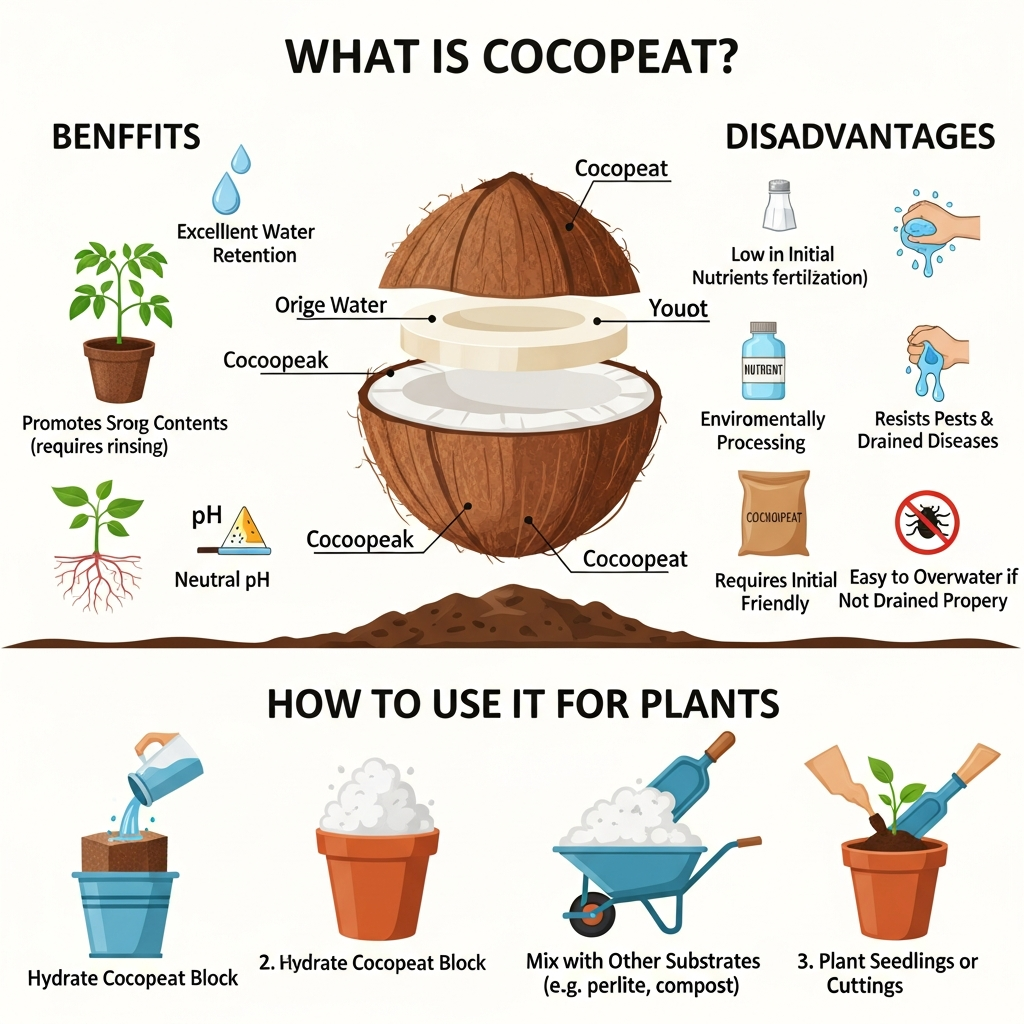
Cocopeat, also referred to as coir pith or coir dust, is the spongy, binding material found within the husk of a coconut. During the fiber extraction process, this pith is separated from the long fibers. Once considered a nuisance waste product, it is now washed, heat-treated, buffered, and compressed into blocks for global horticultural use.
Unlike biologically active soil, coir is an inert growing medium. This means it provides a “blank slate” structure for plant roots, free from weed seeds and soil-borne pathogens. Its physical structure resembles a microscopic sponge, capable of holding up to 8–10 times its weight in water while maintaining high porosity for oxygen exchange.
The Science Behind the Substrate
To truly master cocopeat, one must understand its Cation Exchange Capacity (CEC). Coir has naturally negative charges that attract positive ions (cations). Without proper processing (buffering), it can lock out calcium and magnesium while releasing excess potassium and sodium. High-quality coir is “buffered” to balance this exchange, ensuring nutrients remain available to your plants.
Why Use Cocopeat? 7 Amazing Benefits
Why are expert growers switching to coir in 2026? The advantages go far beyond sustainability. Here are the top seven functional benefits:
- Unmatched Water Retention: Coir holds moisture like a sponge and releases it slowly. This quality is crucial for reducing water waste and surviving heatwaves without daily irrigation.
- Superior Root Aeration: Even when fully saturated, the lignin structure of coir retains air pockets. This prevents the anaerobic conditions that cause root rot, a common killer in standard potting soils.
- Ideal pH Range: With a natural pH of 5.5 to 6.8, it sits in the “sweet spot” for nutrient uptake for most crops, including tomatoes, peppers, and ornamentals.
- 100% Renewable Resource: Unlike peat bogs which take thousands of years to regenerate, coconuts are harvested every 45–60 days. Using coir supports a circular economy.
- Natural Disease Resistance: Coir is naturally resistant to bacterial and fungal growth (such as Pythium). It is also known to harbor beneficial Trichoderma fungi which protect roots.
- Slow Decomposition: Due to its high lignin content, coir degrades very slowly. It can be reused for up to 5 years, unlike peat which breaks down and compacts within a single season.
- incredible Versatility: It functions perfectly as a standalone hydroponic medium, a soil amendment, or a bedding for vermicompost.
According to the Royal Horticultural Society (RHS), the transition to peat-free media is essential for biodiversity, and coir is leading this charge globally.
Cocopeat vs. Peat Moss: The Showdown
The debate between these two substrates is settled when looking at the environmental data. While they share physical similarities, cocopeat wins on sustainability and longevity.
| Feature | Cocopeat | Peat Moss |
|---|---|---|
| Sustainability | High (Renewable waste product) | Low (Destroys carbon sinks) |
| Wettability | Hydrophilic (Absorbs water instantly) | Hydrophobic (Repels water when dry) |
| pH Level | Neutral (5.5 – 6.8) | Acidic (3.5 – 4.5) |
| Durability | Lasts 3–5 years | Lasts 1–2 years |
| Aeration | Excellent porosity | Compacts easily |
How to Use Cocopeat for Plants: Step-by-Step Guide
Transitioning to a soil-less medium requires a slight adjustment in your gardening protocol. Follow these steps for expert results.
1. Rehydration and Washing
Most coir comes in compressed bricks. Soak the brick in warm water (approx 5 liters per 1kg brick). Crucial Step: If you are unsure of the quality, wash the expanded coir with fresh water to leach out excess salts (sodium chloride) that may naturally occur in coconut husks. Use an EC meter to ensure runoff is below 0.5 mS/cm.
2. Buffering Cocopeat (If Necessary)
If you have unbuffered coir, you must treat it. Soak the hydrated coir in a solution of Calcium Nitrate and Magnesium Sulfate (Cal-Mag) for 8–12 hours. This saturates the cation exchange sites with beneficial calcium, preventing calcium deficiency in your future crops.
3. Mixing the Perfect Potting Soil
While coir is great alone, it works best in a mix. Here are two “Gold Standard” recipes:
The General Purpose Mix:
- 50% Cocopeat (Base structure)
- 30% Perlite (Aeration)
- 20% Compost or Worm Castings (Bio-activity)
The Aroid & Tropical Mix:
- 40% Chunky Coir Chips
- 30% Palm Kernel Shell (Superior drainage & aeration)
- 20% Perlite
- 10% Worm Castings
Using Palm Kernel Shell adds significant aeration and drainage structure, mimicking the forest floor environment that tropical plants love.
Advanced Tips: Fertilization and Amendments
Because coir is inert, it contains almost no N-P-K (Nitrogen, Phosphorus, Potassium). You are the chef, and the coir is the plate. You must provide the food.
For organic growers, relying solely on liquid nutrients can be expensive. We recommend amending your coir mix with slow-release organic fertilizers. Palm Kernel Expeller (PKE) is an excellent addition; it adds organic matter and breaks down slowly to provide sustained nutrition. Similarly, Copra Meal can be used as a nitrogen-rich amendment to boost vegetative growth.
Research published by the American Society for Horticultural Science highlights that coir-based substrates, when properly amended, produce yields equal to or higher than peat-based mixes.
Common Disadvantages and How to Fix Them
No medium is perfect. Here is how to handle the common issues with coir:
- Salt Buildup: Low-quality coir is often high in sea salt. Fix: Always buy washed/buffered brands or flush thoroughly before use.
- Nutrient Lockout: As mentioned, coir “hogs” calcium. Fix: Use a Cal-Mag supplement with every watering or amend with gypsum.
- Potassium Release: Coir naturally releases potassium. Fix: Adjust your fertilizer regime to lower potassium levels slightly in the vegetative stage.
Commercial Hydroponics and Future Trends (2026)
In the commercial sector, cocopeat grow bags are the industry standard for tomatoes, cucumbers, and berries. The trend for 2026 is “Crop Steering”—manipulating irrigation frequency and dry-back periods to force plants into vegetative or generative states. Coir’s predictable drying curve makes this precision possible.
Furthermore, agricultural universities like Penn State Extension are constantly refining coir blends to minimize water usage, cementing its place as the substrate of the future.
Makmur Amanah Sejahtera provides high-quality palm products such as Palm Kernel Expeller, Palm Kernel Shell, Crude Palm Oil, Palm Kernel Oil, etc. Kindly contact us at WhatsApp +6282140002198 or email us at admin@makmuramanah.co.id.
Frequently Asked Questions
Is cocopeat good for all types of plants?
Yes, it is excellent for most vegetables, flowers, and tropical plants. However, for succulents and cacti, it retains too much moisture on its own. You should mix it with 50% perlite or pumice to ensure rapid drainage.
Does cocopeat expire or go bad?
Dry, compressed bricks can be stored for years without spoiling. Once hydrated, the medium should be used within a few months to avoid contamination, though it resists rot significantly better than peat moss.
Can I reuse cocopeat for the next growing season?
Absolutely. You can reuse it for 3–5 years. Before reusing, wash it thoroughly with an enzyme solution (like Cannazym) to break down old root material and flush out accumulated salts.
Do I need to add Cal-Mag when using cocopeat?
Yes, this is highly recommended. Because of the cation exchange capacity, coir tends to bind calcium. Adding a Calcium-Magnesium supplement ensures your plants don’t suffer from deficiencies like blossom end rot.
Is cocopeat naturally rich in nutrients?
No, it is an inert medium. While it contains trace potassium, it does not provide sufficient nutrition (NPK) on its own. You must use a complete fertilizer program or mix it with compost.
Conclusion
As we embrace the sustainable technologies of 2026, cocopeat stands out as an essential tool for the conscious grower. Its ability to improve root health, save water, and replace environmentally damaging peat moss makes it the clear winner for modern gardening.
By understanding the importance of buffering, proper fertilization, and correct usage, you can unlock the full potential of your garden. Whether you are using it to amend heavy clay soil or as a base for a high-performance hydroponic system, coir delivers results that speak for themselves.
 English
  Indonesian
  Chinese
  Arabic