
Table of Contents
- What Exactly is an Empty Palm Fruit Bunch (EFB)?
- 7+ Ultimate Applications of EFB
- 1. A Powerhouse for Biofuel and Renewable Energy
- 2. Crafting Rich Compost and Organic Fertilizer
- 3. A Sustainable Source for Pulp and Paper Production
- 4. The Perfect Medium for Mushroom Cultivation
- 5. Building Blocks for Fiberboard and Composite Materials
- 6. Effective Mulching for Sustainable Agriculture
- 7. Producing High-Value Biochar for Soil Health
- 8. Potential in Advanced Biorefineries
- The Environmental and Economic Impact of Using EFB
- The Future of EFB Utilization
- Frequently Asked Questions (FAQ)
- Your Source for Quality Palm Products
- Conclusion: From Waste to Wealth

For decades, the palm oil industry has been a cornerstone of many economies, producing essential goods like Crude Palm Oil and Palm Kernel Oil. However, it has also generated massive amounts of biomass waste. A primary component of this is the Oil Palm Fruit Bunch (EFB), the fibrous husk left behind after the palm fruits are harvested. But what was once considered a disposal problem is now being recognized as a surprisingly powerful resource. This guide explores the incredible transformation of this humble byproduct.
This article will delve into the various applications of EFB, showcasing how innovation is turning agricultural waste into valuable products, contributing to a more sustainable and circular economy in 2025 and beyond.
What Exactly is an Empty Palm Fruit Bunch (EFB)?
An Empty Palm Fruit Bunch is the lignocellulosic material that remains after the oil-bearing fruits have been stripped from the Fresh Fruit Bunch (FFB) in a palm oil mill. These bunches are heavy, bulky, and incredibly fibrous, composed mainly of cellulose, hemicellulose, and lignin. A single mill can produce thousands of tons of this biomass every month.
Historically, managing this waste was a significant logistical and environmental challenge. However, due to its rich organic composition, this fibrous byproduct is an ideal raw material for a wide range of industrial and agricultural applications.
7+ Ultimate Applications of EFB
The versatility of EFB has unlocked numerous value-added applications, transforming it from a liability into a profitable asset. Let’s explore some of its most significant uses.
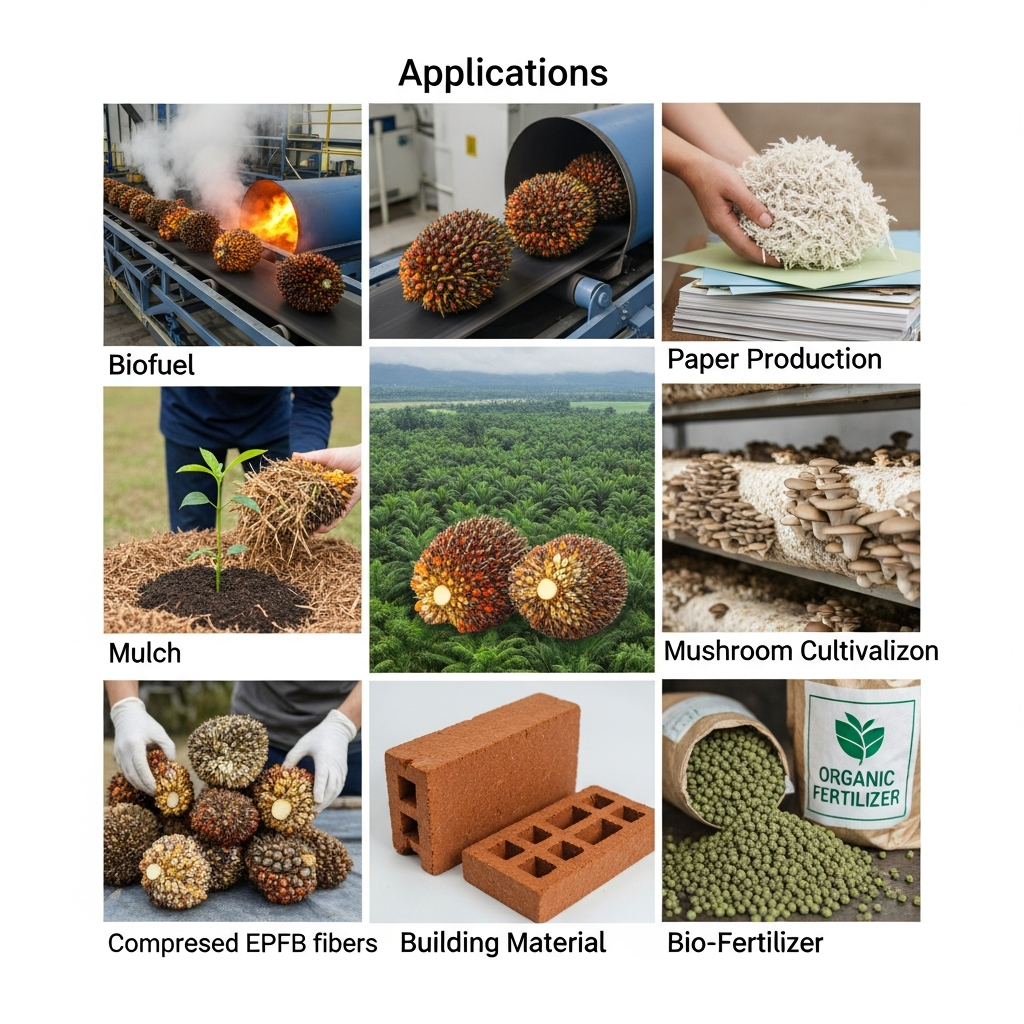
1. A Powerhouse for Biofuel and Renewable Energy
One of the most prominent uses for EFB is in generating renewable energy. Its high calorific value makes it an excellent biomass fuel. It can be used directly in boilers at palm oil mills to generate steam and electricity, reducing their reliance on fossil fuels.
Furthermore, the fibrous material can be processed into solid fuels like pellets or briquettes. These densified fuels are easier to transport and can be used in industrial power plants for co-firing with coal, significantly lowering greenhouse gas emissions. According to a study in the Journal of Renewable and Sustainable Energy Reviews, EFB is a promising feedstock for biofuel production, contributing to energy security.
2. Crafting Rich Compost and Organic Fertilizer
This organic byproduct is a fantastic raw material for large-scale composting. When shredded and composted, it decomposes into a nutrient-rich organic fertilizer. This compost is particularly high in potassium, a crucial nutrient for plant growth.
Using EFB compost improves soil structure, enhances water retention, and promotes beneficial microbial activity. This practice creates a closed-loop system where waste from the plantation is returned to the soil, reducing the need for chemical fertilizers and improving crop yields sustainably.
3. A Sustainable Source for Pulp and Paper Production
The long fibers within EFB make it a viable alternative to wood for producing pulp and paper. This non-wood fiber source helps alleviate pressure on natural forests, combating deforestation.
While the technology is still evolving, several companies have successfully developed processes to turn this biomass into biodegradable packaging, writing paper, and other paper products. This innovation aligns perfectly with the global push for more sustainable materials.
4. The Perfect Medium for Mushroom Cultivation
EFB’s composition of cellulose and lignin makes it an excellent substrate for growing edible mushrooms, such as oyster mushrooms. After sterilization, the shredded byproduct provides the necessary nutrients for the mushroom mycelium to thrive.
This application provides an additional revenue stream for farmers and contributes to local food security. It’s a prime example of how an agricultural byproduct can be integrated into food production systems.
5. Building Blocks for Fiberboard and Composite Materials
The strong fibers of EFB can be extracted and used to manufacture medium-density fiberboard (MDF), particleboard, and other composite materials. These boards are used in furniture, construction, and even automotive interiors.
By using these fibers, manufacturers can reduce their reliance on wood, creating more eco-friendly products. This is a key component in the development of sustainable building materials that are both durable and environmentally responsible.
6. Effective Mulching for Sustainable Agriculture
In its simplest application, shredded EFB is used as mulch in oil palm plantations and other agricultural settings. Spreading this material around the base of trees helps to conserve soil moisture by reducing evaporation.
This mulch also suppresses weed growth, which reduces the need for herbicides. As it slowly decomposes, it releases valuable organic matter and nutrients back into the soil, creating a healthier growing environment. This practice is widely endorsed by organizations like the Roundtable on Sustainable Palm Oil (RSPO).
7. Producing High-Value Biochar for Soil Health
Through a process called pyrolysis (heating in the absence of oxygen), EFB can be converted into biochar. Biochar is a stable, carbon-rich charcoal that offers remarkable benefits as a soil amendment.
According to the International Biochar Initiative, adding biochar to soil can increase fertility, improve water retention, and, most importantly, sequester carbon for centuries, making it a powerful tool in combating climate change.
8. Potential in Advanced Biorefineries
Looking ahead, EFB is seen as a key feedstock for advanced biorefineries. These facilities can break down the biomass into its core components (cellulose, lignin) to produce high-value biochemicals, bioplastics, and advanced biofuels like bioethanol.
Research in this area is rapidly advancing, with studies such as one published by the Frontiers in Energy Research highlighting its potential to replace petroleum-based products and drive a bio-based economy.
The Environmental and Economic Impact of Using EFB
Utilizing EFB effectively brings significant benefits. Environmentally, it reduces landfill waste, decreases methane emissions from decomposition, lowers the carbon footprint of the palm oil industry, and helps conserve natural resources.
Economically, it creates new revenue streams, generates employment in processing and logistics, and reduces operational costs for palm oil mills by providing an in-house energy source. This “waste-to-wealth” approach is a perfect model of a circular economy in action.
The Future of EFB Utilization
The future for the Empty Palm Fruit Bunch is brighter than ever. As technology improves and the global demand for sustainable solutions grows, we can expect to see even more innovative applications emerge. From nanotechnology to the production of specialty chemicals, EFB is poised to become a central player in the green economy.
Investment in research and development is key to unlocking the full potential of this abundant and renewable resource, ensuring it contributes to a more sustainable and prosperous future.
Frequently Asked Questions (FAQ)
Is EFB biodegradable?
Yes, it is fully biodegradable. It is an organic material that decomposes naturally, which is why it is so effective as a compost and mulch.
How is EFB different from palm kernel shells?
Both are byproducts of palm oil production. EFB is the soft, fibrous bunch itself, while Palm Kernel Shell are the hard, woody coverings of the palm fruit’s Palm Kernel. Shells are often used as a high-grade biomass fuel due to their density and low moisture content, while other byproducts like Palm Kernel Expeller serve as animal feed.
What is the energy value of EFB?
The calorific value of raw EFB is typically around 8-10 MJ/kg, which can be increased significantly to over 18 MJ/kg when processed into pellets or briquettes by reducing its high moisture content.
Your Source for Quality Palm Products
Looking for High-Quality Palm Products?
Makmur Amanah Sejahtera provides high-quality palm products such as Palm Kernel Expeller, Palm Kernel Shell, Crude Palm Oil, Palm Kernel Oil, etc. Kindly contact us at WhatsApp +6282140002198 or email us at admin@makmuramanah.co.id.
Conclusion: From Waste to Wealth
The Empty Palm Fruit Bunch is a remarkable example of how industrial perspectives on waste are shifting. No longer a burden, EFB is now a valuable feedstock for energy, agriculture, and manufacturing industries. Its diverse applications underscore its importance in building a circular economy and promoting sustainable practices.
As we continue to innovate, this humble byproduct of the palm oil industry will play an increasingly vital role in our transition to a greener, more resource-efficient world.
 English
  Indonesian
  Chinese
  Arabic