
Contents
- 1. What is RBD Palm Olein CP6? A Detailed Overview
- 2. The Ultimate Guide to RBD Palm Olein CP6 Specifications in 2025
- 3. Common Uses of RBD Palm Olein CP6 in Various Industries
- 4. Understanding the Grades: RBD Palm Olein CP6 vs. CP8 vs. CP10
- 5. The Palm Oil Family: A Spectrum of Products
- 6. The Sustainability Question: Sourcing Ethical RBD Palm Olein CP6
- 7. Frequently Asked Questions (FAQ)
RBD Palm Olein CP6 is one of the most widely traded and versatile vegetable oils in the world. You’ve likely consumed it without even realizing it, as it’s a key ingredient in countless food products, from instant noodles to confectioneries. But what exactly is this popular cooking oil, and what makes it so indispensable to the global food industry?
This comprehensive guide breaks down everything you need to know. We’ll explore the technical specifications of RBD Palm Olein CP6, its vast range of applications, how it compares to other grades, and the crucial topic of sustainability. By the end, you’ll have a clear understanding of this essential commodity.
What is RBD Palm Olein CP6? A Detailed Overview
Let’s break down the name to understand the product. “RBD” stands for Refined, Bleached, and Deodorized. This is a multi-stage process that purifies Crude Palm Oil, removing impurities, color pigments, and odors to create a stable, neutral-flavored, and clear oil suitable for a wide variety of applications.
“Palm Olein” refers to the liquid fraction obtained from fractionating palm oil after the crystallization process. The solid fraction is called Palm Stearin. This liquid component makes RBD Palm Olein CP6 an excellent choice for cooking and frying.
Finally, “CP6” stands for a Cloud Point of 6°C maximum. The cloud point is the temperature at which the oil starts to become cloudy or solidify. A lower cloud point, like that of CP6, indicates better stability in cooler temperatures, making it a premium choice for regions with varying climates.

The Ultimate Guide to RBD Palm Olein CP6 Specifications in 2025
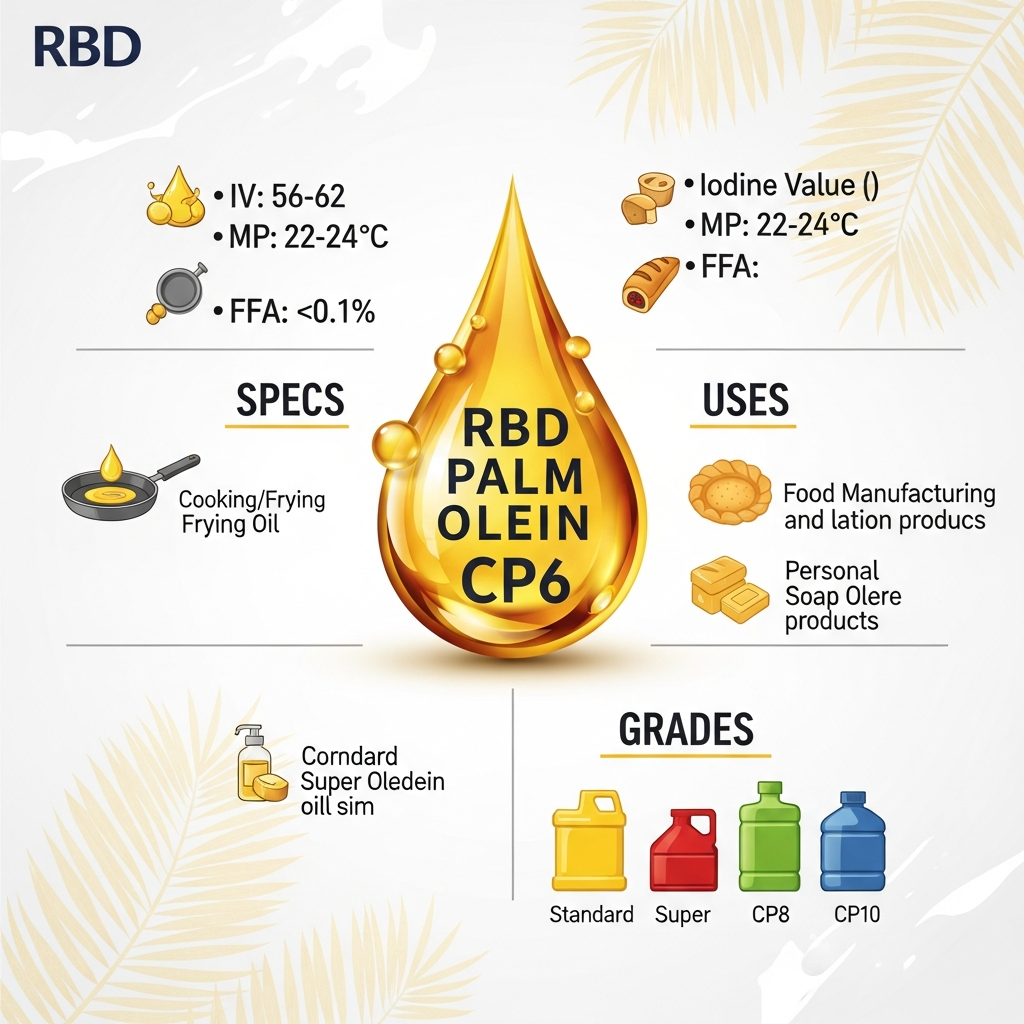
To ensure quality and consistency, RBD Palm Olein CP6 must meet specific international standards. These specifications determine its suitability for different applications, particularly in the food industry. While values can vary slightly by supplier, the typical specs are as follows:
| Parameter | Specification |
|---|---|
| Free Fatty Acids (FFA) (as % Palmitic) | 0.1% Max |
| Moisture & Impurities (M&I) | 0.1% Max |
| Iodine Value (Wijs) | 56 Min |
| Melting Point (°C) | 24 Max |
| Cloud Point (°C) | 6 Max |
| Color (5.25″ Lovibond Cell) | 3 Red Max |
Key Specs Explained
Understanding these parameters is crucial for any buyer or end-user of RBD Palm Olein CP6.
- Free Fatty Acids (FFA): This measures the extent to which the oil has broken down. A low FFA value (Max 0.1%) indicates high purity and good refining, which translates to a longer shelf life. As explained by the Journal of Food Science, lower FFA is a key indicator of quality in edible oils.
- Iodine Value (IV): The Iodine Value indicates the degree of unsaturation in the oil. A minimum IV of 56 for RBD Palm Olein CP6 ensures it remains in its liquid state and has the correct fatty acid profile.
- Cloud Point (CP): As mentioned, the 6°C max cloud point is the defining feature of CP6. This quality ensures the oil does not become cloudy or solidify easily when stored or transported in cooler climates.
Common Uses of RBD Palm Olein CP6 in Various Industries
The neutral taste, high stability, and cost-effectiveness of RBD Palm Olein CP6 make it a preferred choice across multiple sectors. Its applications are extensive and integral to the modern food supply chain.
The Food Industry’s Go-To Frying Oil
The primary use of RBD Palm Olein CP6 is as a cooking and frying oil. Its high smoke point (around 235°C or 455°F) makes it extremely stable at high temperatures, preventing it from breaking down and producing harmful compounds. This makes it perfect for:
- Deep-frying snacks like potato chips and french fries.
- Cooking instant noodles.
- Use in commercial kitchens and fast-food chains.
- An ingredient in margarine, shortening, and confectionery fats.

Beyond the Kitchen: Industrial Applications
While the food industry is the largest consumer, the unique properties of RBD Palm Olein CP6 also lend themselves to non-food applications. It serves as a raw material in the production of soaps, detergents, and other personal care products. Furthermore, it is a significant feedstock for producing biodiesel, a renewable energy source.
Understanding the Grades: RBD Palm Olein CP6 vs. CP8 vs. CP10
When sourcing palm olein, you will encounter different grades, primarily CP6, CP8, and CP10. The key difference lies in the cloud point. Understanding this distinction is crucial for choosing the right product for your needs and climate.
- RBD Palm Olein CP6: The premium grade with a maximum cloud point of 6°C. It offers the best cold stability and is suitable for all climates.
- RBD Palm Olein CP8: A standard grade with a maximum cloud point of 8°C. It is slightly less cold-stable but is a popular, cost-effective choice in temperate and tropical regions.
- RBD Palm Olein CP10: The most common grade, with a cloud point of 10°C. It is best suited for use in warm or tropical climates where the ambient temperature is unlikely to drop and cause the oil to cloud.
The Palm Oil Family: A Spectrum of Products
While RBD Palm Olein is a star product, it comes from a versatile plant that offers a wide range of valuable materials. Understanding the entire ecosystem of palm products reveals its true economic and industrial importance. The process starts with the fresh Oil Palm Fruit Bunch, from which the primary oil is extracted.
From the fruit’s nut, or kernel, we derive other essential products:
- Palm Kernel: The seed of the oil palm fruit, which is crushed to produce another valuable oil.
- Palm Kernel Oil: Different from palm oil, this oil is rich in lauric acid and is a key ingredient in confectionery, soaps, and cosmetics.
- Palm Kernel Expeller (PKE): The nutrient-rich solid residue left after oil extraction from the kernel, widely used as a high-quality animal feed.
- Palm Kernel Shell (PKS): The hard shell of the kernel serves as a clean, efficient, and sustainable biofuel, popular in industrial boilers and power plants.
Each of these by-products plays a crucial role in various global supply chains, from animal nutrition to renewable energy.
The Sustainability Question: Sourcing Ethical RBD Palm Olein CP6
No discussion about palm oil is complete without addressing sustainability. The industry has faced scrutiny for its environmental impact, including deforestation and habitat loss. In response, organizations have emerged to promote responsible production. The most prominent is the Roundtable on Sustainable Palm Oil (RSPO).
The RSPO sets stringent environmental and social criteria for palm oil production. When purchasing RBD Palm Olein CP6, looking for RSPO certification ensures you are sourcing a product that has been produced without causing undue harm to the environment or communities. Consumers and businesses are increasingly demanding this transparency.
Frequently Asked Questions (FAQ)
Q1: What does RBD stand for?
A: RBD stands for Refined, Bleached, and Deodorized. It’s the purification process that makes crude palm oil into the stable, edible oil used globally.
Q2: Is RBD Palm Olein CP6 healthy?
A: It is a source of Vitamin E and is trans-fat-free. However, like all fats, it should be consumed in moderation as part of a balanced diet. The World Health Organization (WHO) provides guidelines on dietary fat intake.
Q3: How should I store RBD Palm Olein CP6?
A: It should be stored in a cool, dry place away from direct sunlight and strong odors. This helps maintain its quality and extends its shelf life.
Makmur Amanah Sejahtera provides high-quality palm products such as Palm Kernel Expeller, Palm Kernel Shell, Crude Palm Oil, Palm Kernel Oil, etc. Kindly contact us at WhatsApp +6282140002198 or email us at admin@makmuramanah.co.id. In conclusion, RBD Palm Olein CP6 is a vital global commodity with specific characteristics that make it uniquely suited for a vast array of applications, especially in food production. Understanding its specifications, uses, and the different grades available is key for anyone in the industry. Most importantly, prioritizing sustainably sourced palm oil is essential for a responsible supply chain.Looking for High-Quality Palm Products?
 English
  Indonesian
  Chinese
  Arabic