
Table of Contents
- What is RBD Palm Olein? A Brief Overview
- The Core Difference: Understanding Cloud Point (CP)
- Deep Dive into RBD Palm Olein CP10 Specifications
- Exploring the Premium Choice: RBD Palm Olein CP8 (Super Olein)
- RBD Palm Olein CP8 vs CP10: A Head-to-Head Comparison
- Practical Applications: Which One Should You Choose?
- The Global Market and Sustainability of Palm Oil
- Frequently Asked Questions (FAQ)
Navigating the world of edible oils can be complex, especially when faced with technical terms like CP8 and CP10. If you’re in the food industry, understanding the RBD Palm Olein CP8 vs CP10 distinction is crucial for optimizing your products, managing costs, and ensuring quality. When sourcing oils derived from the Oil Palm Fruit Bunch, the journey begins with Crude Palm Oil. After extensive processing, this raw material is transformed into various refined products. This guide will demystify two of the most popular fractions, breaking down their specifications, ideal uses, and the key factors that set them apart.
What is RBD Palm Olein? A Brief Overview
Before diving into the CP8 vs CP10 debate, let’s establish a baseline. RBD Palm Olein is a processed form of palm oil. The “RBD” stands for Refined, Bleached, and Deodorized, a process that neutralizes the oil, resulting in a bland taste, light color, and stable shelf life suitable for various cooking applications.
The “Olein” part refers to the liquid fraction obtained from palm oil through a process called fractionation. This process separates the liquid (olein) from the solid fat (stearin). The process also yields valuable byproducts from the Palm Kernel, such as Palm Kernel Oil, Palm Kernel Expeller used in animal feed, and Palm Kernel Shell used as biofuel. This guide focuses specifically on the RBD Palm Olein CP8 vs CP10 comparison, two of the most common liquid fractions, making it a popular choice globally for frying, cooking, and as an ingredient in many food products.
The Core Difference in RBD Palm Olein CP8 vs CP10: Understanding Cloud Point (CP)
The most significant factor in the RBD Palm Olein CP8 vs CP10 comparison is the Cloud Point (CP). The Cloud Point is the temperature at which the oil begins to appear cloudy or hazy as it starts to solidify. This is a critical parameter for both aesthetics and performance.
An oil with a lower cloud point will remain liquid and clear at cooler temperatures. This is particularly important for products sold in temperate climates or for applications where clarity is a key selling point, such as bottled cooking oil or salad dressings.

Deep Dive into RBD Palm Olein CP10 Specifications
RBD Palm Olein CP10 is the most widely produced and used type of palm olein globally. It is the industry standard for general-purpose frying and cooking, prized for its affordability and high heat stability. It is produced through a single fractionation process.
- Cloud Point: Maximum 10° Celsius. It will start to cloud up if the ambient temperature drops to 10°C or below.
- Iodine Value (IV): Typically 56-58. This measures the degree of unsaturation, affecting its stability.
- Uses: Ideal for deep frying in restaurants, industrial food processing (noodles, snacks), and as a general cooking oil in warmer climates.
- Pros: Cost-effective, widely available, excellent for high-heat applications.
- Cons: Can solidify and appear cloudy in cooler weather, which may be unappealing to retail consumers.
- Cloud Point: Maximum 8° Celsius. It remains clear and liquid at lower temperatures compared to CP10.
- Iodine Value (IV): Typically higher, around 58-60, indicating a slightly higher proportion of unsaturated fats.
- Uses: Perfect for bottling as retail cooking oil, salad oils, and for use in mayonnaise. It is preferred by importers in Europe, North America, and other temperate regions.
- Pros: Superior cold stability, visually appealing clear appearance.
- Cons: More expensive due to the additional processing step, slightly lower availability than CP10.
Exploring the Premium Choice: RBD Palm Olein CP8 (Super Olein)
RBD Palm Olein CP8, often marketed as “Super Olein,” is a more premium product. It undergoes a double fractionation process, which more effectively removes solid fats. This results in an oil with a lower cloud point, making the RBD Palm Olein CP8 vs CP10 choice clear for colder climates.
RBD Palm Olein CP8 vs CP10: A Head-to-Head Comparison
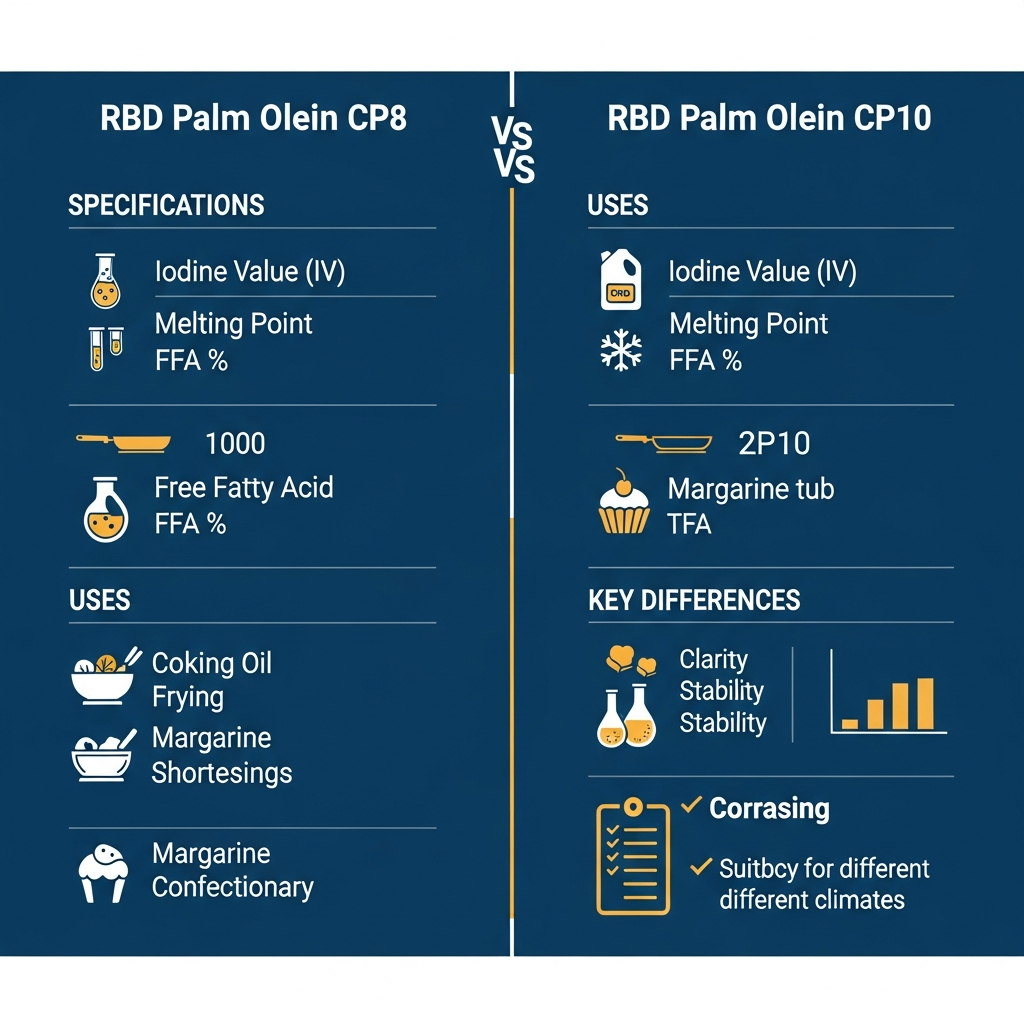
To make the decision easier, let’s directly compare the key attributes in the RBD Palm Olein CP8 vs CP10 showdown. This table highlights the primary differences that influence purchasing decisions for these vegetable oils.
| Feature | RBD Palm Olein CP10 | RBD Palm Olein CP8 (Super Olein) |
|---|---|---|
| Cloud Point | Max 10°C | Max 8°C |
| Fractionation | Single Stage | Double Stage |
| Appearance in Cool Temp. | Becomes cloudy faster | Stays clear and liquid longer |
| Primary Use Case | Industrial Frying, Warm Climates | Retail Bottling, Cool Climates |
| Price | Standard | Premium (Higher) |
| Iodine Value (Typical) | 56-58 | 58-60 |

Practical Applications in the RBD Palm Olein CP8 vs CP10 Debate: Which Should You Choose?
The choice between CP8 and CP10 ultimately depends on your specific needs, target market, and budget. Your choice in the RBD Palm Olein CP8 vs CP10 dilemma directly impacts product quality and consumer perception.
For Food Manufacturers and Restaurants:
If you’re producing snacks, instant noodles, or running a fast-food chain in a warm or tropical region, CP10 is the economical and practical workhorse. Its performance in deep fryers is excellent. However, if your product is a liquid-based one like salad dressing, CP8 is the superior choice to prevent solidification.
For Distributors and Importers:
Your geographical market is the biggest factor. For markets in Asia, Africa, and the Middle East, CP10 is the dominant standard. For markets in Europe, China, or North America, where temperatures frequently drop, resolving the RBD Palm Olein CP8 vs CP10 question in favor of CP8 is essential to ensure a visually appealing, liquid product on store shelves.
The Global Market and Sustainability of Palm Oil
No discussion about palm oil is complete without mentioning sustainability. As a buyer or consumer, it’s vital to source from suppliers committed to responsible practices. Organizations like the Roundtable on Sustainable Palm Oil (RSPO) are working to transform the industry.
Reputable bodies like the World Wildlife Fund (WWF) provide extensive information on the environmental impact of palm oil production. Furthermore, scientific research published in journals like the Journal of Food Chemistry continually explores ways to improve fractionation. For regional information, the Malaysian Palm Oil Council (MPOC) offers valuable market insights.
Frequently Asked Questions (FAQ) about RBD Palm Olein CP8 vs CP10
Is CP8 healthier than CP10?
Nutritionally, the difference between CP8 and CP10 is negligible. CP8 has a slightly higher iodine value, indicating a marginally higher content of unsaturated fats, but both are very similar. The choice in the RBD Palm Olein CP8 vs CP10 comparison is based on physical properties, not health benefits.
Can I substitute CP10 with CP8?
Yes, you can always substitute CP10 with CP8. CP8 will perform just as well, if not better, in any application. However, substituting CP8 with CP10 may cause issues with clouding if the product is stored or used in cool conditions. In the context of RBD Palm Olein CP8 vs CP10, substitution is therefore a one-way street.
Why is CP8 more expensive?
CP8’s higher price point comes from the second stage of fractionation it undergoes. This additional processing step requires more energy and results in a lower yield, increasing the overall production cost of Super Olein.
Your Trusted Palm Product Supplier
Looking for High-Quality Palm Products?
Makmur Amanah Sejahtera provides high-quality palm products such as Palm Kernel Expeller, Palm Kernel Shell, Crude Palm Oil, Palm Kernel Oil, etc. Kindly contact us at WhatsApp +6282140002198 or email us at admin@makmuramanah.co.id.
Conclusion: Making the Right Choice in the RBD Palm Olein CP8 vs CP10 Dilemma
The RBD Palm Olein CP8 vs CP10 decision boils down to a trade-off between cold-weather performance, price, and intended application. CP10 is the economical, all-purpose choice for high-heat cooking in warmer climates. CP8 (Super Olein) is the premium option, essential for maintaining a clear, liquid appearance in cooler temperatures, making it ideal for retail bottling and specific food formulations. By understanding these core differences, you can make an informed decision that aligns perfectly with your product and market needs.

 English
  Indonesian
  Chinese
  Arabic