
Table of Contents
- What Exactly is an Empty Palm Fruit Bunch (EFB)?
- The 7 Ultimate Uses and Benefits of the Empty Palm Fruit Bunch
- 1. A Powerful Source of Renewable Energy (Biomass)
- 2. The Foundation for Nutrient-Rich Compost and Fertilizer
- 3. An Eco-Friendly Pulp and Paper Alternative
- 4. Manufacturing Sustainable Fibreboard and Particleboard
- 5. Production of Advanced Biofuels and Bio-Products
- 6. A Natural Mulch for Healthy Plantations
- 7. An Innovative Material for Bioplastics and Composites
- Environmental and Economic Impact of Utilizing EFB
- Challenges in Processing the Empty Palm Fruit Bunch
- Your Trusted Partner for Palm Products
- Conclusion: From Waste to Wonder
The global palm oil industry is a titan of modern agriculture, producing valuable commodities like Crude Palm Oil, but it also generates an enormous amount of biomass waste. For decades, the focus was solely on the oil, leaving behind mountains of residue. But what if that “waste” was actually a valuable resource? This guide introduces the Oil Palm Fruit Bunch, also known as the Empty Palm Fruit Bunch (EFB), a remarkable byproduct that is transforming sustainable practices across multiple industries.
Once considered a disposal problem, the Empty Palm Fruit Bunch is now recognized for its incredible potential. From generating clean energy to enriching soil and creating eco-friendly materials, EFB is a cornerstone of the circular economy. Let’s dive into what this amazing byproduct is and how it’s making a positive impact.

What Exactly is an Empty Palm Fruit Bunch (EFB)?
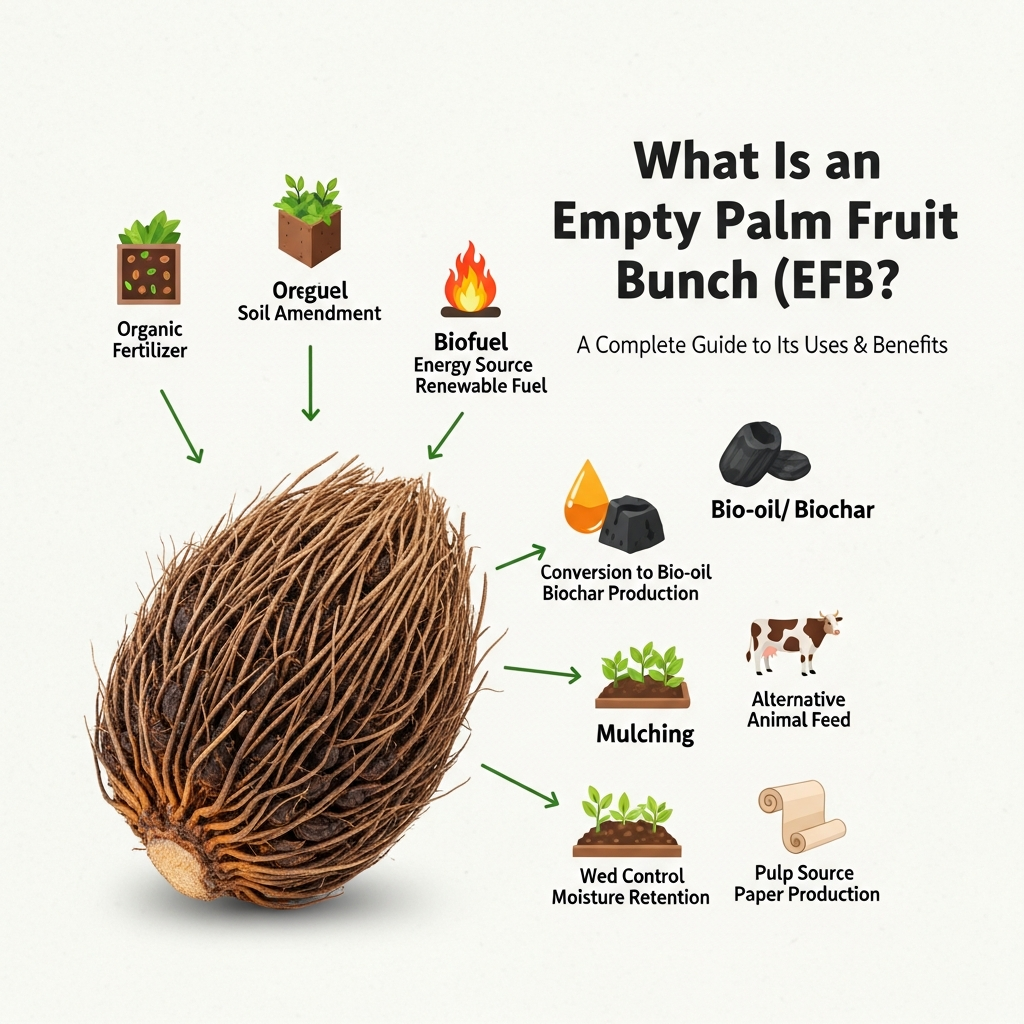
An Empty Palm Fruit Bunch is precisely what its name suggests: the fibrous bunch that remains after the fresh palm fruits have been removed for oil extraction. At the mill, fresh fruit bunches are steam-sterilized and then put through a threshing machine. This process separates the small fruits, which contain the valuable Palm Kernel from which Palm Kernel Oil is derived, from the main stalk. What’s left is the EFB.
This lignocellulosic material is composed of long, tough fibers, water, and residual oil. Historically, these bulky bunches were either burned in the open—releasing significant carbon emissions—or left to rot in landfills. Today, however, we understand that the high biomass content of every single Empty Palm Fruit Bunch makes it a powerhouse for sustainable applications.
The 7 Ultimate Uses and Benefits of the Empty Palm Fruit Bunch
The versatility of EFB is astounding. Its fibrous structure and organic composition make it suitable for a wide range of processes that turn agricultural residue into high-value products. Here are seven of the most significant uses for the Empty Palm Fruit Bunch.
1. A Powerful Source of Renewable Energy (Biomass)
One of the primary uses for the Empty Palm Fruit Bunch is as a solid biofuel. With its high energy content, it can be burned directly in boilers at palm oil mills to generate steam and electricity, creating a self-sustaining energy loop. This reduces the mill’s reliance on fossil fuels and lowers its operational carbon footprint.
Furthermore, processed EFB can be turned into pellets or briquettes, creating a dense, transportable fuel source. This places the Empty Palm Fruit Bunch alongside other valuable biomass fuels like the Palm Kernel Shell and Palm Kernel Expeller as a key player in renewable energy. As a renewable energy source, this application is critical for a cleaner energy future. For more on biomass energy, you can explore research on platforms like ScienceDirect.
2. The Foundation for Nutrient-Rich Compost and Fertilizer
When composted, EFB transforms into a dark, nutrient-rich organic fertilizer. The process breaks down the tough fibers, creating a material that significantly improves soil health. This compost enhances soil structure, increases water retention capacity, and provides essential nutrients like potassium back to the land.
Using compost from an Empty Palm Fruit Bunch reduces the need for chemical fertilizers, which can have negative environmental consequences. It is a perfect example of closing the nutrient loop in agriculture, where byproducts from a crop are used to nourish the next generation of that same crop. The Food and Agriculture Organization (FAO) offers extensive resources on the importance of healthy soil.
3. An Eco-Friendly Pulp and Paper Alternative
The long, strong fibers within the Empty Palm Fruit Bunch are an excellent raw material for producing pulp and paper. This offers a sustainable alternative to traditional wood-based paper, helping to reduce deforestation. The pulp produced from EFB is suitable for various paper products, from writing paper to packaging materials.
By utilizing an agricultural byproduct that is readily available in massive quantities, the paper industry can diversify its fiber sources and adopt more environmentally friendly practices. This innovation turns a potential waste stream into a valuable commodity.
4. Manufacturing Sustainable Fibreboard and Particleboard
In the construction and furniture industries, there is a growing demand for sustainable materials. The fibers from the Empty Palm Fruit Bunch can be processed and bonded together to create medium-density fibreboard (MDF), particleboard, and other composite panels. These boards are strong, durable, and serve as an excellent substitute for wood.
This application not only prevents waste but also provides a renewable resource for building materials, helping to preserve forests. Organizations like the Forest Stewardship Council (FSC) advocate for the use of sustainable and alternative materials in wood-based products.
5. Production of Advanced Biofuels and Bio-Products
Beyond direct combustion, the complex carbohydrates (cellulose and hemicellulose) in an Empty Palm Fruit Bunch can be broken down to produce advanced biofuels like bioethanol. This process, known as enzymatic hydrolysis and fermentation, converts the fibrous material into a liquid fuel that can be blended with gasoline.
Additionally, EFB is a feedstock for biorefineries, which can produce a range of valuable biochemicals and biopolymers. This opens the door to creating green chemicals and materials, further reducing our dependence on petrochemicals. For an overview of this technology, read about lignocellulosic biomass on the U.S. Department of Energy website.
6. A Natural Mulch for Healthy Plantations
In its raw or shredded form, the Empty Palm Fruit Bunch makes an excellent mulching material. Spreading it around the base of palm trees in the plantation helps conserve soil moisture by reducing evaporation, suppresses weed growth, and prevents soil erosion. As the EFB slowly decomposes, it releases organic matter and nutrients directly into the soil.
This is one of the simplest yet most effective uses, directly contributing to the health and productivity of the plantation. It’s a key component of sustainable farming practices, ensuring that nothing goes to waste and the soil remains fertile for years to come.
7. An Innovative Material for Bioplastics and Composites
Researchers and innovators are constantly finding new uses for EFB fibers. One of the most exciting fields is their use as a reinforcing agent in bioplastics and polymer composites. By incorporating these natural fibers, manufacturers can create materials that are stronger, lighter, and more biodegradable than traditional plastics.
These composites are being explored for use in automotive parts, packaging, and consumer goods. This application of the Empty Palm Fruit Bunch showcases its potential to contribute to the next generation of sustainable materials.
Environmental and Economic Impact of Utilizing EFB
The shift from viewing EFB as waste to a resource has profound benefits. Environmentally, it reduces greenhouse gas emissions from burning or decomposition, decreases reliance on fossil fuels and virgin materials like wood, and promotes soil health. It is a perfect illustration of a circular economy in action where the full potential of the Empty Palm Fruit Bunch is realized.
Economically, utilizing the Empty Palm Fruit Bunch creates new revenue streams for palm oil producers. It fosters innovation and job creation in downstream industries like energy production, composting, and manufacturing. This adds value to the entire palm oil supply chain and supports local economies.
Challenges in Processing the Empty Palm Fruit Bunch
Despite its potential, working with EFB is not without challenges. Its high moisture content (around 60-70%) makes transportation and processing difficult and costly. It must be dewatered or dried for many applications, which requires energy. Furthermore, the logistics of collecting, transporting, and processing massive volumes of this bulky material require significant infrastructure investment.
However, ongoing technological advancements are making EFB processing more efficient and cost-effective, steadily overcoming these hurdles and unlocking its full potential.
Your Trusted Partner for Palm Products
Looking for High-Quality Palm Products?
Makmur Amanah Sejahtera provides high-quality palm products such as Palm Kernel Expeller, Palm Kernel Shell, Crude Palm Oil, Palm Kernel Oil, etc. Kindly contact us at WhatsApp +6282140002198 or email us at admin@makmuramanah.co.id.
Conclusion: From Waste to Wonder
The Empty Palm Fruit Bunch is a powerful symbol of the shift towards a more sustainable and resourceful future. What was once an environmental liability for the palm oil industry has become a valuable feedstock for clean energy, regenerative agriculture, and green materials. By harnessing the potential of the EFB, we can reduce waste, combat climate change, and build a truly circular economy.
The journey of the Empty Palm Fruit Bunch from a discarded stalk to a cornerstone of sustainability is a testament to innovation and a reminder that in nature, there is no such thing as waste.

 English
  Indonesian
  Chinese
  Arabic