
Table of Contents
- What is RBD Palm Olein? A Quick Primer
- Understanding the “CP” Rating: What Does Cloud Point Mean?
- A Deep Dive into RBD Palm Olein CP8
- RBD Palm Olein CP8 vs. CP6 (Super Olein): The Key Distinctions
- RBD Palm Olein CP8 vs. CP10: A Comparative Look
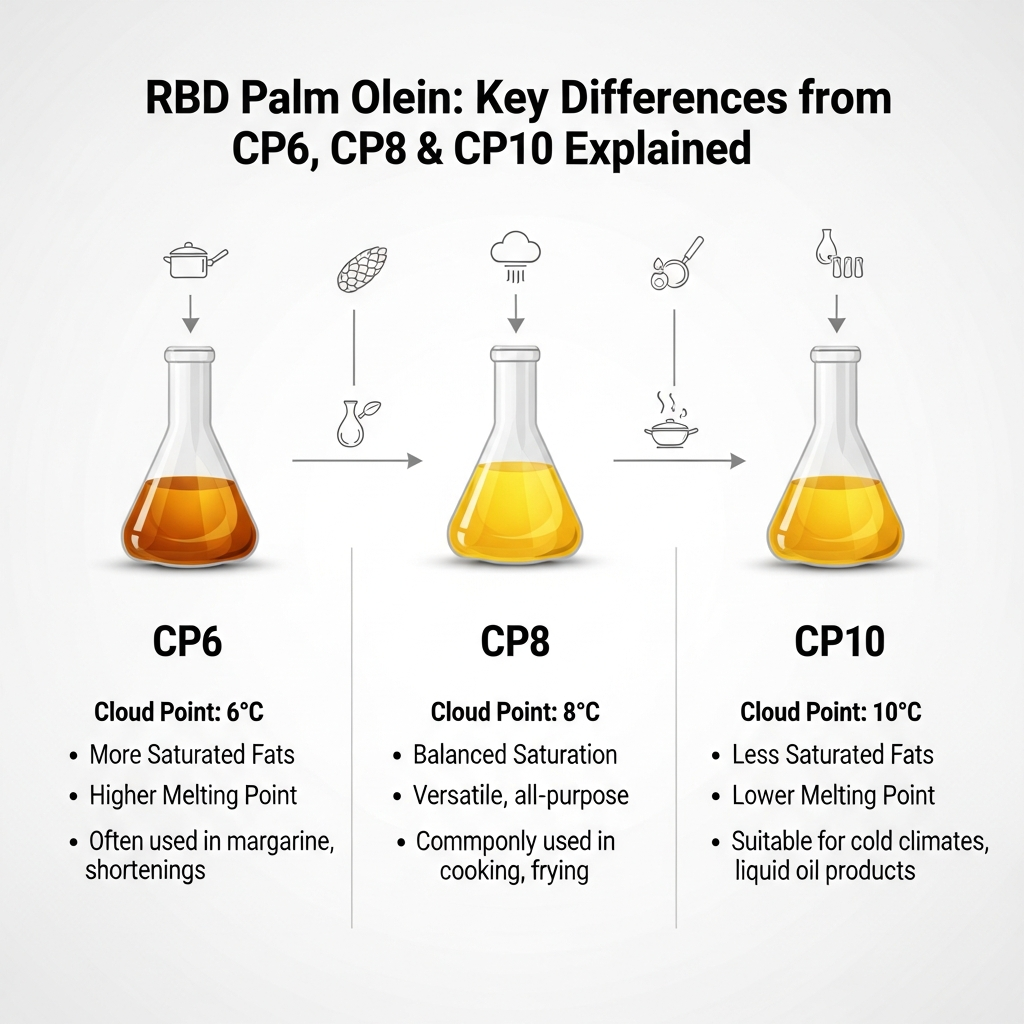
- At-a-Glance Comparison: CP6 vs. CP8 vs. CP10
- Practical Applications: Choosing the Right Olein for Your Needs
- Understanding the Full Value Chain
- Conclusion: Why RBD Palm Olein CP8 is the Balanced Choice
- Your Source for High-Quality Palm Products
Navigating the world of edible oils can be complex, with various grades and specifications to consider. Among the most versatile and widely used is palm olein, but understanding the differences between its grades is crucial for buyers and manufacturers. This guide focuses on RBD Palm Olein CP8, explaining how this popular variant stands out from its siblings, CP6 and CP10, and why it might be the perfect, balanced choice for your needs.
What is RBD Palm Olein? A Quick Primer
First, let’s break down the name. “RBD” stands for “Refined, Bleached, and Deodorized,” a crucial purification process applied to Crude Palm Oil (CPO) to create a stable, neutral-flavored, and clear cooking oil. This raw oil is extracted from the flesh of the Oil Palm Fruit Bunch.
“Palm Olein” is the liquid fraction obtained from this processed palm oil through fractionation. This process cools the oil, allowing the solid fat (stearin) to be separated from the liquid fat (olein). It’s important not to confuse it with Palm Kernel Oil, which is extracted from the fruit’s seed, or Palm Kernel. The resulting olein is a staple for frying and cooking globally. For more detail on palm oil processing, the Malaysian Palm Oil Council (MPOC) offers extensive resources.

Understanding the “CP” Rating: What Does Cloud Point Mean?
The “CP” number is the most critical factor distinguishing these oils. CP stands for “Cloud Point,” which is the temperature at which the oil begins to look cloudy or hazy. This happens because some of the fat molecules start to solidify and crystallize as the temperature drops.
A lower Cloud Point is generally considered a premium attribute, especially in temperate or cooler climates. It means the oil will remain clear and liquid at lower temperatures, which is essential for products like salad dressings or for ensuring a long shelf life without solidification. The Cloud Point is a key parameter defined in international standards, such as those by the FAO/WHO Codex Alimentarius.
A Deep Dive into RBD Palm Olein CP8
RBD Palm Olein CP8 has a Cloud Point of 8°C (max). This specification makes it a highly versatile and sought-after product. It offers a significant improvement over the standard CP10, providing better cold stability without the higher cost associated with the more refined CP6.
This balance makes RBD Palm Olein CP8 an excellent all-purpose cooking and frying oil. It performs well in a wide range of temperatures, making it suitable for markets in both warm and temperate regions. Its properties ensure that food products maintain a consistent quality and appearance.
RBD Palm Olein CP8 vs. CP6 (Super Olein): The Key Distinctions
CP6, often called “Super Olein,” has a maximum Cloud Point of 6°C. It represents a more premium grade of palm olein.
- Cold Stability: CP6 remains clearer at lower temperatures than CP8. This makes it ideal for bottled liquid cooking oil and salad dressings that need to stay transparent even when refrigerated.
- Processing & Cost: Achieving a lower Cloud Point requires a more intensive fractionation process, which makes CP6 more expensive to produce than RBD Palm Olein CP8.
- Iodine Value (IV): CP6 typically has a higher Iodine Value (≥60) compared to CP8 (≥58). A higher IV indicates a greater degree of unsaturation, contributing to its lower melting point. You can find detailed technical explanations on oil properties from sources like the American Oil Chemists’ Society (AOCS).
RBD Palm Olein CP8 vs. CP10: A Comparative Look
CP10 is the most common and standard grade of palm olein. Its Cloud Point is 10°C (max).
- Performance in Cool Weather: CP10 is prone to clouding and solidifying in cooler weather or air-conditioned environments, which can be undesirable for consumers. RBD Palm Olein CP8 offers a distinct advantage here.
- Cost-Effectiveness: CP10 is the most economical of the three because it requires the least amount of processing. It is the go-to choice for industrial frying in warm climates where cold stability is not a concern.
- Versatility: While CP10 is excellent for general frying, the superior cold stability of RBD Palm Olein CP8 makes it a more versatile option for a broader range of applications and international markets.
At-a-Glance Comparison: CP6 vs. CP8 vs. CP10
To simplify the differences, here is a comparative table of these three popular RBD Palm Olein grades.
| Feature | RBD Palm Olein CP6 (Super Olein) | RBD Palm Olein CP8 | RBD Palm Olein CP10 (Standard) |
|---|---|---|---|
| Max Cloud Point | 6°C | 8°C | 10°C |
| Min Iodine Value (IV) | 60 | 58 | 56 |
| Cold Stability | Highest | High | Standard |
| Relative Cost | Highest | Moderate | Lowest |
| Common Use Cases | Premium liquid cooking oil, salad dressing, mayonnaise | All-purpose cooking/frying oil, shortenings, temperate climates | General frying, industrial food production, warm climates |
Practical Applications: Choosing the Right Olein for Your Needs

The choice between these oils ultimately depends on the specific application, target market, and climate. For a manufacturer, understanding these nuances is key to producing a high-quality product. The fractionation process is scientifically detailed in journals, with articles available on platforms like ScienceDirect for those wanting a deeper technical dive.
For businesses looking for a reliable and versatile option, RBD Palm Olein CP8 often hits the sweet spot. It provides enhanced performance over CP10 without the premium price of CP6. This makes it an ideal choice for food service, retail cooking oils, and as an ingredient in margarines and confectioneries.
Understanding the Full Value Chain
While RBD Palm Olein is a primary product, the processing of palm fruit yields other valuable materials. The crushed kernels, after oil extraction, become Palm Kernel Expeller, a protein-rich ingredient for animal feed. Additionally, the hard seed casings are used as Palm Kernel Shell, a clean and efficient biofuel. Understanding these co-products highlights the sustainability and zero-waste potential of the palm oil industry.
Conclusion: Why RBD Palm Olein CP8 is the Balanced Choice
In summary, the primary difference between RBD Palm Olein CP6, CP8, and CP10 is their Cloud Point. This single metric influences their cold stability, price, and ideal applications.
While CP10 is the economical workhorse for warm climates and CP6 is the premium choice for cold-weather applications, RBD Palm Olein CP8 emerges as the outstanding middle-ground. It provides excellent value by offering superior cold stability to the standard grade, ensuring product quality across a wider range of conditions, making it a smart, flexible, and efficient choice for producers and consumers worldwide.
Your Source for High-Quality Palm Products
Looking for High-Quality Palm Products?
Makmur Amanah Sejahtera provides high-quality palm products such as Palm Kernel Expeller, Palm Kernel Shell, Crude Palm Oil, Palm Kernel Oil, etc. Kindly contact us at WhatsApp +6282140002198 or email us at admin@makmuramanah.co.id.
 English
  Indonesian
  Chinese
  Arabic