
Contents
- 1. What Exactly is RBD Palm Olein?
- 2. Understanding Cloud Point: What Does CP8 Mean for RBD Palm Olein CP8?
- 3. Complete Specifications of RBD Palm Olein CP8
- 4. The Critical Difference: RBD Palm Olein CP8 vs. CP10
- 5. Top Industrial and Culinary Uses of RBD Palm Olein CP8
- 6. Health and Nutritional Profile
- 7. Conclusion: Why Choose RBD Palm Olein CP8?
Welcome to your ultimate guide on RBD Palm Olein CP8, one of the world’s most versatile and widely used edible oils. Whether you’re in the food manufacturing industry, a culinary professional, or simply curious, this article breaks down everything you need to know. We’ll dive deep into its specifications, primary uses, and the crucial differences between CP8 and its close relative, CP10.
Derived from the versatile Oil Palm Fruit Bunch, palm oil products are cornerstones of the global food supply chain, and understanding the specific grades is essential for choosing the right product for your needs. This guide is designed to provide clear, actionable information.
1. What Exactly is RBD Palm Olein?
Let’s start by breaking down the name. “RBD” stands for Refined, Bleached, and Deodorized. This is a multi-stage process that Crude Palm Oil undergoes to remove impurities, color pigments, and odors, resulting in a stable, bland, and light-colored oil. “Olein” refers to the liquid fraction obtained from the fractionation of palm oil. The final product, RBD Palm Olein CP8, is a clear, high-quality liquid oil at room temperature.

2. Understanding Cloud Point: What Does CP8 Mean for RBD Palm Olein CP8?
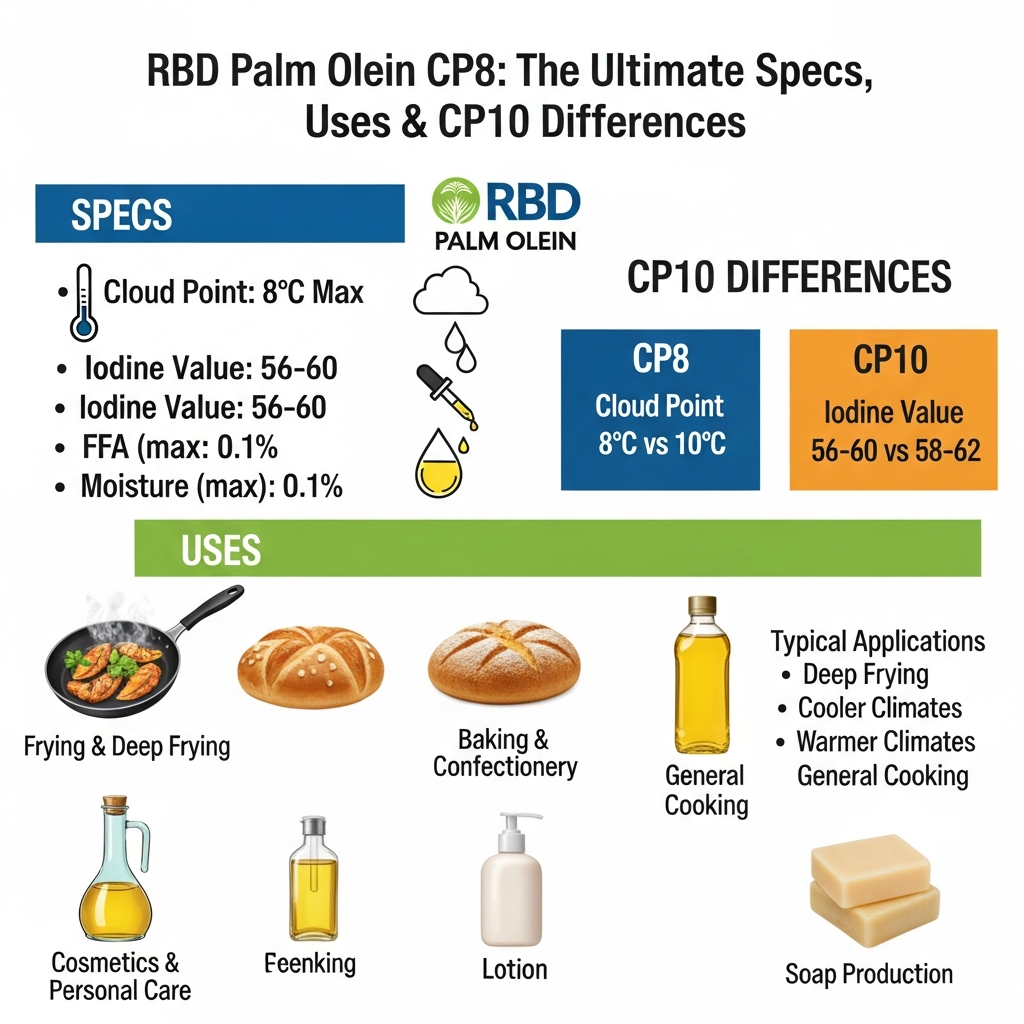
The “CP” in the name stands for Cloud Point, which is the most critical specification for this product. The Cloud Point is the temperature at which the oil begins to turn cloudy or solidify as it cools. Therefore, “CP8” signifies that the maximum cloud point for this grade of oil is 8° Celsius.
This low cloud point is a significant advantage. It ensures that the RBD Palm Olein CP8 remains liquid and clear in cooler climates or under refrigerated conditions where other oils might solidify. This property is vital for producing food products that maintain a consistent texture and appearance.
3. Complete Specifications of RBD Palm Olein CP8
To be classified as high-quality RBD Palm Olein CP8, the product must meet stringent international standards. These specifications guarantee its performance, shelf life, and safety for consumption. Below is a detailed table of the typical technical specifications.
| Parameter | Specification |
|---|---|
| Free Fatty Acid (FFA) as Palmitic | 0.1% Max |
| Moisture & Impurities (M&I) | 0.1% Max |
| Iodine Value (Wijs) | 56 Min |
| Cloud Point (°C) | 8°C Max |
| Color (5.25″ Lovibond Cell) | 3 Red Max |
| Melting Point (°C) | 24°C Max |
Each of these parameters is crucial for guaranteeing the quality of RBD Palm Olein CP8. For instance, a low Free Fatty Acid (FFA) value indicates a well-refined oil with a longer shelf life, while the Iodine Value points to the degree of unsaturation. For official standards, you can refer to resources like the Codex Alimentarius Commission, which sets international food standards.
4. The Critical Difference: RBD Palm Olein CP8 vs. CP10
The primary and most significant difference between RBD Palm Olein CP8 and CP10 is the cloud point. While CP8 has a maximum cloud point of 8°C, CP10 has a maximum cloud point of 10°C. This two-degree difference has major practical implications.
RBD Palm Olein CP8 is considered a premium grade because it undergoes a more intensive fractionation process to achieve its lower cloud point. This makes it more suitable for temperate or cooler countries and for applications requiring refrigeration, as it is less likely to become cloudy and thick. CP10 is more common and slightly less expensive, making it a staple in tropical regions where ambient temperatures are consistently high.
4.1. At a Glance: CP8 vs. CP10
| Feature | RBD Palm Olein CP8 | RBD Palm Olein CP10 |
|---|---|---|
| Cloud Point | 8°C Maximum | 10°C Maximum |
| Cold Stability | Higher | Standard |
| Ideal Climate | Temperate / Cooler Regions | Tropical / Hot Regions |
| Processing | More rigorous fractionation | Standard fractionation |
| Cost | Slightly higher | Standard |
The choice between them depends entirely on the end-use and the environmental conditions of the target market. Research into palm oil fractionation, like that found on platforms such as ScienceDirect, highlights the technical processes behind creating these distinct grades.

5. Top Industrial and Culinary Uses of RBD Palm Olein CP8
The unique properties of RBD Palm Olein CP8 make it a preferred choice in various sectors. Its excellent stability, neutral taste, and resistance to oxidation are highly valued.
5.1. Premium Frying Oil
With a high smoke point (around 235°C or 455°F), RBD Palm Olein CP8 is perfect for deep frying. It imparts a crispy texture to foods without leaving an oily taste. It is widely used in the production of instant noodles, potato chips, doughnuts, and french fries. Its oxidative stability means it can be used for longer than many other oils, offering economic benefits to restaurants and food businesses. For more on the science of frying, industry resources like FoodNavigator offer deep insights.
5.2. Food Manufacturing and Processing
Beyond frying, this versatile oil is a key ingredient in:
- Margarine and Shortening: Its consistency contributes to the perfect texture.
- Confectionery: Used in chocolate fillings, creams, and coatings for a smooth mouthfeel.
- Bakery Products: Provides moisture and texture to cakes and biscuits.
- Infant Formula: As a source of palmitic acid.
The versatility of palm derivatives is extensive. For instance, while olein is used for liquid applications, other products like Palm Kernel Oil offer different properties beneficial for solid fats, and the solid Palm Kernel itself is a valuable commodity.
5.3. Non-Food Applications
While primarily an edible oil, derivatives of RBD Palm Olein CP8 are also used in the manufacturing of soaps, detergents, and cosmetics due to their fatty acid composition.
[Suggested Video: Embed a short video from a certified sustainable palm oil producer showing the refining process from palm fruit to bottled olein.]
6. Health and Nutritional Profile
The nutritional profile of RBD Palm Olein CP8 makes it a significant source of energy. It is rich in Vitamin E, particularly tocotrienols, which are potent antioxidants. However, like all fats, it should be consumed in moderation as it contains a balanced ratio of saturated and unsaturated fatty acids. For comprehensive dietary advice, it is always best to consult guidelines from health organizations like the World Health Organization (WHO), which provides recommendations on fat consumption.
7. Conclusion: Why Choose RBD Palm Olein CP8?
In summary, RBD Palm Olein CP8 stands out as a premium, versatile edible oil defined by its excellent cold stability. Its maximum cloud point of 8°C makes it the superior choice for applications in cooler climates and for products requiring consistency across various temperatures. From industrial frying to confectionery, its stability, neutral flavor, and economic value make it an indispensable ingredient in the global food industry.
By understanding its specifications and how it differs from CP10, you can make an informed decision to select the right oil that meets your quality and performance standards.
Beyond the oil itself, the palm industry yields numerous valuable co-products. Materials like Palm Kernel Expeller serve as nutritious animal feed, while Palm Kernel Shell is a sought-after biofuel, highlighting the zero-waste potential of sustainable palm oil processing.
Looking for High-Quality Palm Products?
Makmur Amanah Sejahtera provides high-quality palm products such as Palm Kernel Expeller, Palm Kernel Shell, Crude Palm Oil, Palm Kernel Oil, etc. Kindly contact us at WhatsApp +6282140002198 or email us at admin@makmuramanah.co.id.
 English
  Indonesian
  Chinese
  Arabic