
Table of Contents
- What Exactly Are Empty Palm Fruit Bunches (EFB)?
- Why Repurpose Empty Palm Fruit Bunches? The Environmental and Economic Case
- 9+ Profitable Uses for Empty Palm Fruit Bunches
- Challenges and Future Outlook for Empty Palm Fruit Bunches
- Conclusion: From Waste to Wealth
In the vast world of agriculture, what if one of the largest waste products could be transformed into a valuable resource? The palm oil industry, a global giant, produces millions of tons of biomass waste annually. Among the most significant is a material known as Empty Palm Fruit Bunches (EFB), a resource brimming with untapped potential.
Historically viewed as a disposal problem, these fibrous bunches are now at the center of a green revolution. They represent a golden opportunity to create sustainable products, generate renewable energy, and build a circular economy. This guide explores the most profitable uses and applications for this remarkable biomass.
What Exactly Are Empty Palm Fruit Bunches (EFB)?
The journey starts with the Oil Palm Fruit Bunch, a large cluster of oil-rich fruits. Empty Palm Fruit Bunches are the fibrous residue left over after these fresh fruitlets have been stripped from the bunch in a palm oil mill. Imagine a large, woody, and fibrous structure that once held hundreds of small fruits. Once the fruits are removed for extracting Crude Palm Oil and Palm Kernel Oil from the valuable Palm Kernel, this ’empty’ bunch remains.
Primarily composed of cellulose, hemicellulose, and lignin, EFB is a classic example of lignocellulosic biomass. Every ton of crude palm oil produced generates approximately one ton of these empty bunches. Given the scale of global palm oil production, this amounts to a massive, consistent, and readily available raw material stream.
[Image: A large pile of raw Empty Palm Fruit Bunches at a palm oil mill, showcasing their fibrous texture and scale. Alt text: A large pile of raw Empty Palm Fruit Bunches (EFB) waiting for processing at a sustainable facility.]
Why Repurpose Empty Palm Fruit Bunches? The Environmental and Economic Case
The motivation to find uses for Empty Palm Fruit Bunches goes beyond simple waste management. Disposing of them in landfills is unsustainable, and the traditional practice of open burning releases significant greenhouse gases and pollutants into the atmosphere.
Repurposing EFB offers a powerful two-fold benefit. Environmentally, it avoids pollution, reduces reliance on fossil fuels, and promotes a circular economy. Economically, it transforms a costly waste problem into a new revenue stream, creating value-added products and generating green jobs in processing and logistics.
9+ Profitable Uses for Empty Palm Fruit Bunches
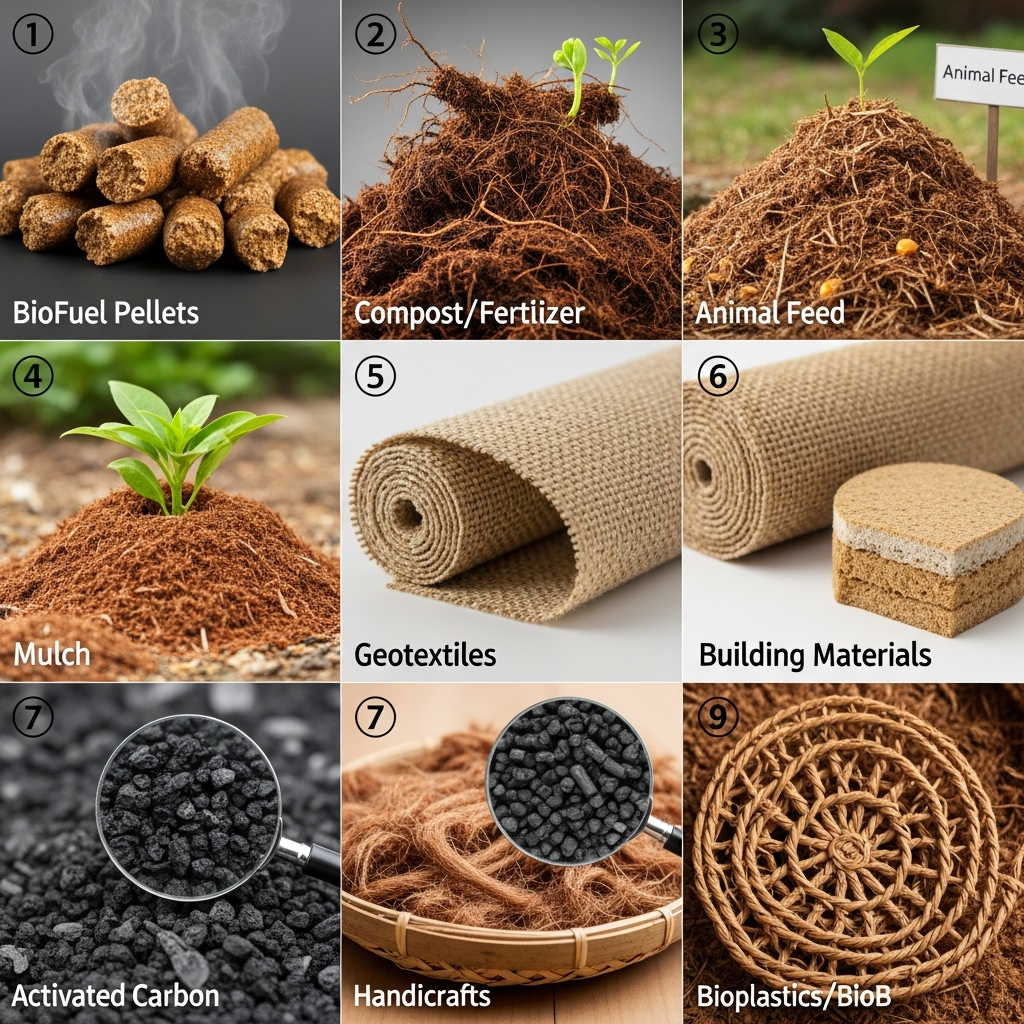
Technological advancements have unlocked numerous ways to convert EFB from a liability into a profitable asset. Here are nine of the most promising applications.
1. Biofuel and Renewable Energy
One of the most valuable applications for Empty Palm Fruit Bunches is in energy generation. Due to their high calorific value when dried, they can be processed into various forms of solid biofuel, including:
- Pellets & Briquettes: Compressing shredded EFB creates dense pellets or briquettes that are easier to transport and burn more efficiently than raw biomass.
- Direct Combustion: EFB can be used directly as fuel in industrial boilers and biomass power plants to generate electricity and heat, often replacing coal or natural gas.
This application directly contributes to renewable energy targets and reduces carbon emissions. It positions EFB alongside other valuable biomass fuels from the palm industry, such as the dense and efficient Palm Kernel Shell. For more technical details, research from journals like ScienceDirect highlights its potential as a sustainable fuel source.
2. Composting and Soil Conditioning
Raw Empty Palm Fruit Bunches are incredibly rich in organic matter and potassium (K). Through composting, this biomass decomposes into a nutrient-dense, dark organic fertilizer. This compost is an excellent soil conditioner that improves soil structure, water retention, and fertility.
Applying EFB compost back to palm plantations or other agricultural lands reduces the need for chemical fertilizers, closes the nutrient loop, and enhances crop yields. This practice is a cornerstone of sustainable agriculture.
3. Pulp and Paper Production
The high fiber content in EFB makes it a viable alternative to wood for producing pulp and paper. As global demand for paper products continues to rise, using non-wood sources like Empty Palm Fruit Bunches helps alleviate pressure on natural forests.
While the process requires specialized technology to handle the unique properties of palm fibers, it has been successfully implemented to produce various paper products, from writing paper to packaging materials. The Food and Agriculture Organization (FAO) of the United Nations has extensively documented the importance of non-wood fibers.
4. Production of Bio-based Chemicals
The sugars locked within the cellulose and hemicellulose of EFB can be extracted and fermented to produce valuable bio-based chemicals. This process, often part of a biorefinery concept, can yield products like bioethanol, xylitol, and lactic acid.
While this is a more technologically advanced application, it represents a high-value frontier for biomass utilization, creating sustainable alternatives to petroleum-based chemicals and fuels.
5. Animal Feed
Though naturally tough and fibrous, Empty Palm Fruit Bunches can be processed into a palatable and nutritious feed for ruminant animals like cattle and goats. The process typically involves shredding, steam treatment, and fermentation to break down the tough fibers and improve digestibility.
This application provides a low-cost, sustainable feed source, often used to supplement other palm-based feed ingredients like the protein-rich Palm Kernel Expeller, helping to address fodder shortages and reduce the overall cost of livestock farming.
6. Medium for Mushroom Cultivation
The sterile, fibrous nature of processed EFB makes it an ideal substrate for growing various types of edible mushrooms, particularly oyster mushrooms. The bunches provide the necessary nutrients and physical structure for the mushroom mycelium to colonize and fruit.
Mushroom cultivation on EFB is a profitable venture that can be done at both small and large scales, turning agricultural waste into a high-value food product quickly.
[Image: A close-up of oyster mushrooms growing from a substrate block made of processed Empty Palm Fruit Bunches. Alt text: Oyster mushrooms flourishing on a substrate made from Empty Palm Fruit Bunches, a sustainable cultivation medium.]
7. Fiberboard and Composite Materials
The strong fibers from Empty Palm Fruit Bunches can be used to manufacture medium-density fiberboard (MDF), particleboard, and other composite panels. These engineered wood products have wide applications in the furniture, construction, and automotive industries.
Using EFB fiber reduces the demand for virgin wood and creates building materials that are both eco-friendly and durable.
8. Mulching in Agriculture
In its simplest application, shredded EFB makes for excellent agricultural mulch. Spread around the base of trees and crops, it helps to:
- Suppress weed growth.
- Conserve soil moisture by reducing evaporation.
- Regulate soil temperature.
- Slowly release nutrients as it decomposes.
This is a low-cost, high-impact use that directly improves farm productivity. The benefits of mulching are well-documented by horticultural authorities like the Royal Horticultural Society (RHS).
9. Biochar Production
Through a process called pyrolysis (heating in the absence of oxygen), Empty Palm Fruit Bunches can be converted into biochar. Biochar is a stable, carbon-rich form of charcoal that offers incredible benefits for both soil health and climate change mitigation.
When added to soil, it improves water and nutrient retention, enhances microbial activity, and, most importantly, sequesters carbon for hundreds of years. This process effectively locks away carbon that would have otherwise been released into the atmosphere. The International Biochar Initiative provides extensive information on its benefits.
[Video: A short, animated video showing the journey of Empty Palm Fruit Bunches from the mill to being processed into biochar through pyrolysis, highlighting the carbon sequestration benefit.]
Challenges and Future Outlook for Empty Palm Fruit Bunches
Despite their immense potential, challenges in utilizing Empty Palm Fruit Bunches remain. These include high initial moisture content (which makes transportation costly), logistical hurdles in collecting and centralizing the biomass, and the capital investment required for processing facilities.
However, with rising demand for sustainable solutions and ongoing technological innovation, the future is bright. Research is continuously improving the efficiency of conversion technologies, making the economics of EFB utilization increasingly favorable. The shift towards a global circular economy positions EFB as a key resource for a sustainable future.
Conclusion: From Waste to Wealth
Empty Palm Fruit Bunches are a powerful testament to the principle that “waste is just a resource in the wrong place.” From powering homes and enriching soils to building furniture and sequestering carbon, their applications are as diverse as they are profitable.
By harnessing the potential of EFB, the palm oil industry can move towards a more sustainable, zero-waste model. This not only mitigates its environmental footprint but also unlocks significant economic value, proving that profitability and sustainability can, and should, go hand in hand.
Makmur Amanah Sejahtera provides high-quality palm products such as Palm Kernel Expeller, Palm Kernel Shell, Crude Palm Oil, Palm Kernel Oil, etc. Kindly contact us at WhatsApp +6282140002198 or email us at admin@makmuramanah.co.id.Looking for High-Quality Palm Products?
 English
  Indonesian
  Chinese
  Arabic