
- What is RBD Palm Olein and Why Does CP Matter?
- Specifications Showdown: A Technical Look at RBD Palm Olein CP8 vs CP10
- Key Differences Explained: Cloud Point, IV, and Cost
- Applications and Uses: Which Palm Olein Should You Choose?
- From Fruit to Fraction: The Palm Oil Product Family
- Sourcing, Quality, and Sustainability in Palm Olein
- Frequently Asked Questions (FAQ)
- Your Trusted Palm Olein Supplier
- The Final Verdict
Navigating the world of edible oils can be complex, especially with technical terms like “RBD Palm Olein.” If you’re in the food industry, a distributor, or simply a curious consumer, understanding the distinction in the RBD Palm Olein CP8 vs CP10 debate is crucial for making informed decisions. This ultimate guide will demystify these terms, highlighting their specifications, core differences, and ideal applications to help you choose the perfect oil for your needs.
Palm oil is a global staple, and its liquid fraction, olein, is prized for its versatility and stability. The “CP” value, which stands for Cloud Point, is the single most important factor that differentiates these two popular variants. Let’s dive deep into the RBD Palm Olein CP8 vs CP10 comparison.
What is RBD Palm Olein and Why Does CP Matter?
Before comparing CP8 and CP10, let’s break down the name. RBD stands for Refined, Bleached, and Deodorized. This is a critical purification process that transforms crude palm oil into a clean, stable product. It removes impurities (like gums), color pigments, and volatile odors, resulting in a bland, light-yellow oil ready for consumption.
Palm Olein is the liquid fraction obtained from palm oil after a physical process called fractionation. This process involves controlled cooling of the oil, which causes the solid, more saturated fat (stearin) to crystallize. The crystals are then filtered out, leaving the liquid olein behind. The key to the RBD Palm Olein CP8 vs CP10 discussion lies in the precision and intensity of this fractionation.
The Cloud Point (CP) is the temperature at which the oil starts to become cloudy or solidify as trace amounts of higher-melting-point fats begin to crystallize. A lower CP value means the oil can withstand colder temperatures before this happens. This is a vital factor for product appearance, shelf stability, and usability, especially in temperate or cold climates where oil might otherwise solidify in transit or on the shelf.
Specifications Showdown: A Technical Look at RBD Palm Olein CP8 vs CP10
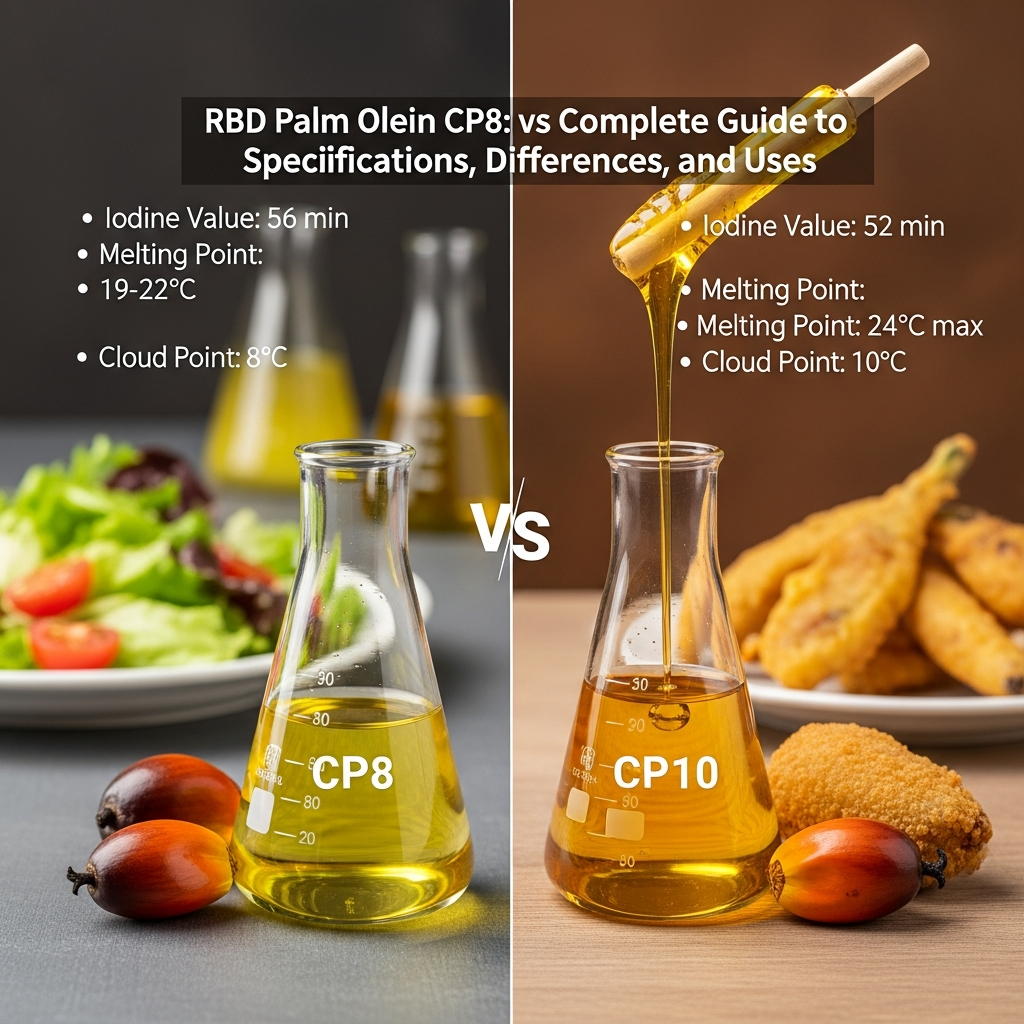
While both are high-quality cooking oils, their technical specifications reveal their intended uses. Here’s a direct comparison of the typical values in the RBD Palm Olein CP8 vs CP10 matchup.
| Specification | RBD Palm Olein CP10 | RBD Palm Olein CP8 (Super Olein) |
|---|---|---|
| Cloud Point (CP) | Max 10°C | Max 8°C |
| Iodine Value (IV) | 56 min | 58 min |
| Free Fatty Acids (FFA) | Max 0.1% | Max 0.1% |
| Moisture & Impurities (M&I) | Max 0.1% | Max 0.1% |
| Color (5.25″ Lovibond) | 3 Red Max | 3 Red Max |
Key Differences Explained: Cloud Point, IV, and Cost
The table highlights two major differences that drive the RBD Palm Olein CP8 vs CP10 choice: Cloud Point and Iodine Value. Let’s explore what these mean in practical terms.
- Temperature Performance (Cloud Point): This is the primary distinction. RBD Palm Olein CP8 remains clear and liquid at temperatures down to 8°C, whereas CP10 will start to cloud up at 10°C. This 2°C difference is significant, making CP8 a superior choice for cooking oil in colder regions, as it resists solidification on the shelf or in the pantry.
- Degree of Unsaturation (Iodine Value): The Iodine Value (IV) measures the degree of unsaturation in a fat. CP8, also known as “Super Olein,” has a higher IV (min 58) than CP10 (min 56). This indicates that CP8 is slightly more unsaturated, a direct result of the more intensive fractionation process it undergoes to remove more saturated fats and achieve its lower cloud point. You can learn more about edible oil standards from the FAO Codex Alimentarius.
- Fractionation Process and Cost: To achieve the lower 8°C cloud point, palm oil must undergo a more rigorous, often double or even triple, fractionation process. This extra step increases processing time, energy consumption, and capital costs. Consequently, RBD Palm Olein CP8 is consistently priced at a premium over CP10.

Applications and Uses: Which Palm Olein Should You Choose?
The choice in the RBD Palm Olein CP8 vs CP10 dilemma depends almost entirely on your application, climate, and budget.
When to Use RBD Palm Olein CP10
CP10 is the most widely produced and used palm olein globally. Its balance of quality, stability, and cost-effectiveness makes it the standard choice for:
- General Cooking and Frying: In tropical and temperate climates where ambient temperatures stay above 10°C, CP10 is an excellent and economical frying oil.
- Food Manufacturing: It is a key ingredient in instant noodles, potato chips, doughnuts, and other snack foods that require a stable frying medium.
- Margarine and Shortening: It’s a foundational component in the production of various food spreads and baking fats.
When to Use RBD Palm Olein CP8
CP8 is considered a premium or specialized product. Its superior cold stability makes it the preferred option for:
- Cooking Oil in Colder Climates: For countries in Europe, North America, and parts of Asia, CP8 is sold as a liquid cooking oil because it remains clear on supermarket shelves and in homes during winter.
- High-Quality Frying: Its stability and reliable liquid state make it a premium choice for industrial frying where consistency is paramount.
- Salad Oils and Dressings: It is often blended with other oils for use in salad dressings and mayonnaise, where maintaining a liquid state under refrigeration is advantageous.

From Fruit to Fraction: The Palm Oil Product Family
Understanding the RBD Palm Olein CP8 vs CP10 choice is easier when you see where they fit in the larger palm product ecosystem. The process begins with the Oil Palm Fruit Bunch, which contains the fruitlets. These fruitlets are processed to extract Crude Palm Oil (CPO) from the outer flesh (mesocarp). This CPO is then refined to create RBD Palm Oil, which is then fractionated into olein (the liquid we’ve been discussing) and stearin.
Inside the fruitlet is a nut, which contains the Palm Kernel. This kernel is crushed to produce two co-products: the versatile Palm Kernel Oil (PKO), used widely in confectionery and oleochemicals, and Palm Kernel Expeller (PKE), a protein-rich meal highly valued for animal feed. Even the leftover Palm Kernel Shell is used as a clean, efficient biofuel. Each component of the fruit bunch has significant economic value.
Sourcing, Quality, and Sustainability in Palm Olein
Regardless of whether you choose CP8 or CP10, sourcing from a reputable supplier is paramount. Ensure your supplier adheres to international quality standards and can provide a Certificate of Analysis (COA) for each batch, verifying its specifications.
Furthermore, sustainability is a major focus in the palm oil industry. Look for suppliers committed to responsible sourcing, ideally with certifications from the Roundtable on Sustainable Palm Oil (RSPO). This ensures the palm oil is produced in an environmentally and socially responsible manner.
Frequently Asked Questions (FAQ)
Is there a nutritional difference between CP8 and CP10?
The nutritional profiles are very similar. CP8 is slightly higher in unsaturated fats due to the extra fractionation, but the difference is marginal and generally not significant for the average consumer’s diet.
Can I substitute CP8 for CP10?
Yes, you can always use CP8 in an application that calls for CP10, as it meets and exceeds the temperature stability requirements. However, since CP8 is more expensive, this substitution is not always cost-effective. The reverse is not always true; using CP10 in a cold climate where CP8 is needed may result in undesirable solidification.
How does palm olein pricing work?
Palm olein prices are tied to the global crude palm oil (CPO) market, with major benchmarks like the Bursa Malaysia Derivatives exchange. In the RBD Palm Olein CP8 vs CP10 market, CP8 consistently commands a premium over CP10 due to its higher processing costs and specialized demand.
Your Trusted Palm Olein Supplier
Looking for High-Quality Palm Products?
Makmur Amanah Sejahtera provides high-quality palm products such as Palm Kernel Expeller, Palm Kernel Shell, Crude Palm Oil, Palm Kernel Oil, etc. Kindly contact us at WhatsApp +6282140002198 or email us at admin@makmuramanah.co.id.
The Final Verdict: A Clear Choice for Every Need
The RBD Palm Olein CP8 vs CP10 comparison is not about which oil is “better,” but which is “right” for the intended purpose. The choice is a strategic trade-off between cold stability, application requirements, and cost.
RBD Palm Olein CP10 is the versatile, cost-effective workhorse of the edible oil world, perfect for general frying and food production in most climates. On the other hand, RBD Palm Olein CP8 (Super Olein) is the premium, specialized option, offering superior performance in cold temperatures and applications where absolute clarity is paramount.
By understanding their distinct properties, you can optimize your product quality, manage costs effectively, and ensure your cooking oil meets the specific demands of your market and application.

 English
  Indonesian
  Chinese
  Arabic