
Table of Contents
- What Is an Empty Palm Fruit Bunch?
- The Unique Composition of an Empty Palm Fruit Bunch
- 7 Ultimate Uses and Applications of Empty Palm Fruit Bunch
- 1. A Powerhouse for Biofuel and Renewable Energy
- 2. Gold Standard for Composting and Soil Conditioning
- 3. A Sustainable Source for Pulp and Paper Production
- 4. Effective Mulching in Modern Agriculture
- 5. Building Blocks for Bio-Based Chemicals
- 6. Raw Material for Eco-Friendly Fiberboard
- 7. A Viable Livestock Feed Supplement
- Environmental and Economic Benefits
- Challenges and the Bright Future Ahead
- Your Source for High-Quality Palm Products
- Conclusion: More Than Just Waste
What Is an Empty Palm Fruit Bunch?
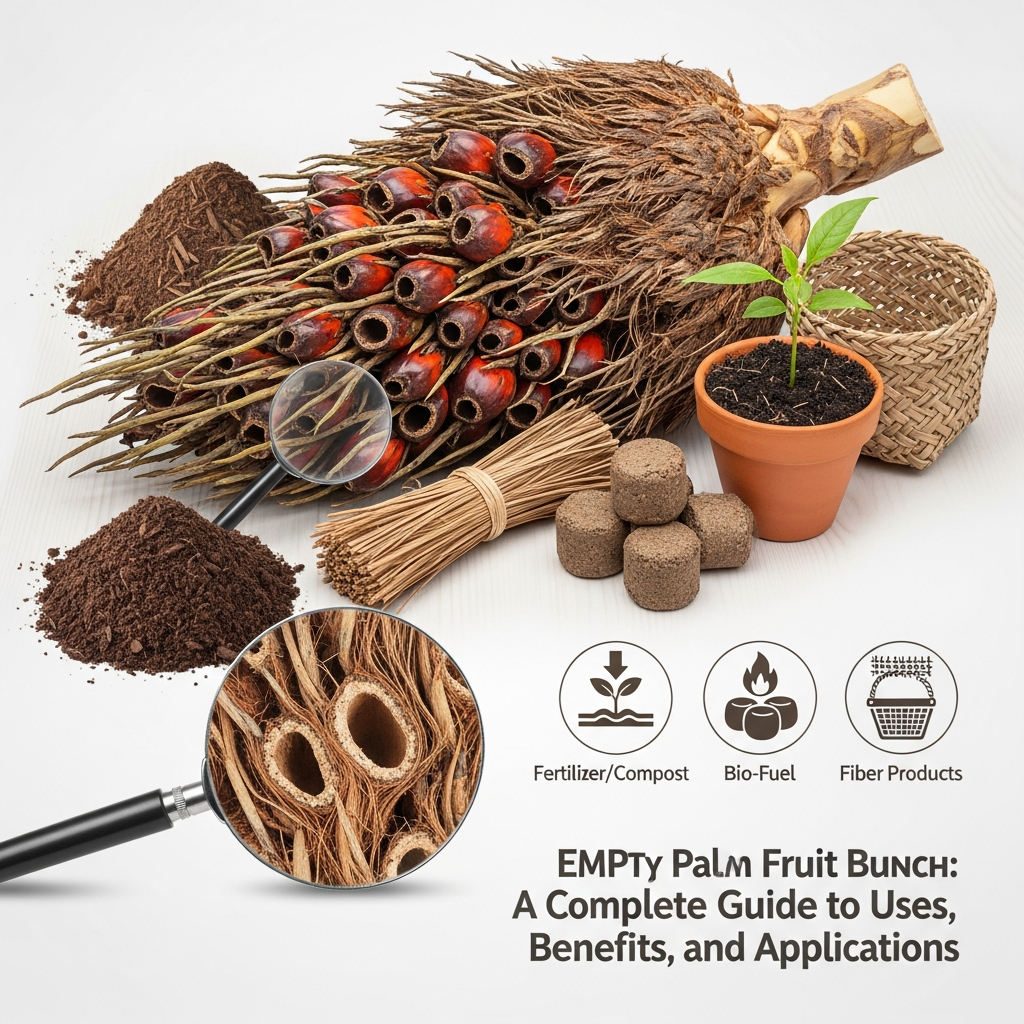
In the vast world of palm oil production, which yields primary products like Crude Palm Oil, the Oil Palm Fruit Bunch (commonly known as Empty Palm Fruit Bunch or EPFB) stands out as a major byproduct. Simply put, it is the fibrous biomass left behind after the fresh palm fruits have been stripped from the bunch for oil extraction. For every ton of crude palm oil produced, a significant amount of this biomass is generated.
Historically, managing the sheer volume of the Empty Palm Fruit Bunch was a logistical challenge for mills. However, with a growing focus on sustainability and the circular economy, this humble byproduct is now recognized for its immense potential across various industries. Understanding its uses is key to unlocking a more sustainable future.

The Unique Composition of an Empty Palm Fruit Bunch
The versatility of the Empty Palm Fruit Bunch stems from its rich chemical composition. It is primarily made of lignocellulosic material, which includes cellulose, hemicellulose, and lignin. These organic polymers are the building blocks of plant cell walls and are packed with potential energy and structural value. The initial process separates the valuable Palm Kernel, which is then processed into other goods.
Furthermore, an Empty Palm Fruit Bunch has a high moisture content when fresh and contains essential nutrients like potassium. This unique blend of fiber, moisture, and minerals is what makes it an ideal candidate for everything from energy generation to soil enhancement. Its composition is a focal point of research for developing new green technologies. For a deeper scientific look, studies published on platforms like ScienceDirect offer detailed analysis of its properties.
7 Ultimate Uses and Applications of Empty Palm Fruit Bunch
The applications for this abundant resource are diverse and impactful. Here are seven of the most significant uses for the Empty Palm Fruit Bunch that highlight its journey from waste to wealth.
1. A Powerhouse for Biofuel and Renewable Energy
One of the most prominent uses for an Empty Palm Fruit Bunch is in generating renewable energy. It can be used directly as a solid fuel in boilers at palm oil mills to produce steam and electricity—a process known as cogeneration. This not only powers the mill but can also feed surplus energy back into the grid.
Beyond direct combustion, it can be processed into higher-value biofuels like bio-pellets, bio-oil, and cellulosic ethanol. This is similar to how Palm Kernel Shell is also utilized as a high-grade solid biofuel. As the world seeks alternatives to fossil fuels, biomass like the Empty Palm Fruit Bunch is a critical component, a fact supported by research from bodies like the International Renewable Energy Agency (IRENA).
2. Gold Standard for Composting and Soil Conditioning
When composted, the Empty Palm Fruit Bunch transforms into a nutrient-rich organic fertilizer. This compost is highly effective at improving soil structure, increasing water-holding capacity, and replenishing essential nutrients in the ground, particularly in the palm plantations themselves. This creates a closed-loop system where waste from the harvest goes back to nourish new growth.
This application not only reduces the need for chemical fertilizers but also helps sequester carbon in the soil, contributing to climate change mitigation. It is a cornerstone of sustainable farming practices in the palm industry.

3. A Sustainable Source for Pulp and Paper Production
The high cellulose content in the Empty Palm Fruit Bunch makes it a viable non-wood alternative for producing pulp and paper. Leveraging this resource can help reduce the logging of natural forests for paper manufacturing, offering a more sustainable and eco-friendly option. The fiber quality is suitable for various paper products, from writing paper to packaging materials.
4. Effective Mulching in Modern Agriculture
In its raw or shredded form, the Empty Palm Fruit Bunch is an excellent mulching material. Spreading it around the base of trees helps conserve soil moisture by reducing evaporation, suppresses weed growth, and regulates soil temperature. As the mulch slowly decomposes, it releases valuable organic matter and nutrients back into the soil, further boosting plant health.
5. Building Blocks for Bio-Based Chemicals
Advanced biorefinery processes can break down the complex sugars within the Empty Palm Fruit Bunch to create valuable bio-based chemicals. These include products like xylitol (a sugar substitute), lactic acid (used in bioplastics), and other platform chemicals that are foundational for creating green products. This represents a high-value application that is a key focus of ongoing research and development.
6. Raw Material for Eco-Friendly Fiberboard
The strong fibers of the Empty Palm Fruit Bunch are ideal for manufacturing medium-density fiberboard (MDF) and particleboard. These engineered wood products are used widely in furniture and construction. Using EPFB instead of traditional wood sources helps preserve forests and provides a sustainable outlet for this agricultural residue, as championed by organizations like the Forest Stewardship Council (FSC) that explore non-timber resources.
7. A Viable Livestock Feed Supplement
While not directly edible in its raw state, the Empty Palm Fruit Bunch can be processed and treated to become a valuable source of roughage for ruminant animals like cattle and goats. Methods like steam treatment or fermentation can break down the tough lignin and improve its digestibility, making it a sustainable component of animal feed, much like Palm Kernel Expeller, another valuable byproduct. This is especially relevant in regions looking for cost-effective, alternative feed sources, a topic often covered by the Food and Agriculture Organization (FAO).
Environmental and Economic Benefits
Utilizing the Empty Palm Fruit Bunch offers a powerful win-win scenario. Environmentally, it transforms a potential pollutant into a green resource, reducing landfill waste, cutting greenhouse gas emissions by replacing fossil fuels, and promoting healthier soils. Economically, it creates new revenue streams for palm oil mills, reduces their operational costs for energy and waste disposal, and fosters innovation in the bio-based economy.
Challenges and the Bright Future Ahead
Despite its potential, challenges remain. The high moisture content of a fresh Empty Palm Fruit Bunch makes transportation and processing costly. Efficiently collecting and converting the biomass on a large scale requires significant investment in infrastructure and technology. However, ongoing research is constantly yielding more efficient and cost-effective conversion methods.
The future outlook is incredibly positive. As global demand for sustainable materials and energy continues to grow, the importance of the Empty Palm Fruit Bunch will only increase. It stands as a prime example of how agricultural byproducts can become central to a thriving circular economy.
Your Source for High-Quality Palm Products
Looking for High-Quality Palm Products?
Makmur Amanah Sejahtera provides high-quality palm products such as Palm Kernel Expeller, Palm Kernel Shell, Crude Palm Oil, Palm Kernel Oil, etc. Kindly contact us at WhatsApp +6282140002198 or email us at admin@makmuramanah.co.id.
Conclusion: More Than Just Waste
The Empty Palm Fruit Bunch is a testament to the idea that waste is simply a resource in the wrong place. From powering factories and enriching soils to creating eco-friendly paper and furniture, its applications are as impressive as they are diverse. By embracing the full potential of this valuable biomass, the palm oil industry can take significant strides toward greater sustainability, proving that economic productivity and environmental stewardship can go hand in hand.
 English
  Indonesian
  Chinese
  Arabic