
Table of Contents
- 1. What Exactly is RBD Palm Olein CP8?
- 2. Understanding the Key Specifications of RBD Palm Olein CP8
- 3. Where is RBD Palm Olein CP8 Used?
- 4. The Ultimate Showdown: RBD Palm Olein CP8 vs. CP10
- 5. Advantages and Considerations of Using RBD Palm Olein CP8
- 6. Your Trusted Supplier for High-Quality Palm Products
- 7. Your Final Takeaway on RBD Palm Olein CP8
In the vast world of cooking oils, technical terms can often be confusing. If you’ve ever come across terms like “fractionation” or “cloud point,” you know how specific the industry can be. This guide dives deep into one of the most widely used edible oils globally: RBD Palm Olein CP8. We’ll explore exactly what it is, its detailed specifications, and how it stands apart from its close relative, CP10.
What Exactly is RBD Palm Olein CP8?
Let’s break down the name to understand the product. RBD Palm Olein CP8 is a specific type of palm oil, and each part of its name describes a step in its production process and a key physical characteristic.
RBD stands for Refined, Bleached, and Deodorized. This is a standard purification process for many vegetable oils. The Crude Palm Oil (CPO) is refined to remove impurities, bleached to remove natural coloring pigments, and deodorized under vacuum and high temperatures to eliminate any unwanted tastes and odors. The result is a bland, stable oil perfect for various cooking applications.
Palm Olein refers to the liquid fraction obtained from palm oil through a process called fractionation. Palm oil is semi-solid at room temperature, and fractionation separates it into a liquid portion (olein) and a solid portion (stearin). This process makes palm olein a popular choice for liquid cooking oil, distinct from other derivatives like Palm Kernel Oil, which is extracted from the seed of the palm fruit.
CP8 stands for Cloud Point 8. This is the most crucial specification for this grade. The cloud point is the temperature at which the oil starts to become cloudy or hazy as it cools, indicating the beginning of solidification. For RBD Palm Olein CP8, this process begins at a maximum of 8° Celsius.
Understanding the Key Specifications of RBD Palm Olein CP8
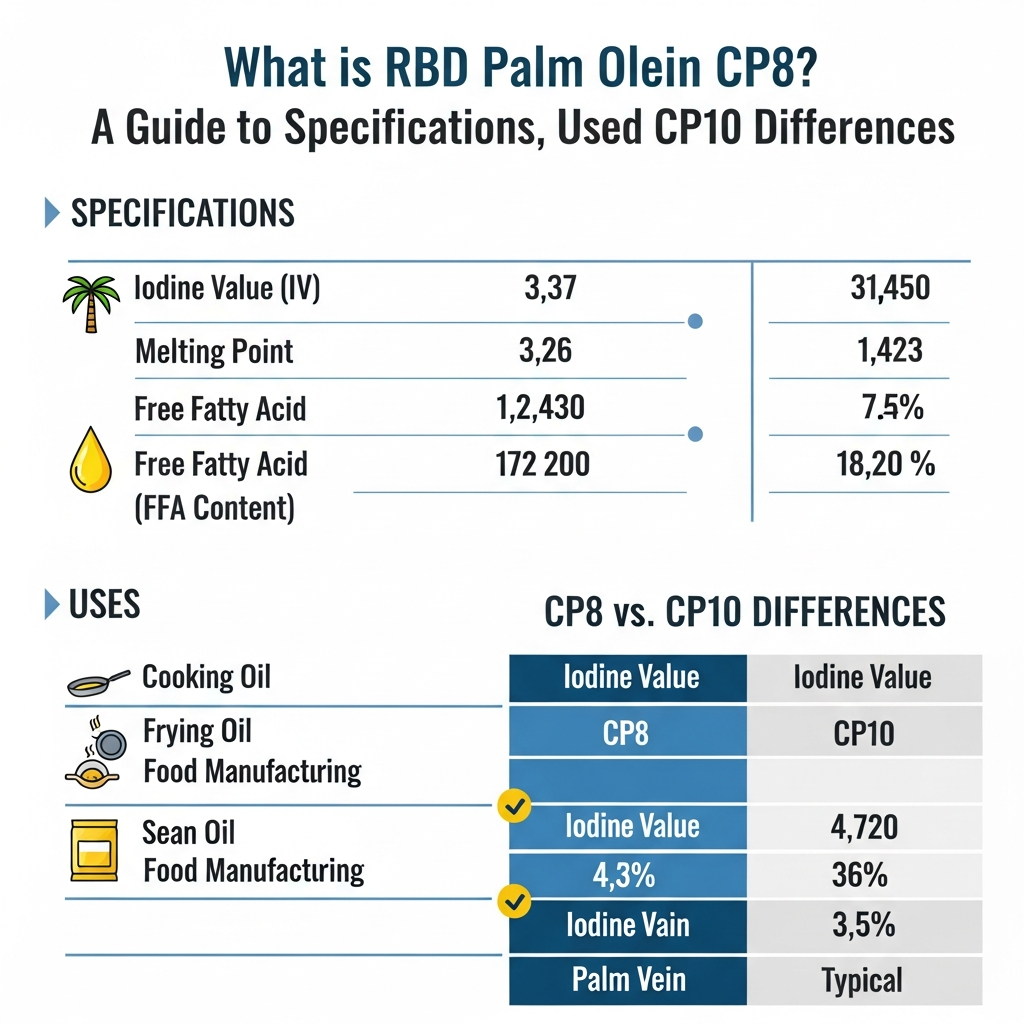
Beyond the cloud point, several technical specifications define the quality and purity of RBD Palm Olein CP8. These parameters are crucial for industrial buyers and ensure the product meets international standards.
- Free Fatty Acids (FFA): Typically specified as 0.1% max. A low FFA value indicates a well-refined oil with less tendency to break down and smoke at high temperatures.
- Iodine Value (IV): Usually in the range of 56-62. The Iodine Value measures the degree of unsaturation in the oil, which affects its stability and physical state.
- Moisture & Impurities (M&I): A maximum of 0.1% is standard. This ensures the oil is pure and free from water, which can cause sputtering during frying.
- Color (Lovibond): Typically a maximum of 3 Red on the 5.25″ Lovibond scale, resulting in a light golden-yellow appearance.
- Cloud Point: A maximum of 8°C, which is the defining characteristic of the CP8 grade.
For a deeper dive into these technical parameters, you can explore resources from the Malaysian Palm Oil Council (MPOC), which sets industry standards.

Where is RBD Palm Olein CP8 Used?
The unique properties of RBD Palm Olein CP8 make it an incredibly versatile and cost-effective oil for various applications across the food industry and in households.
Its primary application is as a premium deep-frying oil. Thanks to its high smoke point (around 235°C or 455°F) and excellent oxidative stability, it resists breaking down even after repeated use. This makes it a favorite for restaurants and industrial food producers making products like instant noodles, potato chips, and frozen french fries.
It’s also widely used as a general-purpose cooking oil in many parts of the world, especially in Asia and Africa. Its neutral flavor profile ensures that it doesn’t interfere with the natural taste of the food being cooked. This makes this particular grade of palm olein a reliable choice for daily cooking.
The Ultimate Showdown: RBD Palm Olein CP8 vs. CP10
One of the most common points of confusion is the difference between CP8 and CP10. While they are very similar, the subtle distinction in their cloud point has significant implications for their use.
The Main Distinguishing Factor: Cloud Point
The only real difference lies in the cloud point. RBD Palm Olein CP8 has a maximum cloud point of 8°C, whereas CP10 has a maximum cloud point of 10°C. This means CP8 will remain liquid at slightly lower temperatures compared to CP10.
This difference is achieved through an additional step or a more controlled fractionation process, which removes more of the higher-melting-point fats. As a result, producing CP8 can be slightly more expensive. The process of oil fractionation is a fascinating science that allows for the customization of fats for specific applications.
How Does This Affect Performance and Use?
- Climate Suitability: CP8 is better suited for temperate or cooler climates where ambient temperatures might drop and cause CP10 to solidify or become cloudy. CP10 is perfectly suitable for tropical climates.
- Application Specifics: For products that may be refrigerated or stored in cooler conditions, such as certain sauces or dressings, CP8 is the preferred choice to prevent cloudiness.
- Cost: CP10 is generally more common and slightly more affordable due to the less intensive processing required.
Essentially, the choice between RBD Palm Olein CP8 and CP10 comes down to climate, application, and budget.

Advantages and Considerations of Using RBD Palm Olein CP8
Like any product, RBD Palm Olein CP8 has both distinct advantages and important points to consider.
Advantages:
- Excellent Stability: Its high resistance to oxidation gives it a long shelf life and makes it reusable for frying without quickly going rancid.
- High Smoke Point: As mentioned, its high smoke point makes it one of the best oils for high-temperature cooking. You can read more about the importance of cooking oil smoke points for safety and flavor.
- Neutral Taste: It allows the flavor of the food to shine through, which is ideal for a wide range of culinary creations.
- Cost-Effective: Palm oil is one of the most efficient oil-producing crops, making its derivatives highly affordable.
Considerations:
From a nutritional standpoint, palm oil is high in saturated fat. Health organizations like the World Health Organization (WHO) advise moderating saturated fat intake as part of a balanced diet. Additionally, consumers are increasingly concerned about the environmental impact of palm oil cultivation. It’s crucial to source from suppliers who manage the entire lifecycle of the Oil Palm Fruit Bunch and its derivatives sustainably. This includes not just the oil from the fruit and the Palm Kernel, but also valuable co-products like Palm Kernel Expeller for animal feed and Palm Kernel Shell for biomass energy.
Your Trusted Supplier for High-Quality Palm Products
To ensure you receive top-grade products like RBD Palm Olein CP8 sourced responsibly, it’s vital to partner with a reliable supplier. A good supplier guarantees quality specifications and adherence to sustainable practices.
Looking for High-Quality Palm Products?
Makmur Amanah Sejahtera provides high-quality palm products such as Palm Kernel Expeller, Palm Kernel Shell, Crude Palm Oil, Palm Kernel Oil, etc. Kindly contact us at WhatsApp +6282140002198 or email us at admin@makmuramanah.co.id.
Your Final Takeaway on RBD Palm Olein CP8
In conclusion, RBD Palm Olein CP8 is a highly refined, stable, and versatile cooking oil defined by its key specification: a cloud point of 8°C. This property makes it exceptionally suitable for frying and for use in cooler climates where other oils might solidify.
Its neutral flavor, high smoke point, and affordability have made it a cornerstone of the global food industry. By understanding its properties and how it differs from CP10, you can confidently choose the right oil for your specific culinary or industrial needs.
 English
  Indonesian
  Chinese
  Arabic