Table of Contents
Table of Contents
The palm oil industry often finds itself in the spotlight. Beyond primary products like Crude Palm Oil (CPO) and Palm Kernel Oil (PKO), many are still unaware of the extraordinary potential of its byproducts. One of the most abundant is Oil Palm Empty Fruit Bunches (EFB), also commonly referred to as empty bunches (jangkos).
This waste is not mere trash, but a treasure waiting to be processed into high-value products. Once regarded simply as waste, utilizing oil palm empty fruit bunches has now become key to realizing more sustainable and circular plantation practices.

What Are Oil Palm Empty Fruit Bunches (EFB)?
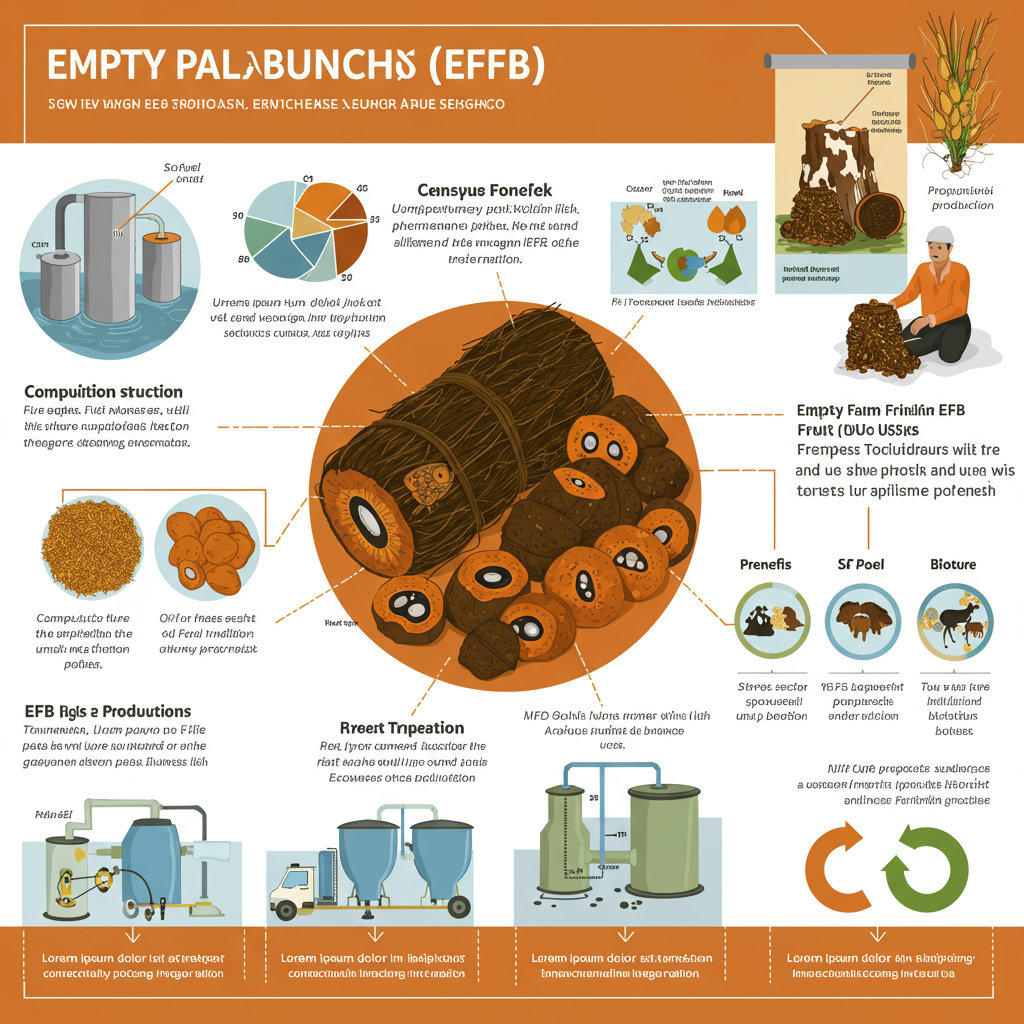
Oil Palm Empty Fruit Bunches are part of Fresh Fruit Bunches (FFB) remaining after the palm fruitlets are stripped at the mill. This process separates the fruitlets, which will be processed into CPO and palm kernel (Palm Kernel). EFB is characterized by being fibrous, moist, and rich in organic components such as cellulose, hemicellulose, and lignin.
As the world's largest palm producer, Indonesia generates millions of tons of EFB every year. If not managed properly, this waste can cause environmental issues. However, with appropriate technology, this waste oil palm empty fruit bunch can be transformed into highly valuable resources.
7+ Extraordinary Key Benefits of Oil Palm Empty Fruit Bunches
The potential of EFB is diverse, spanning agriculture, energy, and manufacturing sectors. Below are several of its primary benefits.
1. Soil-Enriching Organic Fertilizer
The most common benefit of oil palm empty fruit bunch is as a raw material for organic fertilizer. Its high Potassium (K) content is excellent for plant growth. Applying EFB compost to plantation land can improve soil structure, enhance water retention, and reduce reliance on chemical fertilizers. Utilizing this waste aligns with the use of other derivative products such as Palm Kernel Expeller for high-quality animal feed.
According to a study from the Bogor Agricultural Institute (IPB), EFB composting effectively returns essential nutrients to the soil, supporting a sustainable agricultural cycle.
2. Renewable Biomassa Energy Source
EFB has a calorific value that can be utilized as fuel (biomass). Many palm mills use oil palm empty fruit bunch as boiler fuel to generate electricity (co-generation). In addition to EFB, other products such as Palm Kernel Shell are also popular biomass sources.
EFB can also be processed into bio-pellets, which are easier to transport and possess a denser, more uniform calorific value.
Interesting Fact: The energy produced from 1 ton of dried EFB is equivalent to the energy of approximately 250 liters of fuel oil.
3. Raw Material for Pulp and Paper
The high fiber (cellulose) content in oil palm empty fruit bunch makes it a potential alternative raw material for the pulp and paper industry. This utilization helps reduce pressure on forests as the primary source of wood fiber.

4. Growing Medium for Edible Mushrooms
For mushroom farmers, EFB serves as an excellent growing medium (substrate), especially for oyster and straw mushrooms. Its fibrous structure and water-retention capacity create an ideal environment for mushroom mycelium growth, unlocking new agribusiness opportunities.
5. Particle Board and Composite Materials
Fiber from oil palm empty fruit bunch can also be processed into particle board, medium-density fiberboard (MDF), and various composite products. These products can be used as wood substitutes for furniture, wall panels, and other building materials. This innovation is supported by various studies, such as those summarized in the journal Materials Today: Proceedings.
6. Bioethanol Production
Through hydrolysis and fermentation processes, the cellulose in EFB can be converted into bioethanol. Although the technology is still developing, this demonstrates great potential oil palm empty fruit bunch as a source of second-generation biofuels.
7. Raw Material for Agricultural Mulch
Applied directly around plants, EFB serves as organic mulch that helps retain soil moisture, suppress weeds, and slowly release nutrients as it decomposes.
Oil Palm Empty Fruit Bunch Processing Methods
To maximize its benefits, EFB needs to undergo several processing steps, including:
- Shredding: EFB is shredded into smaller sizes for easier processing.
- Composting: Mixed with microbial activators and allowed to decompose until mature.
- Pelletizing: EFB is dried and compacted into solid fuel.
- Incineration: Burned in boilers to generate heat and electrical energy.
Challenges and the Future of EFB Utilization
Despite its great potential, the utilization of oil palm empty fruit bunch still faces challenges. Its high moisture content (60-70%) makes it heavy to transport and inefficient for direct combustion. In addition, investment in processing technology requires substantial costs.
However, with the growing awareness of the circular economy and the demand for sustainable palm oil practices, innovations in EFB processing continue to emerge. Support from the government and research institutions such as the National Research and Innovation Agency (BRIN) is crucial to accelerating the adoption of this technology.
Conclusion
Oil Palm Empty Fruit Bunches has transformed from mere waste into a valuable commodity that supports the sustainability of the palm oil industry. With benefits ranging from soil enrichment and renewable energy sources to industrial raw materials, EFB is a tangible example of the zero waste principle within the circular economy.
Maximizing the potential of EFB not only delivers economic benefits, but also serves as a concrete step in preserving the environment toward a greener and more responsible future.
Makmur Amanah Sejahtera provides high-quality palm products such as Palm Kernel Expeller, Palm Kernel Shell, Crude Palm Oil, and Palm Kernel Oil. Please contact us via WhatsApp at +6282140002198 or email to admin@makmuramanah.co.id to get the best offer.