
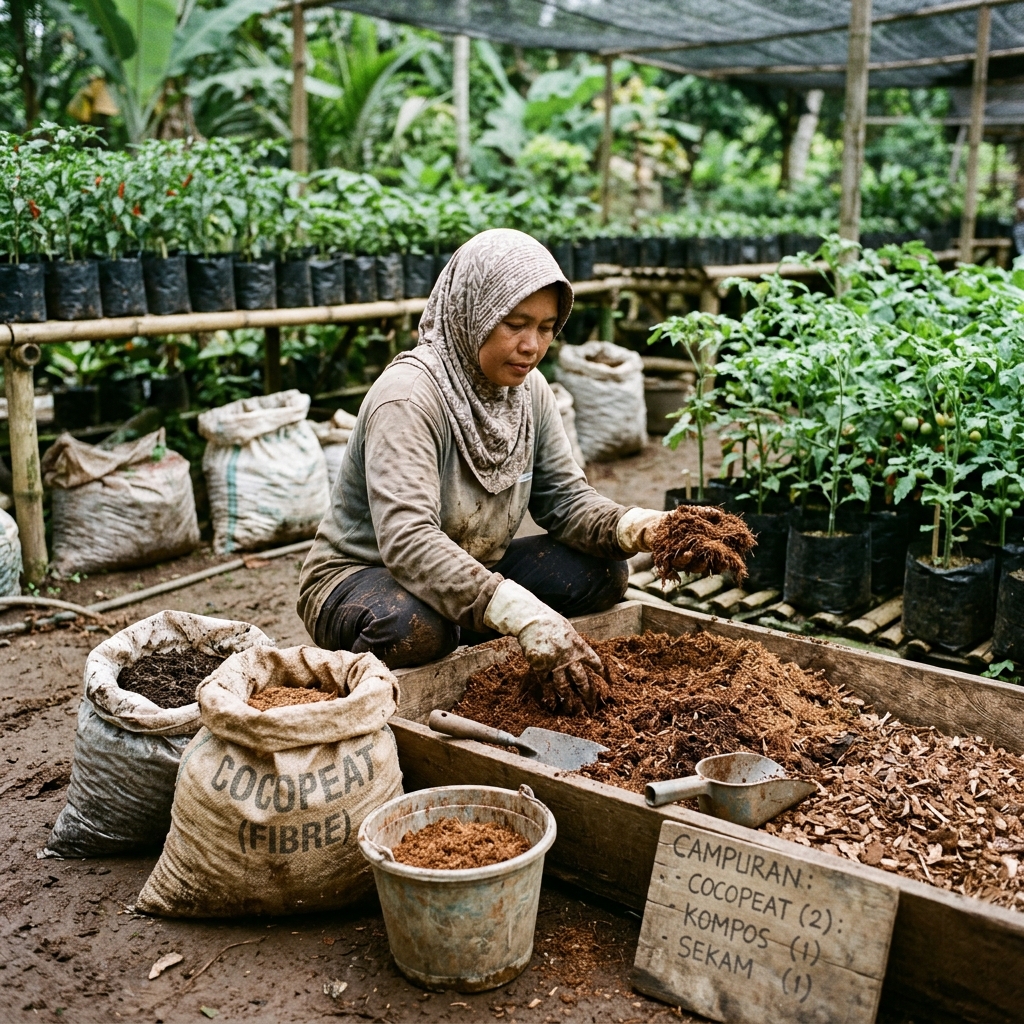
The utilization of cocopeat as an eco-friendly organic growing medium is surging among horticulture enthusiasts and modern commercial farmers. Many growers complain about conventional soil conditions that quickly compact, lack oxygen circulation, and lead to wasteful daily irrigation water consumption. Such adverse conditions often restrict soil aeration and hinder the absorption of vital nutrients for productive vegetation.
International demand for coconut coir derivatives continues to grow in tandem with the global transformation toward renewable, circular agricultural practices. According to agricultural statistics from Food and Agriculture Organization (FAO), Indonesia produces more than 2.8 million tons of coconuts each year. This abundant coconut industry byproduct presents a significant opportunity to supply high-quality coco peat without damaging natural peatland ecosystems.
Getting to Know Cocopeat: Physical Characteristics and Nutrient Content
Cocopeat is an organic growing medium in the form of a fine powder derived from processing coconut coir after its coarse fibers are separated. This microporous cellulose material boasts an impressive water-holding capacity of up to ten times its original dry weight. Such moisture retention capability delivers consistent moisture stability around horticultural plant roots throughout the day.
Physically, coconut coir dust features a naturally loose, soft texture resembling conventional peat moss, yet it offers a far superior sustainability profile. Encyclopedic data from Coconut Coir on Wikipedia explains that coconut fiber structure is dominated by cellulose biopolymers and complex lignin. This natural polymer chain makes the growing medium resistant to rapid biological degradation inside planting containers.

Chemically, the pH parameter of this growing medium falls naturally within the range of 5.5 to 6.8, which is highly favorable for plant roots. Nevertheless, raw powder freshly processed from coir spinning generally still contains concentrated tannin compounds and free potassium cations. The presence of these dissolved salts must be stabilized before direct contact with the roots of vulnerable, young seedlings.
Beyond its powder form for pots and polybags, coarse coconut fiber weave is also widely utilized as soil erosion control netting, or cocomesh on steep plantation slopes. The combination of coir dust and netting proves just how valuable the coconut tree is for ecology and critical land restoration in Indonesia.
Advantages and Disadvantages of Cocopeat for Cultivated Plants
Understanding the advantages and disadvantages of cocopeat for plants is crucial so that your agricultural strategy achieves cost efficiency and optimal harvest productivity. The choice of growing medium must be tailored to the environmental microclimate, watering frequency, and the commodities you are cultivating.
Key Advantages of Cocopeat Growing Medium
- Exceptional Moisture Retention: The micro-sponge structure of coconut fiber retains irrigation water longer, thereby cutting daily watering requirements by up to 40%.
- Maximum Soil Aeration and Drainage: Micro-pores prevent clay compaction and minimize the risk of root rot caused by excessive waterlogging.
- Free from Parasitic Pathogens: Pure, high-quality coir dust material possesses biological resistance against invasion by certain soil-borne pathogenic fungi.
- Sustainable Organic Growing Medium: Serves as a direct substitute for peat moss whose extraction often destroys global peatland carbon reserves.
A comparative agronomic study from the scientific journal Scientia Horticulturae revealed that substituting peat with processed coconut coir is capable of consistently maintaining shoot dry biomass and vegetation photosynthetic rates without inducing chlorosis symptoms.
Disadvantages That Must Be Anticipated
- High Natural Tannin Content: Raw media retains tanning substances that risk binding nitrogen cations as well as free iron in the soil.
- Inert Characteristics: Cocopeat does not contain adequate amounts of primary macronutrients, so scheduled fertilization remains mandatory.
- Natural Salinity Level Variations: Coastal coconut palms produce husks with high electrical conductivity (EC) values if they have not been thoroughly rinsed with clean water.
How to Process Cocopeat Before Use to Remove Tannins
Tannin compounds are plant polyphenols that serve a protective function, shielding coconut shells and husks from premature decay in open nature. However, dissolved tannins in groundwater can precipitate essential micronutrients, trigger leaf chlorosis, and stunt the root development of young seedlings.

Practical Step-by-Step Guide to Processing Coconut Coir Dust
Apply the following processing sequence for cocopeat before use so the growing medium is safely prepared for seedlings:
- Hydration and Expansion: Place the compressed coir block into a plastic container, then pour clean water over it until the material fully expands.
- Initial 24-Hour Soaking: Soak the cocopeat overnight so the deepest pores become saturated and the concentrated tannins dissolve into the soaking water.
- Rinsing and Straining: Drain the deep reddish water resembling strong brewed tea, then rinse repeatedly 3 to 4 times using running water.
- Calcium Nitrate Buffering Treatment: Soak the medium in a Calcium Nitrate solution (dosage of 10 grams per liter of water) for 12 hours so the calcium displaces excess sodium cations.
- Electrical Conductivity Testing: Measure the final runoff or squeezed water using a digital EC meter. Ensure the EC value is below 0.5 mS/cm before planting seedlings in the medium.
Plantation guidelines from scientific institutions Oregon State University Extension emphasizes that the process of buffering calcium is crucial to prevent young plants from experiencing chlorosis and calcium-magnesium deficiency during the early growth phase.
Video: Technical demonstration of tannin washing and cocopeat EC testing prior to planting.
Application Guide for Cocopeat Growing Media Across Various Agricultural Systems
The flexible physical characteristics of coconut fiber allow it to be used in a wide range of modern cultivation methods, from home garden scales to high-tech precision hydroponic plantations.
Use in Fertigation Hydroponic Cultivation
In substrate drip fertigation hydroponic systems for premium melon commodities, cherry tomatoes, and bell peppers, cocopeat is blended with rice husk ash or perlite at a 70:30 ratio. This composition maintains a balance of moisture retention and root oxygen porosity, ensuring liquid fertilizer nutrient solutions are absorbed without the risk of anaerobic waterlogging.
Formulation Ratio of Cocopeat and Soil Mix for Pots
Planting directly in 100% coco coir dust outdoors runs the risk of oversaturating the root zone during heavy rainy seasons. Apply this proven ratio of cocopeat and soil mix:
- 2 Parts Washed Coco Peat: Functions to retain moisture and maintain looseness in the root zone.
- 1 Part Fertile Topsoil: Supports upright plant stems and supplies essential micronutrient minerals.
- 1 Part Matured Organic Fertilizer (Compost or Vermicompost): Provides soil microorganism populations and sustained-release nutrients.
- 1 Part Rice Husk Ash or Volcanic Sand (Pasir Malang): Ensures smooth water drainage and soil aeration during intensive watering.
In the integrated agribusiness of plantations and livestock, the utilization of high-protein organic materials for animal nutrition can also be obtained through processed coconut commodities such as products Copra Meal as well as premium-grade palm oil by-products such as Palm Kernel Expeller to create an efficient and self-sustaining agricultural supply chain.
Parameter Comparison of Popular Organic Growing Media
The following technical comparison table summarizes the functional properties of various growing media commonly used by horticultural farmers in Indonesia:
| Evaluation Parameter | Cocopeat (Coconut Coir) | Topsoil Humus | Raw Carbonized Rice Husk | Commercial Rockwool |
|---|---|---|---|---|
| Water Absorption Capacity | Very High (8–10x weight) | Moderate (tends to compact) | Low to Moderate | High (easily saturated) |
| Soil Aeration Level | Very Good & Porous | Decreases when wet and compacted | Very Good & Loose | Good |
| Growing Media pH Stability | 5,5 – 6,8 (Sedikit Asam) | 6,0 – 7,5 (Sangat Variatif) | 6,5 – 7,5 (Netral/Basa) | 7,0 – 8,0 (Cenderung Basa) |
| Inherent Nutrient Content | Rendah (Inert Organik) | Tinggi (Kaya Mineral) | Sedang (Silika & Kalium) | Nol (Steril Sintetis) |
| Daya Tahan Masa Pakai | 2 to 3 Years | 1 Tahun (Perlu olah tanah) | 1 Tahun (Mudah lapuk) | 1 Kali Siklus Tanam |
| Eco-Friendly Aspect | 100% Organik & Terbarukan | Kurang ramah bila dikeruk liar | Limbah tani terbarukan | Anorganik (Sulit terurai) |
Update Estimasi Harga Cocopeat per Kg Terbaru 2026
Memasuki tahun 2026, stabilitas produksi sabut kelapa nasional menjaga struktur harga komoditas serbuk kelapa tetap kompetitif bagi kebutuhan pembudidaya tanaman. Ketersediaan suplai berkualitas dapat diakses langsung melalui produsen terpercaya seperti produk cocopeat yang disiapkan khusus untuk spesifikasi perkebunan lokal maupun permintaan pasar global.

Berikut adalah rincian kalkulasi harga cocopeat per kg terbaru 2026 di sentra agribisnis Indonesia berdasarkan varian pemrosesan bahan:
- Curah Basah Mentah (Unwashed): Rp 1.500 – Rp 2.500 per kg. Varian ekonomis ini baru keluar dari pemintalan sabut dengan kadar air di atas 40% dan mewajibkan pencucian tanin mandiri secara intensif.
- Curah Kering Siap Pakai (Washed / Low EC): Rp 3.500 – Rp 5.500 per kg. Telah dibilas air tawar, dikeringkan di bawah sinar matahari hingga kadar air di bawah 20%, dan berkadar garam rendah.
- Kemasan Blok Pres 5 Kg (High EC): Rp 20.000 – Rp 30.000 per blok (setara Rp 4.000 – Rp 6.000 per kg). Praktis dalam logistik penyimpanan dan dapat mengembang hingga 65 liter media gembur setelah direhidrasi.
- Kemasan Blok Pres 5 Kg (Low EC / Steril): Rp 35.000 – Rp 50.000 per blok (setara Rp 7.000 – Rp 10.000 per kg). Media grade ekspor premium yang langsung dapat diaplikasikan pada instalasi fertigasi tanpa pencucian ulang.
Selain pemanfaatan limbah serat kelapa, sektor perkebunan tropis juga memproduksi sumber biomassa bernilai kalori tinggi seperti Palm Kernel Shell yang menjadi substitusi bahan bakar boiler industri terkemuka demi menurunkan emisi karbon global secara nyata.
Makmur Amanah Sejahtera provides high-quality processed palm products such as Palm Kernel Expeller, Palm Kernel Shell, Crude Palm Oil, Palm Kernel Oil, and others. Please contact us via WhatsApp +6282140002198 or email admin@makmuramanah.co.id.
Frequently Asked Questions: Pertanyaan Seputar Cocopeat
Apakah cocopeat harus dicuci sebelum digunakan?
Ya, media serbuk sabut kelapa mentah wajib dicuci untuk melarutkan senyawa tanin dan menurunkan kadar garam natrium berlebih. Kandungan tanin yang tertinggal dapat mengikat hara nitrogen, mengganggu penyerapan zat besi mikro, serta meracuni perakaran bibit muda yang baru tumbuh.
Apa perbedaan mendasar antara cocopeat dan cocofiber?
Cocopeat merupakan butiran serbuk gabus halus sabut kelapa yang berfungsi sebagai media tanam berdaya serap air tinggi. Sebaliknya, cocofiber adalah untaian serat panjang elastis kelapa yang lazim diolah untuk bahan jok mobil, kasur matras, tali tambang, serta anyaman peredam erosi tebing.
Tanaman apa saja yang paling cocok menggunakan cocopeat?
Media organik ini sangat ideal bagi persemaian benih sayuran daun, tanaman hies populer seperti aroid dan aglaonema, serta buah komersial hidroponik presisi seperti stroberi, tomat beef, dan melon jepang yang membutuhkan sirkulasi aerasi perakaran seimbang dan retensi kelembapan stabil.
Berapa lama masa pakai efektif cocopeat di dalam pot tanaman?
Kandungan biopolimer lignin tinggi membuat struktur serbuk sabut kelapa mampu bertahan 2 hingga 3 tahun tanpa mudah terurai lapuk. Anda cukup membilas ulang sisa garam pupuk, menjemurnya di terik matahari, dan media siap digunakan kembali untuk rotasi tanam selanjutnya.
Bisakah cocopeat digunakan murni 100% tanpa dicampur tanah?
Penggunaan serbuk murni 100% sangat lumrah pada sistem hidroponik tetes tertutup dengan injeksi nutrisi hara teratur. Namun pada pot kebun terbuka, pencampuran bersama sekam bakar dan kompos tanah tetap dianjurkan agar media tidak terlalu becek tergenang saat musim hujan lebat.

Conclusion
Memilih media tanam organik yang tepat, memiliki kapasitas ikat air melimpah, dan berpori gembur merupakan pondasi vital bagi keberhasilan budidaya tanaman hortikultura modern. Penggunaan media tanam cocopeat terbukti nyata mampu menjaga kelembapan mikro akar secara berkesinambungan tanpa mengorbankan pasokan oksigen yang dibutuhkan vegetasi.
Kunci keberhasilan penggunaan media serbuk sabut kelapa ini bertumpu pada ketuntasan proses netralisasi zat tanin, pencucian garam mineral bebas, serta ketepatan takaran campuran media sesuai komoditas pilihan Anda. Pantau terus update harga cocopeat per kg terbaru 2026 dan aplikasikan cocopeat berkualitas prima demi mewujudkan panen kebun yang subur, sehat, dan menguntungkan bisnis agrikultur Anda.



