
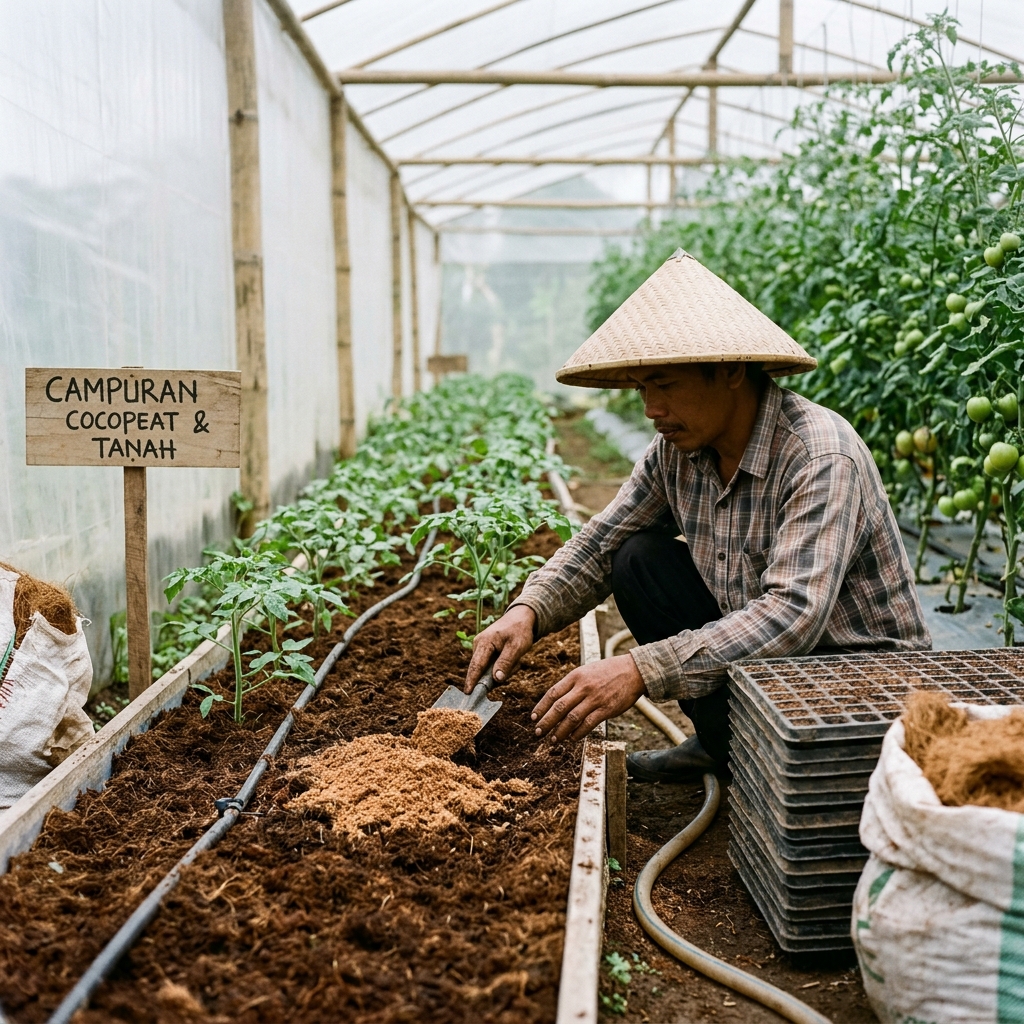
Knowing cocopeat benefits for plants in depth is a crucial first step for urban farming practitioners, commercial growers, and ornamental plant hobbyists alike. Optimizing cocopeat benefits for plants can address topsoil degradation constraints (topsoil) and the increasingly pressing clean water scarcity in modern crop cultivation.
According to a report from Food and Agriculture Organization (FAO), global agricultural land degradation has accelerated the transition toward soilless cultivation (soilless culture). Amidst this shift, coconut coir dust processed into high-quality organic substrates has proven its agronomic and economic effectiveness.
What Is Cocopeat and Why Is It So Popular?
Technically, cocopeat is an eco-friendly organic growing medium made from pure coconut coir dust (coco coir dust) produced by milling the fibrous husk of coconuts. Based on a botanical overview on Wikipedia Coir, this dust features a porous micro-sponge structure capable of retaining moisture and water-soluble nutrients with exceptionally high physical stability.
The popularity of this growing medium has skyrocketed drastically due to its renewable nature compared to peat moss (natural peat moss), whose exploitation damages the world's wetland ecosystems. Coconut raw materials in tropical regions such as Southeast Asia are abundant, making it an economical growing medium choice with a low carbon footprint.

Physical and Chemical Characteristics of Quality Cocopeat
Not all processed coco coir is ready for direct use on plants without proper agronomic treatment. Commercial-grade cocopeat possesses specific characteristics that must be carefully verified:
- Acidity Level (pH): Relatively neutral and balanced, ranging from 5.5 to 6.8.
- Electrical Conductivity (EC): Must be below 0.5 mS/cm for the washed variant (washed free of salts and tannins).
- Water Holding Capacity: Capable of holding a water volume up to 8–10 times its dry weight.
- Cation Exchange Capacity (CEC): Ranges between 60–130 meq/100g, highly ideal for binding calcium, magnesium, and potassium cations.
9 Scientifically Proven Benefits of Cocopeat for Plants
The application of cultivation research proves that cocopeat benefits for plants goes beyond just a physical support medium. Here are nine fundamental advantages that make it the gold standard of modern agricultural substrates:
1. Exceptionally High Water Holding and Retention Capacity
The primary advantage of coco coir lies in its extraordinarily high water retention capacity. The micropore structure within the capillary network of coconut fibers can hold water molecules much longer than ordinary clay soil. With this advantage, watering frequency can be reduced by up to 30–50%, maintaining consistent root zone moisture even amidst extreme dry seasons.
2. Ensures Optimal Aeration and Air Porosity
In addition to retaining water, this porous material maintains 15–25% aeration space even under saturated wet conditions. Adequate oxygen availability around the root cap prevents the emergence of anaerobic conditions that often trigger root rot (root rot). Balanced aeration allows root cell respiration to proceed smoothly without hindrance.
3. Superior Benefits of Cocopeat for Plant Root Systems
Its light and crumbly texture minimizes mechanical resistance as young root tips begin to develop and branch. Research in ScienceDirect Agricultural Studies indicates that the lateral root systems of vegetable seedlings grow up to 25% denser in coco coir media compared to conventional soil-sand media. The exploration of these young cocopeat benefits for plants has been proven to accelerate seedling transplant readiness.
4. Stable Neutral pH for Various Species
Most horticultural plants require a media pH in the range of 5.8 to 6.5 for optimal absorption of micro and macro nutrients. The stable acidity level of cocopeat prevents drastic soil pH fluctuations, eliminating the need for frequent liming (dolomite) application as required with highly acidic peat soils.
5. Environmentally Friendly, Renewable, and Sustainable
The use of sphagnum peat moss is globally facing strict restrictions because the exploitation of peatlands releases ancient carbon reserves into the atmosphere. Cocopeat is a 100% renewable and biodegradable by-product of the coconut industry (biodegradable), making it the option most aligned with sustainable agriculture principles.
6. Prevents the Growth of Pathogenic Fungi and Soil Parasites
Naturally, coconut coir contains lignocellulose compounds and micromicelles that resist rapid decomposition by rotting microorganisms. A sterile substrate processed hygienically is free from dangerous soil-borne pathogen spores such as Fusarium oxysporum and Rhizoctonia solani, as well as nuisance weed seeds.
7. The Perfect Substrate for Hydroponic Farming Systems
In hydroponic drip fertigation methods, uniform moisture around the slab or polybag ensures uniform distribution of nutrient solution intake. Through this application, the benefits of cocopeat for cultivated crops have been widely adopted by export-quality cherry tomato, bell pepper, melon, and strawberry producers.
8. Enhancing Fertilizer Absorption Efficiency Through High CEC
The high Cation Exchange Capacity (CEC) value in coconut coir dust acts as a temporary reservoir for micro and macro nutrients. Dissolved nutrients are not immediately washed away (leaching) during watering, but are gradually absorbed by the plant root system according to the needs of the vegetative and generative phases.
9. Durable and Reusable Multiple Times
The high lignin content allows the physical structure of this substrate to degrade very slowly over 3 to 5 years of cultivation. After the harvest cycle is complete, this substrate only needs to be re-sterilized by sun drying or steam washing, and is then ready to be reused for the next planting season without losing its elasticity.

Comparison of Cocopeat with Other Popular Growing Media
To objectively understand its agronomic position, let's examine an in-depth comparison between cocopeat and several alternative growing media commonly used in Indonesia:
| Assessment Parameters | Cocopeat (Coconut Coir) | Carbonized Rice Husk (Rice Husk Biochar) | Peat Moss (Natural Peat) | Ordinary Topsoil |
|---|---|---|---|---|
| Water Retention Capacity | Very High (8-10x weight) | Low to Moderate | High (7-8x weight) | Moderate (Compacts quickly) |
| Aeration & Drainage Level | Good and Stable | Very Good / Porous | Medium | Low when wet |
| Natural pH Range | 5.5 – 6.8 (Ideal) | 6.5 – 7.5 (Weakly alkaline) | 3.5 – 4.5 (Very Acidic) | 5.0 – 7.0 (Highly Variable) |
| Nutrient Content | Low (Rich in Potassium) | High Silica (SiO2) | Very Low | Fairly Complete |
| Environmental Impact | Environmentally Friendly (Renewable) | Environmentally Friendly | Damages Swamp Ecosystems | Potential Land Erosion |
| Pathogen / Weed Risk | Very Low (Weed-free) | Sterile due to combustion | Low | High (Abundant weed seeds) |
Based on the table above, the use of coco coir consistently excels in moisture retention and ecological sustainability. Official horticultural guidelines from Royal Horticultural Society (RHS) also recommend the use of coco coir as the primary substitute for imported peat moss in eco-friendly greening programs.
How to Properly Optimize the Benefits of Cocopeat for Plants
To ensure the full potential of cocopeat benefits for plants is maximized without physiological root constraints, it is essential to follow the correct processing protocol prior to planting seedlings.
1. Washing and Removal of Natural Tannins Phase
Raw, unprocessed coco coir contains natural tannins and sodium chloride (NaCl) salts in fairly high concentrations. Excessive tannin compounds can inhibit root development and aggressively bind soil nitrogen.
- Soak raw cocopeat powder in a container filled with clean water for 12–24 hours.
- Stir thoroughly, then discard the soak water, which will be a dark reddish-brown like strong tea.
- Rinse again with running water 2–3 times until the runoff water appears clear and the EC value drops below 0.5 mS/cm.
- Squeeze the cocopeat pulp until it is moist and crumbly, with no excess water dripping when squeezed tightly.

2. Best Growing Media Mix Formulations
Although cocopeat can be used at 100% purity in drip hydroponic systems, its use in conventional pots is recommended in combination with drainage-supporting media. The following ideal formulations are proven to deliver exceptional plant growth performance:
- For Seedlings & Young Sprouts: 70% clean cocopeat + 30% perlite or carbonized rice husk.
- For Foliage Ornamental Plants (Aroids, Monstera, Philodendron): 30% cocopeat + 30% fermented raw rice husk + 20% rice husk charcoal + 20% vermicompost. As a pot base layer or evaporation-preventing mulch, you can also add natural hard chips such as crushed Palm Kernel Shell high-quality.
- For Potted Horticultural Vegetables: 40% cocopeat + 30% loose topsoil + 30% mature manure. In the animal feed and organic fertilizer industries, integrating nutrient-rich byproducts such as Copra Meal or Palm Kernel Expeller has proven capable of enriching the biology of decomposed growing media in a balanced way.
Watch the Practical Video Tutorial: Learn the complete demonstration of the buffering calcium nitrate and coconut coir washing techniques so that the benefits of cocopeat for plants can be maximized without the risk of yellowing leaves:
[Video Embed: Complete Guide to Processing and Buffering Cocopeat Blocks for Beginners]
Fatal Mistakes to Avoid When Using Cocopeat
Many beginner growers complain of wilting plants or yellowing leaves after transplanting into coconut coir. Nearly all of these issues stem from three common mistakes:
First, neglecting the tannin washing process. Using fresh coconut coir dust directly from traditional coconut grating places will poison plants due to excessively high concentrations of chloride and unbound potassium.
Second, overwatering (overwatering). Because this medium retains moisture exceptionally well, the pot surface may appear somewhat dry even though the interior is still very wet. Always check a depth of 3 cm with a wooden skewer before deciding to water.
Third, forgetting to add calcium and magnesium fertilizer. The coconut coir structure naturally favors calcium (Ca) and magnesium (Mg) at its cation exchange sites, meaning cations from fertilizer can become locked up if the substrate has not been treated with buffering calcium nitrate beforehand.
To obtain a contamination-free, ready-to-use growing medium, you are advised to choose cocopeat products standardized products that have undergone rigorous washing, drying, and laboratory testing processes.
Makmur Amanah Sejahtera provides high-quality processed palm products such as Palm Kernel Expeller, Palm Kernel Shell, Crude Palm Oil, Palm Kernel Oil, and others. Please contact us via WhatsApp +6282140002198 or email admin@makmuramanah.co.id.
Frequently Asked Questions (FAQ)
Can cocopeat be used directly without washing?
Raw cocopeat must not be used directly as it contains high levels of tannins and chloride salts that inhibit root growth. Always wash and rinse the medium until the runoff water is clear with an EC value below 0.5 mS/cm, unless the product is labeled as pre-washed or buffered ready-to-use.
How long is the lifespan of cocopeat as a growing medium?
The lifespan of coconut coir substrate reaches 3 to 5 years because it is rich in lignin fibers that decompose very slowly. You simply need to remove old root residues and dry it under direct sunlight before reusing it in the next planting season.
What plants are suitable for growing in cocopeat?
This medium is ideal for foliage ornamental plants such as Monstera and Philodendron, vegetable seedlings, hydroponic fruit crops like tomatoes and melons, and hard plant seedling propagation via stem cuttings requiring stable aeration.
Does cocopeat contain nutrients for plants?
Cocopeat contains natural potassium but is low in nitrogen, phosphorus, and calcium. Therefore, coconut coir functions primarily as a physical support medium and moisture regulator, making regular application of macro-micro fertilizer solutions mandatory for growers.
What is the ideal mixing ratio of cocopeat and charred rice husks?
The most ideal mixing ratio for general potting media is 1:1, namely 50% coconut coir dust and 50% charred rice husks. This balanced combination ensures high water retention capacity while maintaining air circulation and drainage to prevent excessive waterlogging.
Conclusion
Optimizing cocopeat benefits for plants is a smart strategy for tackling modern farming challenges in the 2026 era. With its ability to retain moisture up to 10 times its weight, provide balanced root aeration, and support environmental sustainability, this coconut coir waste has transformed into a world-class agricultural asset.
Make sure to always choose high-quality, tannin-free cocopeat, combine it with porous materials such as rice husks or perlite, and provide balanced nutrient intake. Start applying all of these cocopeat benefits for plants right now to achieve much more abundant and superior-quality harvests!



