
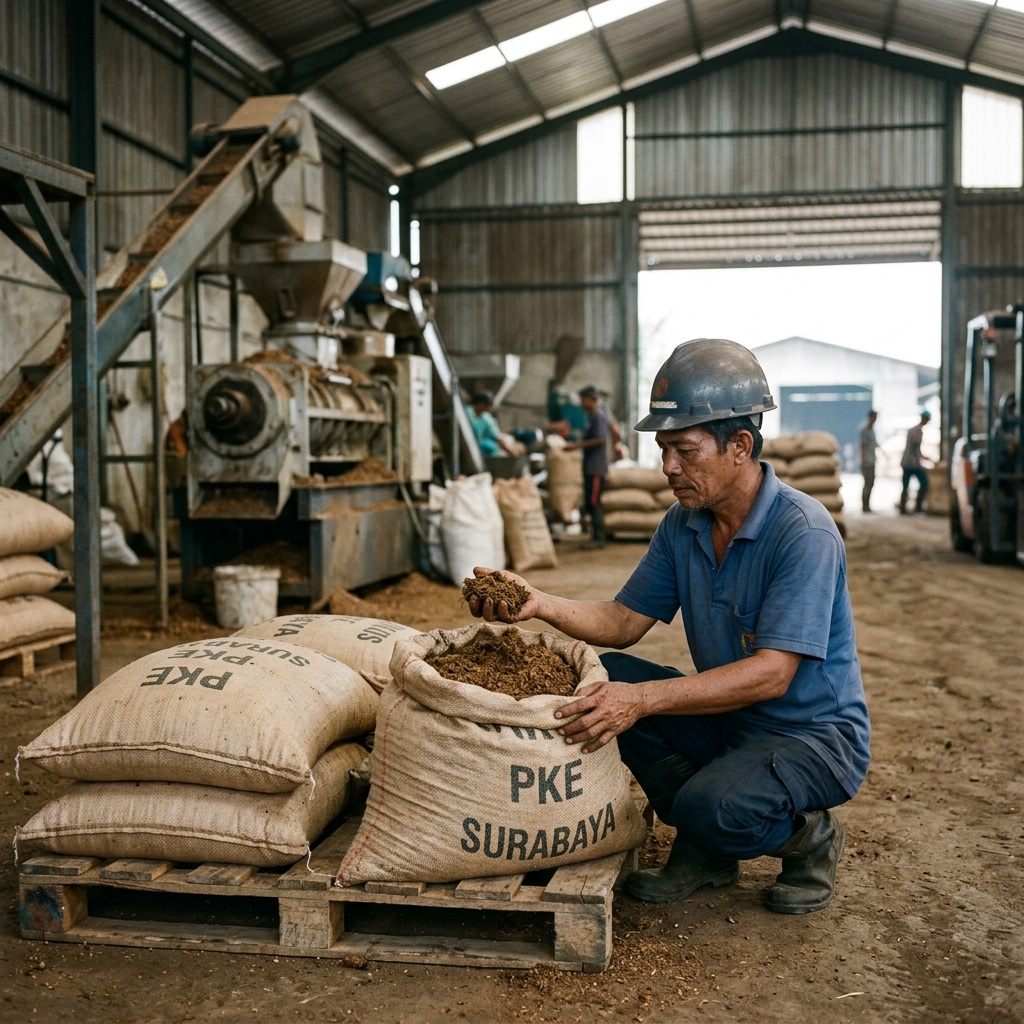
Palm Kernel Expeller has become the most sought-after efficient feed solution for agribusiness players today. Commercial feed costs that have surged by up to 40% in recent years demand that farmers look for high-protein alternatives without sacrificing the daily weight gain of livestock. Without a precise formulation strategy, your livestock business profit margins can be significantly eroded amidst the 2026 market dynamics.
This comprehensive guide is here to thoroughly address those challenges. Based on industry research and feed laboratory nutritional analysis, we break down everything about this high-value solid palm oil by-product. You will learn about animal feed nutritional profiles, optimal dosages, cost-efficiency comparisons, and how to choose a trusted Surabaya livestock feed supplier to maintain the operational continuity of your farm business.
What Is Palm Kernel Expeller? Definition and Key Characteristics
Palm Kernel Expeller (PKE) is a highly nutritious solid by-product obtained from the mechanical extraction process of oil palm fruit kernel meat. PKE features a deep brown to golden color, a distinctive savory roasted nut aroma, and a dense flake texture highly favored by ruminant livestock.
In the modern agronomy industry, the utilization of PKE has been recognized by various international research bodies, including Food and Agriculture Organization (FAO), as an essential pillar of sustainable feed. In addition to being energy-rich from digestible fiber, this palm kernel cake contributes quality plant protein that optimally supports meat and milk productivity.

Differences Between Palm Kernel Expeller (PKE) and Palm Kernel Meal (PKM)
Many beginners equate PKE with PKM, even though their processing methods result in different nutritional characteristics. According to scientific documentation on Wikipedia Palm Kernel Meal, these terminologies refer to derivatives of palm kernel cake processing using distinct extraction techniques:
- Palm Kernel Expeller (PKE): Produced through high-pressure mechanical pressing (screw press) without chemical solvents. This method retains a residual vegetable oil content of between 6% and 10%, delivering superior metabolizable energy intake for livestock.
- Palm Kernel Meal (PKM): Obtained through chemical solvent extraction (solvent extraction), typically using liquid hexane. The residual oil is very low (less than 2%), resulting in a lower energy density compared to PKE.
For this reason, purely Palm Kernel Expeller mechanically processed products are much more favored by commercial farmers because they combine protein and essential fats in a balanced manner.
Mechanical Processing of Quality Palm Kernel Expeller
The physical and chemical quality of PKE is rooted in the primary processing chain of the palm oil mill. The process begins with separating the fiber and hard shell using a depericarper. The kernel seeds are then dried to a moisture content below 7% to prevent the growth of harmful mycotoxin-producing molds.
Once dried, the palm kernels enter crushing machines and screw presses. Mechanical friction heat expels crude palm kernel oil (CPKO), leaving behind a dense cake residue. The final stage involves gradual cooling before PKE is packed in breathable bags or stored in well-ventilated silos to ensure its organoleptic quality remains perfectly preserved until it reaches consumers.
Nutritional Content of Palm Kernel Expeller for Livestock
Understanding the nutritional parameters of PKE is fundamental before integrating it into a Total Mixed Ration (TMR). Various feed research publications on ScienceDirect demonstrate that the chemical profile of PKE possesses a high-quality fiber fraction in the form of hemicellulose, which is efficiently fermented by rumen microbes.
Details of the palm kernel expeller pke protein content and standard chemical parameters can be examined in the laboratory matrix below:
| Nutritional Component | Average Percentage (%) | Primary Function for Livestock |
|---|---|---|
| Crude Protein | 14,5% – 17,5% | Supports muscle tissue synthesis and milk casein formation |
| Crude Fat | 7,0% – 10,0% | Dense source of metabolizable energy and a solvent for vitamins A, D, E, and K |
| Crude Fiber | 15,0% – 18,0% | Maintains stable rumen pH and prevents sub-acute acidosis disorders |
| Moisture Content | Maximum 10.0% | Ensures shelf-life stability and prevents mold spore growth |
| Ash (Ash Content) | 3,5% – 5,5% | Natural provider of macro and micro minerals such as phosphorus and zinc |
| Ruminant Metabolizable Energy (ME) | 10,5 – 11,5 MJ/kg | Boosts daily weight gain and sustains lactation energy |
The nutritional combination above confirms that PKE is not merely an ordinary feed filler, but rather a functional ruminant concentrate feed capable of partially replacing high-cost imported raw materials.
Structural Carbohydrate Fraction and Rumen Digestibility
The uniqueness of PKE lies in its non-starch polysaccharide structure. Most of the fiber in PKE consists of soluble mannans and cellulose that do not cause sudden lactic acid spikes in the cow's rumen.
Rumen cellulolytic bacteria break down this fiber into volatile fatty acids (VFAs) such as acetate and propionate. These compounds act directly as precursors for blood glucose and milk fat synthesis in productive dairy livestock.
Amino Acid Profile and Mineral Balance
Although PKE has limitations in lysine and methionine amino acids when fed to poultry, its amino acid composition is highly favorable for rumen microflora. Microbes digest PKE nitrogen to synthesize high biological value microbial protein.
In terms of minerals, PKE features a favorable phosphorus-to-calcium ratio. An organic phosphorus content reaching 0.6% substantially aids sturdy bone development in young feeder cattle.
7 Great Benefits of Palm Kernel Expeller for the Livestock Industry
The use of quality palm kernel expeller provides various measurable operational and financial advantages for modern livestock farming. Here are 7 main benefits of applying PKE in livestock nutrition management:
- Significantly Reducing Feed Ration Costs: Partial substitution of imported soybean meal-based concentrates with PKE can reduce daily ration budgets by up to 25%–35% without reducing feed conversion ratio (FCR).
- Increasing Average Daily Gain (ADG): The amino acid and essential fatty acid content in PKE is proven to boost the daily weight gain of beef cattle up to 1.0–1.3 kg per head per day.
- Reducing the Risk of Rumen Acidosis: Unlike corn or wheat grains that are rich in rapidly fermentable starch, PKE fiber is digested slowly by microbes, maintaining the stability of rumen fluid pH above 6.2.
- Increasing Milk Production and Solid Non-Fat (SNF): In dairy farming, PKE stimulates milk fat synthesis, ensuring milk fat content and specific gravity meet the premium standards of the dairy processing industry (IPS).
- Highly Stable Shelf Life: The low moisture content of PKE (below 10%) provides a shelf life of up to 6 months in dry tropical warehouses without significant deterioration in nutritional quality.
- High Palatability Thanks to a Savory Aroma: Natural palm vegetable oil emits a distinctive savory aroma that stimulates livestock appetite, especially during the adaptation transition to new concentrate feed.
- Abundant Year-Round Availability: As the world's number one palm producer, Indonesia guarantees that PKE stocks remain stable throughout the year without seasonal constraints like imported grain commodities.

Efficiency Comparison of Palm Kernel Expeller vs Other Alternative Feeds
In formulating balanced rations, farmers often compare PKE with other plant-based raw material sources such as Copra Meal (copra meal) and soybean meal (Soybean Meal / SBM). Each offers specific advantages depending on the livestock performance targets.
Copra meal stands out with its sweet aroma and high protein digestibility, making it an ideal complement when blended with PKE. Meanwhile, quality regulations from the Ministry of Agriculture of the Republic of Indonesia continue to encourage the utilization of local, renewable raw materials to reduce reliance on imported soybean meal, whose prices fluctuate with global currency exchange rates.
In addition to protein-rich concentrate feeds, the integration of oil palm and coconut plantation by-products also includes items such as Cocopeat for high-sanitation livestock bedding, as well as Palm Kernel Shell (palm kernel shells) as boiler biomass for feed mills. For early-lactation dairy farms, rumen-bypass energy supplements such as Calcium Salts of Palm Oil Fatty Acids can be combined with PKE to maximize milk production without triggering an energy deficit.
Why Choose a Palm Kernel Expeller Supplier in Surabaya?
Surabaya holds a pivotal position as the most vital logistics and agricultural commodity trading epicenter in Eastern Indonesia. Choosing a Surabaya-based PKE supplier delivers unmatched supply chain advantages for domestic livestock industry players.
1. Connectivity to the Port of Tanjung Perak
The Port of Tanjung Perak serves as the primary gateway for maritime logistics distribution. Supplies of PKE from Sumatra and Kalimantan transit through Surabaya's container and bulk terminals before being distributed to East Java, Bali, NTB, NTT, and Sulawesi. The advantage of these regular routes significantly slashes freight costs.
2. Quality Assurance through Modern Warehousing
Experienced East Java palm kernel expeller distributors implement certified commodity handling systems. Modern warehousing is equipped with optimal aeration circulation, hygienic pallet arrangements, and routine sanitation to eliminate the risk of mold growth during storage.
3. Supply Scalability Ahead of the 2026 Demand Surge
The year 2026 is projected to see strong growth in livestock product consumption. A strategic partnership with a Surabaya supplier ensures that Surabaya 2026 palm kernel expeller prices remain competitive and your delivery fleet quotas are allocated reliably without shipment delays.
Practical Guidelines and Effective Dosage for PKE
Understanding the proper application of palm kernel expeller in cattle feed is crucial to the successful adaptation of the animal's digestive tract. A gradual acclimation process must be implemented so that rumen microbes can proliferate and adjust to the new feed substrate.
Recommended Dosage for Dairy and Beef Cattle
For beef cattle fattening (feedlot), PKE can be included in a proportion of 20% to 40% of the total dry weight of the concentrate ration. Provide a transition period of 7–14 days starting with a 10% dosage, then increase it gradually. PKE blends well with corn stover, elephant grass silage, or brewer's spent grains.
In dairy cattle, the optimal dosage ranges from 15% to 25% of the total dry matter of the concentrate. This dosage provides an ideal supply of natural palm fat to boost milk solids without causing digestive disorders or affecting the flavor of fresh milk.
Application in Poultry and Monogastric Livestock
The digestive system of poultry and swine (monogastric) has limitations in digesting non-starch polysaccharides (NSP) such as beta-mannan. Therefore, the dosage for broiler chickens and laying hens is limited to a maximum of 5%–8%. The use of fiber-degrading enzymes (commercial mannanase) is highly recommended to break down the cell walls of PKE so that its metabolizable energy is maximally absorbed.
Makmur Amanah Sejahtera provides high-quality processed palm products such as Palm Kernel Expeller, Palm Kernel Shell, Crude Palm Oil, Palm Kernel Oil, and others. Please contact us via WhatsApp +6282140002198 or email admin@makmuramanah.co.id.
Frequently Asked Questions About Palm Kernel Expeller
Is Palm Kernel Expeller safe for consumption by all types of livestock?
PKE is very safe for ruminants such as cattle, sheep, and goats. For poultry and swine, its inclusion is limited to a maximum of 5%–8% and it is recommended to be combined with mannanase enzymes so that the crude fiber fraction can be completely digested without burdening the monogastric digestive system.
What is the shelf life of Palm Kernel Expeller in tropical warehouses?
PKE can remain in prime condition for 4 to 6 months in tropical climates. As a prerequisite, the initial moisture content must be below 10%, and it should be stored in breathable sacks in a well-ventilated room, placed on dry wooden pallets to avoid moisture from concrete floors.
How do you identify high-quality Palm Kernel Expeller?
High-quality PKE has a savory, fragrant aroma typical of roasted nut oil, with no rancid or musty odor, a uniform brown color, no clumping due to moisture, and is free from contamination by sharp palm kernel shells or foreign matter.
Why is shipping Palm Kernel Expeller from Surabaya more advantageous?
Surabaya is supported by Tanjung Perak Port with the most extensive cargo routes in Eastern Indonesia. This results in more economical sea and land freight costs, rapid loading and unloading handling, and guaranteed stable supply without seasonal disruptions.
Does PKE require cooking before being fed to cattle?
No cooking or boiling is necessary. PKE can be mixed directly into dry concentrate feed (TMR) or stirred with water and molasses as a highly nutritious daily wet mash ready to be served directly to livestock.
Conclusion: The Key to Livestock Feed Efficiency Success in 2026
Entering the agribusiness competitive landscape of 2026, which increasingly demands efficiency, integrating high-quality raw materials has become the key to the success of modern livestock businesses. The use of cattle feed supplements based on palm kernel expeller has been empirically proven to reduce ration costs by up to a third of the budget while consistently boosting daily livestock weight gain.
Ensure you always partner with an experienced distributor ready to provide laboratory test transparency and a guaranteed, uninterrupted supply. Secure your supply quota of Palm Kernel Expeller high quality directly from a trusted supplier to safeguard the continuity of your increasingly profitable livestock business.



