
Have you ever checked the ingredient list on your favorite snacks, instant noodles, or baked goods? If so, you’ve likely come across “palm oil” or one of its derivatives. One of the most common and versatile forms is RBD Palm Olein CP6, a powerhouse ingredient in the global food industry. But what exactly is it, and why is it so widely used?
This guide will demystify RBD Palm Olein CP6, breaking down its name, production process, various grades, and extensive applications. We’ll explore its functional benefits for manufacturers and consumers alike, while also touching on important health and sustainability considerations. By the end, you’ll have a clear understanding of this ubiquitous cooking oil.
Daftar isi
- What Is RBD Palm Olein? A Simple Definition
- Demystifying the Name: What Do “RBD” and “CP6” Mean?
- How Is RBD Palm Olein CP6 Made?
- Key Characteristics of RBD Palm Olein CP6
- What Are the Common Uses of RBD Palm Olein CP6?
- The Major Benefits of Using RBD Palm Olein CP6
- Beyond Olein: Exploring the Palm Oil Family Tree
- Sustainability and Health: An Important Perspective
- Pemasok Terpercaya Anda untuk Produk Sawit
- Conclusion: The Go-To Choice for Stability and Versatility
What Is RBD Palm Olein? A Simple Definition
At its core, RBD Palm Olein is the liquid fraction obtained from palm oil. This oil is first extracted from the fruit of the oil palm tree. The “RBD” part of its name refers to the refining process it undergoes, making it a stable, neutral, and light-yellow liquid perfect for a vast array of food applications. This processed form is the most widely traded type of palm oil globally.
Tidak seperti Minyak Sawit Mentah, which is reddish and has a strong flavor, the refining process for RBD Palm Olein CP6 strips away these characteristics. This results in a highly consistent and reliable product that doesn’t interfere with the taste or smell of the food it’s used in, making it a favorite for industrial-scale cooking and food manufacturing.

Demystifying the Name: What Do “RBD” and “CP6” Mean?
The name “RBD Palm Olein CP6” might sound technical, but it’s a precise description of the product’s properties. Let’s break it down into its two main components to understand what makes this oil unique.
RBD: Refined, Bleached, & Deodorized
This acronym describes the three crucial steps in the purification process that transforms crude palm oil into a finished product ready for consumption:
- Halus: This initial step removes impurities and free fatty acids (FFAs) that can cause the oil to smoke or go rancid quickly. Refining improves the oil’s stability.
- Diputihkan: Here, the oil is filtered through natural clays to remove the deep red-orange pigments (carotenoids) found in crude palm oil. This results in a light, golden-yellow liquid.
- Diberi penghilang bau: In the final step, steam is used under a vacuum to strip away any residual odors and flavors, yielding a completely neutral oil.
CP6: Cloud Point 6
The “CP” stands for Cloud Point, which is the temperature at which the oil starts to become cloudy or solidify. “CP6” means the cloud point of this specific grade is 6°C (42.8°F). This is a critical specification, as it ensures the oil remains liquid and clear in cooler climates and refrigerated conditions, preventing unwanted crystallization.
This low cloud point is a key advantage of RBD Palm Olein CP6, making it a reliable, free-flowing oil for use in dressings, sauces, and for bottling as a consumer cooking oil.
How Is RBD Palm Olein CP6 Made?
The journey from palm fruit to bottled oil involves a sophisticated process called fractionation. After the crude palm oil is refined (RBD process), it is slowly cooled under controlled conditions. This causes the solid, higher-melting-point fats (known as palm stearin) to crystallize.
These solid crystals are then separated from the liquid portion through filtration. The remaining liquid is Palm Olein. To achieve the specific RBD Palm Olein CP6 grade, this process is carefully managed to ensure the cloud point is at or below 6°C. This meticulous process guarantees a high-quality, stable liquid oil. For an in-depth look at food processing, you can explore resources from the Institute of Food Technologists.
Key Characteristics of RBD Palm Olein CP6
Besides its low cloud point, RBD Palm Olein CP6 is valued for several other key characteristics:
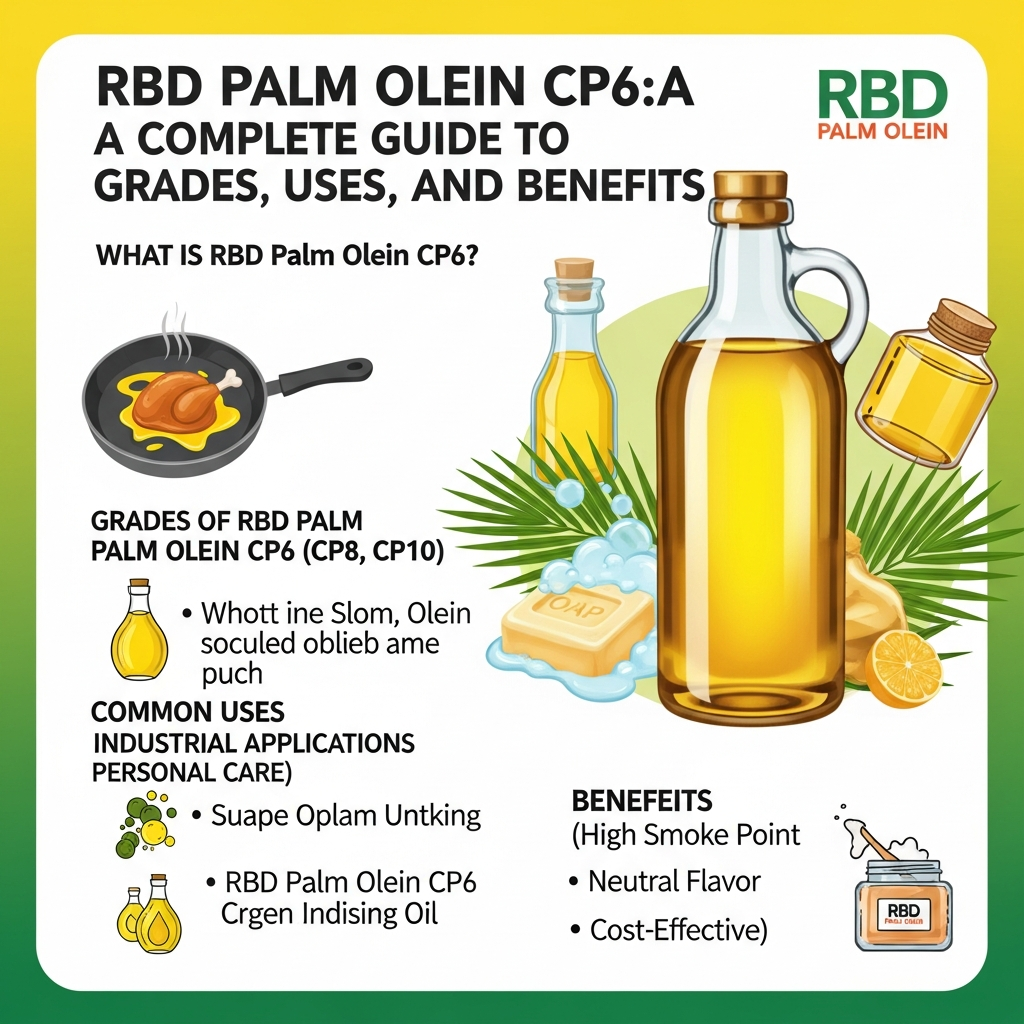
- Titik Asap Tinggi: It has a smoke point of around 235°C (455°F), making it excellent for high-heat cooking methods like deep-frying and stir-frying.
- Stabilitas Oksidatif: The oil is naturally resistant to oxidation, which means it has a long shelf life and is less prone to becoming rancid. This is a major benefit for packaged foods.
- Profil Rasa Netral: Its lack of taste and odor ensures that it carries the flavor of the food it’s cooking rather than imposing its own.
While CP6 is a premium grade, other grades like CP8 and CP10 are also common. The number simply indicates a higher cloud point (8°C and 10°C, respectively), making them suitable for warmer climates where solidification is less of a concern.
What Are the Common Uses of RBD Palm Olein CP6?
Fleksibilitas dari RBD Palm Olein CP6 makes it a staple ingredient across the food industry. You can find it in:
- Memasak & Menggoreng: It’s the go-to choice for restaurants and food manufacturers for deep-frying items like french fries, chips, and instant noodles due to its stability and cost-effectiveness.
- Kue dan Roti: It helps create a moist texture in cakes, biscuits, and pastries.
- Margarin & Lemak Nabati: It’s a key component in producing spreads and solid fats.
- Manisan: Used in chocolate coatings and fillings for a smooth mouthfeel.
- Susu Formula Bayi: As a source of palmitic acid, a fatty acid found in human breast milk. The Organisasi Kesehatan Dunia provides extensive research on dietary fats and nutrition.
The Major Benefits of Using RBD Palm Olein CP6
Manufacturers and consumers benefit from the unique properties of RBD Palm Olein CP6 in several ways:
- Efektivitas Biaya: Oil palm is an incredibly efficient crop, producing more oil per hectare than any other vegetable oil crop. This high yield translates to a more affordable and stable price point.
- Functionality & Versatility: Its stability at high temperatures and neutral profile make it suitable for almost any food application, from frying to baking.
- Longer Shelf Life: Its natural resistance to oxidation helps extend the shelf life of products it’s used in, reducing food waste.
- Nilai Gizi: It is a natural source of Vitamin E (tocopherols and tocotrienols), which are powerful antioxidants. According to studies on PubMed Pusat, tocotrienols may offer various health benefits.

Beyond Olein: Exploring the Palm Oil Family Tree
The oil palm tree is remarkably efficient, producing more than just the oil that becomes RBD Palm Olein. The fruit’s kernel, for instance, is also a source of valuable products. From the Inti Sawit itself, we get Minyak Inti Sawit, which has a different fatty acid profile and is widely used in confectionery and non-food items like soap.
The processing also yields significant by-products. After oil is extracted from the kernel, the remaining solids become Mesin Pengekstrak Inti Sawit, a high-protein ingredient for animal feed. The hard Cangkang Inti Sawit is a clean, efficient biofuel. Even the fruit bunches, once stripped, are not wasted; the Tandan Buah Kelapa Sawit can be used as fertilizer or converted into energy.
Sustainability and Health: An Important Perspective
No discussion of palm oil is complete without addressing the valid concerns around sustainability and health. Historically, palm oil cultivation has been linked to deforestation and habitat loss. In response, industry-wide standards have been developed to promote responsible production.
When choosing products, look for certifications from the Forum Meja Bundar tentang Minyak Sawit Berkelanjutan (RSPO). The RSPO works with producers to ensure palm oil is cultivated in an environmentally and socially responsible way. Supporting certified sustainable palm oil helps drive the industry toward better practices.
Dari perspektif kesehatan, RBD Palm Olein CP6 is often criticized for its saturated fat content. However, it contains a balanced profile of saturated and unsaturated fats and is free of trans fats. Like any oil or fat, moderation is key to a healthy diet.
Pemasok Terpercaya Anda untuk Produk Sawit
Mencari Produk Sawit Berkualitas Tinggi?
Makmur Amanah Sejahtera menyediakan produk-produk sawit berkualitas tinggi seperti bungkil inti sawit, cangkang inti sawit, minyak sawit mentah, minyak inti sawit, dll. Silakan hubungi kami melalui WhatsApp +6282140002198 atau email kami di admin@makmuramanah.co.id.
Conclusion: The Go-To Choice for Stability and Versatility
RBD Palm Olein CP6 is far more than just a generic “vegetable oil.” It is a highly refined, incredibly functional product engineered for performance and consistency. Its unique combination of a high smoke point, neutral flavor, long shelf life, and affordability has made it an indispensable ingredient in the global food supply chain. By understanding its properties and opting for sustainably sourced options, both consumers and manufacturers can continue to benefit from this versatile oil.
 Indonesian
  English
  Chinese
  Arabic