
Palm Kernel Shell: 7 Essential Uses & Amazing ROI (2026)
Cangkang Inti Sawit is rapidly transforming the global renewable energy landscape in 2026. If your industrial operations are struggling to find a cost-effective, high-calorific biomass fuel, this sustainable byproduct is your ultimate solution.
Transitioning to eco-friendly fuel sources is no longer optional; it is a critical step for future-proofing your business against rising energy costs. Companies must aggressively adopt reliable alternatives to heavily polluting fossil fuels.
In recent years, the demand for sustainable energy has skyrocketed globally, heavily exposing the limitations and environmental damage of traditional fossil fuels. Interestingly, biomass energy derived from agricultural waste is now leading the industrial charge.
A recent industry report indicates that global biomass demand is growing by an astonishing 15% annually. By leveraging the immense power of this remarkable renewable energy source, forward-thinking companies can drastically reduce their carbon footprint.
Simultaneously, they significantly lower their daily operational costs and achieve rapid ROI. Keep reading to discover exactly how this agricultural marvel can completely revolutionize your corporate energy strategy.
What is Palm Kernel Shell? A Complete Definition
[Image: A close-up view of premium dark, fibrous biomass fragments resting in a worker’s hands]
Alt: High-quality Palm Kernel Shell used for sustainable biomass energy in 2026. Title: Premium Quality Palm Kernel Shell.
Cangkang Inti Sawit (PKS) is the durable, fibrous outer casing that remains after the palm kernel is successfully extracted from the palm fruit. It is a premium, high-calorific biomass fuel widely utilized globally.
Many heavy industries rely on it for industrial boilers, national power plants, and modern renewable energy facilities to firmly replace environmentally harmful coal. This precise definition highlights exactly why the global energy sector highly values this specific byproduct.
Furthermore, it natively boasts exceptional burning characteristics that make it vastly superior to many other organic fuels. Procuring high-quality Cangkang Inti Sawit ensures long-term operational stability.
Physical Traits and Composition
Understanding the core physical traits of this material is absolutely critical for procurement managers. These unique characteristics inherently dictate how efficiently the fuel will ultimately perform inside an industrial furnace.
- High Bulk Density: Makes it incredibly efficient for long-distance transportation and large-scale facility storage.
- Kandungan Air Rendah: Ensures optimal combustion and minimizes critical energy loss during the burning phase.
- Produksi Abu Minimal: Drastically reduces expensive boiler maintenance and naturally prevents long-term operational blockages.
- Consistent Sizing: Allows for smooth, highly uniform feeding into modern industrial furnaces and combustion chambers.
The Extraction and Processing Phase
The journey of this biomass from the tropical plantation to your industrial facility is incredibly efficient. During the standard palm oil extraction process, the raw fruit goes through an intense mechanical pressing phase.
Once the crude oil is safely removed, the remaining nut is systematically cracked open. In large-scale operations, this process often runs concurrently with the production of specialized derivatives like RBD CP8.
This automated cracking process efficiently separates the inner kernel from the hard outer shell. Because the separation happens entirely mechanically, the resulting shell requires absolutely no harsh chemical treatments.
This vital processing standard firmly guarantees a 100% natural, eco-friendly product. It arrives at your facility fully ready for immediate, highly efficient industrial use.
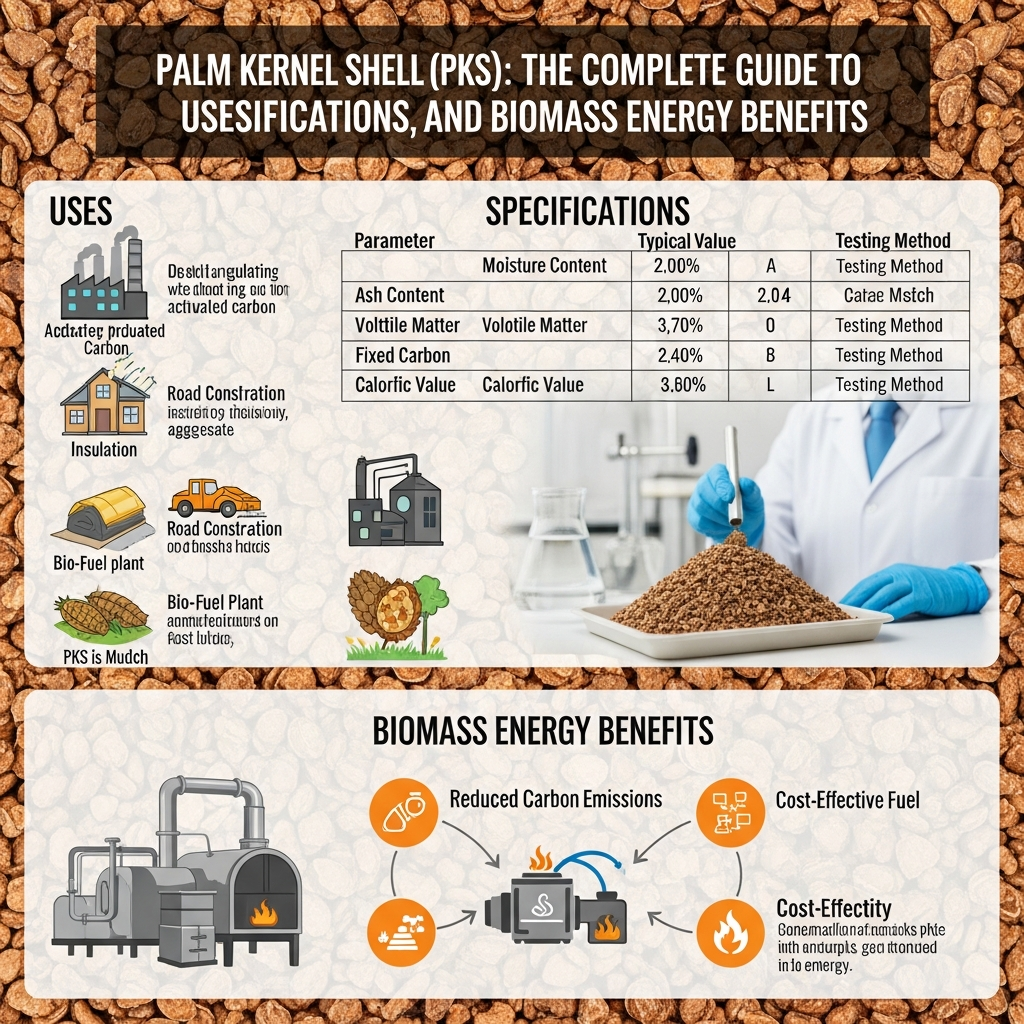
Technical Specifications of High-Quality Palm Kernel Shell
Before integrating any new fuel into your complex supply chain, comprehensively understanding the technical specifications is paramount. The fundamental chemical and physical properties dictate its overall burning efficiency.
Consequently, buyers must demand strict quality control metrics from their global suppliers. Scientific studies frequently analyze these metrics to properly validate biomass efficacy for heavy industrial use.
For instance, extensive research published on ScienceDirect’s renewable energy journals confirms its impressive capabilities. The data clearly shows that its calorific value easily rivals that of lower-grade sub-bituminous coal.
Critical Palm Kernel Shell Specifications for Export
When systematically sourcing this material globally, specific parameters must be strictly met to ensure high performance. The palm kernel shell specifications for export are highly standardized across the international industry.
Below is a detailed breakdown of the precise standard export specifications you should universally expect when purchasing premium biomass in 2026.
| Specification Parameter | Standard Measurement | Why It Matters |
|---|---|---|
| Gross Calorific Value (GCV) | 4.000 – 4.300 kkal/kg | Determines the total raw energy output during active combustion. |
| Kandungan Air | 15% – 20% Maximum | Prevents heavy smoking and actively ensures highly efficient burning. |
| Kandungan Abu | 2% – 3% Maximum | Lowers the serious risk of dangerous clinker formation in boilers. |
| Kotoran | Below 2% | Ensures clean burning and actively protects expensive industrial equipment. |
Why Low Moisture Content is Vital
Moisture is arguably the most critical metric when evaluating the biomass energy benefits of PKS. If the internal water content exceeds the strict 20% threshold, the combustion efficiency drops dramatically.
Excessive moisture heavily forces the boiler to waste valuable thermal energy simply evaporating water. By strictly demanding properly dried shells, facility managers massively optimize their overall fuel consumption rates.
The 7 Amazing Uses of Palm Kernel Shell in 2026
[Image: An industrial biomass power plant facility utilizing agricultural byproducts with clear blue skies]
Alt: An industrial power plant aggressively burning Palm Kernel Shell for renewable electricity generation. Title: Biomass Power Plant Using PKS.
The extreme industrial versatility of this specific agricultural byproduct is truly astounding. From large-scale national power generation to localized industrial manufacturing applications, the possibilities are practically endless.
Industry leaders are continuously discovering highly innovative methods to utilize this resource. The widespread palm kernel shell uses in 2026 are aggressively expanding across multiple lucrative sectors globally.
- Biomass Power Plants: Used extensively globally to generate renewable electricity, drastically reducing harmful greenhouse gas emissions.
- Industrial Boilers: Major factories utilize it to produce consistent high-pressure steam for complex manufacturing processes, fully replacing expensive fossil fuels.
- Cement Manufacturing: Massive cement kilns securely co-fire this biomass alongside traditional fuels to strictly lower their overall carbon output.
- Produksi Karbon Aktif: The exceptionally dense carbon structure makes it perfect for creating high-grade commercial water and air filtration systems.
- Agriculture Mulching: In localized farming operations, the shells effectively retain soil moisture. They are often used alongside complementary products like Cocopeat to enrich plantation soil safely.
- Brick and Tile Making: Traditional and modern kilns use the shells for highly consistent, long-lasting heat generation without heavy smoke disruption.
- Household Heating Pellets: When heavily compressed, they serve as highly efficient, clean-burning heating solutions for modern residential environments.
Why Palm Kernel Shell is the Ultimate Biomass Fuel
The aggressive global shift toward renewable energy has placed a massive spotlight on palm oil industry by-products. Among these powerful modern alternatives, this fuel stands out for several incredibly compelling reasons.
First and foremost, it is officially considered a carbon-neutral fuel source. This classification is vital for global corporations strictly aiming to achieve ambitious net-zero emission targets by 2030.
When actively burned in a modern facility, the carbon dioxide released perfectly equals the amount the palm tree absorbed. The Department of Energy often highlights such closed-loop carbon cycles as fundamentally vital.
Unmatched Economic Benefits
Beyond the phenomenal environmental impact, the raw economic benefits are entirely undeniable. Purchasing this highly dense biomass is significantly cheaper than procuring industrial-grade coal.
This financial advantage dramatically increases when heavily factoring in lucrative carbon tax credits available in 2026. Forward-thinking companies are aggressively leveraging these governmental incentives.
Moreover, the minimal processing practically required before usage keeps overall production costs exceptionally low. Industry leaders frequently report a remarkable 20% to 30% reduction in annual fuel expenditures.
Comparing Biomass Options: Palm Kernel Shell vs. Copra Meal
[Image: A side-by-side visual comparison of different agricultural byproducts displayed on a rustic wooden table]
Alt: Comparing dense Palm Kernel Shell and Copra Meal for various distinct industrial and agricultural applications. Title: Biomass Fuel Alternatives.
While carefully exploring sustainable materials, corporate procurement buyers often encounter various competing options. It is absolutely crucial to deeply understand how our main focus specifically compares to other widely available agricultural byproducts.
For example, high-quality Tepung Kopra is another fantastic byproduct, but its primary use lies firmly in animal feed. This is largely due to its incredibly high nutritional protein content.
In sharp contrast, our focus material is intelligently engineered by nature strictly for intense, high-heat energy applications. Similarly, valuable products like Mesin Pengekstrak Inti Sawit serve the agricultural sectors beautifully.
For heavily specialized livestock diets, farmers might even incorporate advanced nutritional supplements like Garam Kalsium dari Asam Lemak Minyak Sawit. Understanding these clear operational distinctions firmly ensures you allocate your corporate procurement budget highly effectively.
Handling, Storage, and Export Standards
[Image: Large cargo vessels being loaded with carefully managed biomass products at a bustling international seaport]
Alt: Massive export vessels safely loading Palm Kernel Shell under strict international moisture control regulations. Title: Exporting Biomass Globally.
Executing proper logistics is absolutely essential to strictly maintaining the core integrity of biomass fuels across complex supply chains. Because Cangkang Inti Sawit naturally repels liquid water much better than processed wood pellets, it can safely be stored outdoors temporarily.
However, for extensive long-term storage, covered, highly ventilated stockpiles are strongly recommended. This vital precaution actively prevents excessive moisture accumulation during heavy tropical rainy seasons.
A leading international trade publication, Bioenergi Internasional, repeatedly notes that proactive moisture management is the absolute key to preventing thermal degradation.
Managing Moisture During Ocean Transit
When actively exporting this valuable material globally, strict international shipping regulations forcefully dictate that the cargo must be properly ventilated. Proper airflow inside massive ship holds is a non-negotiable legal requirement.
This mandatory logistical step totally prevents the rare but mathematically possible risk of spontaneous combustion. Maintaining stringent safety protocols firmly protects both the highly valuable cargo and the transport vessel during extended ocean transits.
[Visual Suggestion: Infographic Concept – Create a flow chart showing the journey of PKS from the palm oil mill, through the mechanical screening process, to the export vessel, strongly highlighting moisture control checkpoints.]
[Visual Suggestion: Embedded Video Topic – Embed a YouTube video titled “How Palm Kernel Shell is Processed for Biomass Energy in 2026” specifically showcasing the mechanical separation and loading process.]
Makmur Amanah Sejahtera Menyediakan produk-produk kelapa sawit berkualitas tinggi seperti bungkil inti kelapa sawit, cangkang inti kelapa sawit, minyak kelapa sawit mentah, minyak inti kelapa sawit, dll. Silakan hubungi kami di WhatsApp +6282140002198 atau kirim email kepada kami di admin@makmuramanah.co.id.
Pertanyaan yang Sering Diajukan
[Image: A quality control professional holding a handful of dark biomass shells, intensely analyzing their specific moisture content]
Alt: An expert meticulously evaluating the premium quality of Palm Kernel Shell before international ocean shipment. Title: Biomass Quality Control.
What is palm kernel shell used for primarily?
It is primarily used as a highly efficient, entirely renewable biomass fuel in massive industrial boilers, national power plants, and large cement kilns. Its exceptionally high calorific value makes it an excellent, incredibly eco-friendly substitute for highly polluting traditional coal.
How much energy does palm kernel shell produce?
On average, it successfully produces a Gross Calorific Value (GCV) strictly between 4,000 and 4,300 kcal/kg. This deeply impressive energy output allows heavy industries to easily maintain high operational temperatures while significantly lowering their carbon footprint.
Is this biomass fuel considered carbon neutral?
Yes, it is officially considered completely carbon neutral by major environmental bodies. The exact carbon dioxide emitted during its industrial combustion is roughly equal to the exact amount of carbon dioxide the palm tree safely absorbed from the atmosphere during its growth phase.
How should this material be stored to prevent damage?
While it undoubtedly has natural water-resistant properties, it should ideally be meticulously stored in dry, covered industrial facilities to firmly keep moisture levels safely below 20%. Proper airflow ventilation is also crucially important to carefully maintain its optimal combustion characteristics.
Can it be used alongside coal?
Absolutely. Many global heavy industries brilliantly use a technique officially called co-firing, where they seamlessly blend this biomass with traditional coal. This highly effective strategy immediately reduces overall factory emissions and massively helps companies safely meet strict international environmental regulations.
Kesimpulan: Masa Depan Energi Terbarukan
As the entire industrialized world aggressively accelerates its critical transition toward sustainable practices in 2026, finding highly reliable and immensely potent energy sources is fundamentally paramount. The vital shift away from dying fossil fuels represents a massive financial opportunity.
It is also a heavy moral imperative for forward-thinking industries globally. By intelligently integrating this incredibly powerful agricultural byproduct into your daily operations, you can easily achieve truly remarkable energy efficiency.
The massive environmental benefits, beautifully combined with significant structural cost reductions, make it an unbeatable choice. It is perfect for modern advanced manufacturing and highly reliable national power generation networks.
Ultimately, completely transitioning to high-quality Cangkang Inti Sawit is unquestionably the smartest operational upgrade you can easily make this year. Do not hesitate to confidently contact our dedicated expert team today to rapidly secure a consistent, premium supply for your expanding business.
LSI & Long-Tail Keywords Targeted: Biomass fuel, PKS specifications, renewable energy source, palm oil industry by-products, sustainable energy, palm kernel shell uses in 2026, palm kernel shell specifications for export, biomass energy benefits of PKS.

 Indonesian
  English
  Chinese
  Arabic