
Table of Contents
- What Exactly is an Empty Palm Fruit Bunch (EFB)?
- 11 Powerful Uses for Empty Palm Fruit Bunch (EFB)
- 1. Biofuel for Clean Energy Generation
- 2. High-Nutrient Compost and Organic Fertilizer
- 3. Sustainable Pulp and Paper Production
- 4. Medium for Mushroom Cultivation
- 5. Reinforcement for Bioplastics and Composites
- 6. Soil Mulching and Erosion Control
- 7. Absorbent Animal Bedding
- 8. Manufacturing of Fiberboard and Particleboard
- 9. Production of Bio-oil via Pyrolysis
- 10. Creation of Activated Carbon for Filtration
- 11. Eco-Friendly Building Materials
- Conclusion: From Waste to Wealth
The palm oil industry is a global giant, but it produces a massive amount of biomass waste. For every ton of Crude Palm Oil, about 1.2 tons of empty fruit bunches (EFB) are generated. Traditionally seen as a disposal problem, innovative thinking is transforming this waste into a valuable resource. This article explores the 11 most powerful uses for empty palm fruit bunch, showcasing how we can create a more sustainable, circular economy.
What Exactly is an Empty Palm Fruit Bunch (EFB)?
An Empty Palm Fruit Bunch is what remains of the Oil Palm Fruit Bunch after the fruits have been removed for oil extraction. While the fruits are processed, the seed, or Palm Kernel, is used for other valuable products. The leftover bunches are a lignocellulosic material, rich in cellulose, hemicellulose, and lignin. This composition makes them an incredibly versatile raw material for a wide range of applications.

Instead of letting them rot in landfills or burning them in open fields, which contributes to air pollution, industries are now discovering potent new uses for empty palm fruit bunch. Let’s dive into the most impactful applications.
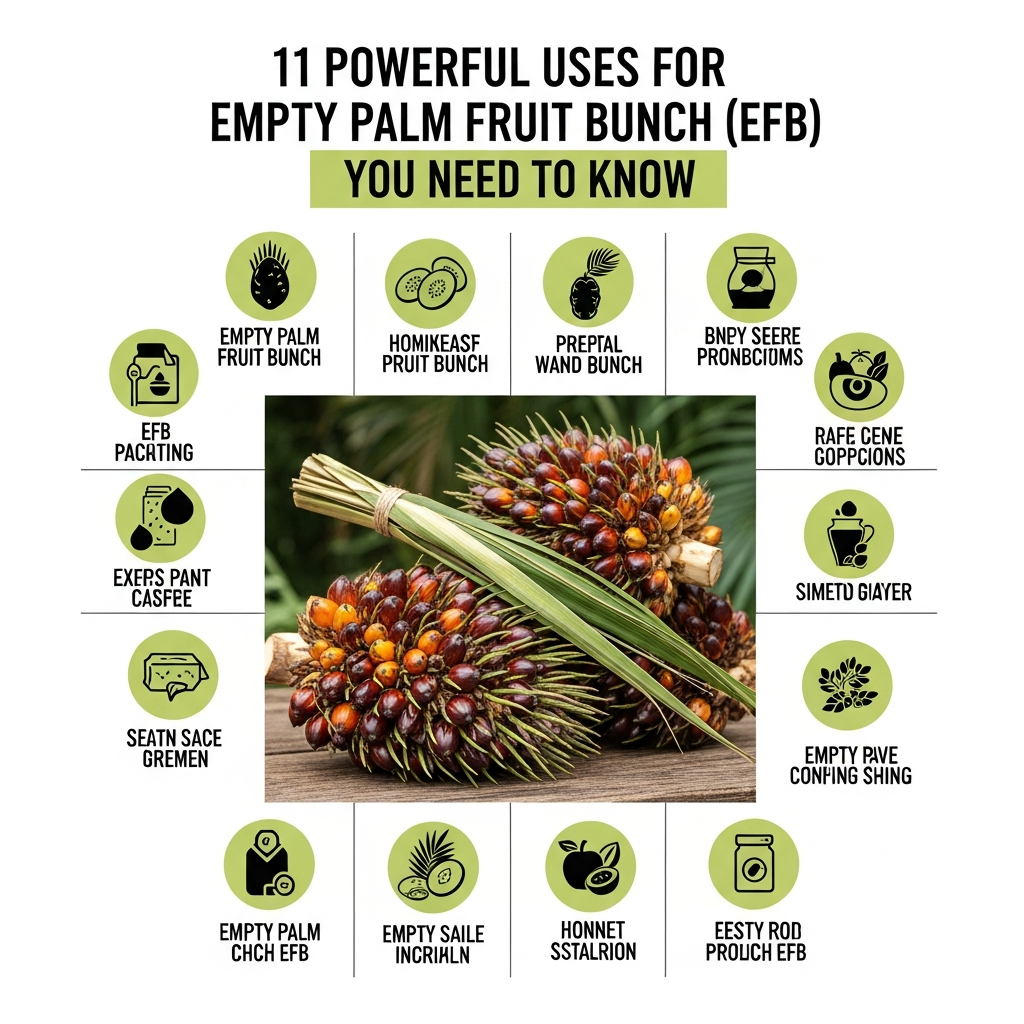
11 Powerful Uses for Empty Palm Fruit Bunch (EFB)
1. Biofuel for Clean Energy Generation
One of the most significant uses for empty palm fruit bunch is as a solid biofuel. EFB can be processed into pellets or briquettes or used directly in biomass boilers to generate steam and electricity. This reduces reliance on fossil fuels, lowers the industry’s carbon footprint, and is often done alongside using Palm Kernel Shell as another key biomass fuel. According to the International Renewable Energy Agency (IRENA), biomass is a critical component of the global renewable energy mix.
2. High-Nutrient Compost and Organic Fertilizer
EFB is rich in potassium (K) and other essential plant nutrients. Through composting, it decomposes into a dark, soil-like material called humus, which is an excellent organic fertilizer. Applying this compost back to the palm plantations improves soil structure, water retention, and nutrient content. This is one of the most eco-friendly uses for empty palm fruit bunch.
3. Sustainable Pulp and Paper Production
The high fiber content in EFB makes it a viable alternative to wood for producing pulp and paper. This non-wood fiber source helps reduce deforestation and pressure on natural forests. Research published in journals like Industrial Crops and Products has demonstrated the feasibility of EFB pulp for various paper products, from writing paper to packaging materials.
4. Medium for Mushroom Cultivation
Looking for unique uses for empty palm fruit bunch? Look no further than agriculture. The sterilized, shredded fibers of EFB serve as an excellent substrate for growing edible mushrooms, particularly Oyster mushrooms. The material provides the necessary nutrients and physical structure for mycelium to thrive, turning agricultural waste into a food source.

5. Reinforcement for Bioplastics and Composites
The strong natural fibers in EFB can be extracted and used as reinforcement in biodegradable plastics and composite materials. These “biocomposites” are lightweight, strong, and environmentally friendly, suitable for automotive parts and consumer goods. This innovative use of agricultural fiber is much like how Palm Kernel Oil is refined for specialty fats and oleochemicals, turning byproducts into high-value items.
6. Soil Mulching and Erosion Control
Spreading shredded EFB around the base of palm trees or other crops acts as a natural mulch. This layer helps to suppress weed growth, conserve soil moisture, and regulate soil temperature. As it slowly decomposes, it also adds organic matter back into the soil, preventing erosion. This is one of the simplest yet most effective uses for empty palm fruit bunch on the plantation itself.
7. Absorbent Animal Bedding
When dried and processed, EFB serves as a comfortable, absorbent bedding material for livestock. Its ability to keep enclosures clean improves animal hygiene. This makes it a sustainable bedding material, contrasting with other byproducts like Palm Kernel Expeller, which serves as a high-protein component in animal feed.
8. Manufacturing of Fiberboard and Particleboard
Similar to its use in paper, EFB fibers can be pressed with a binder to create medium-density fiberboard (MDF) and particleboard. These engineered wood products are essential for the furniture and construction industries. Utilizing EFB reduces the demand for virgin timber, making it another one of the many sustainable uses for empty palm fruit bunch.
9. Production of Bio-oil via Pyrolysis
Pyrolysis is a thermochemical process that heats biomass in the absence of oxygen to produce bio-oil, biochar, and syngas. Bio-oil can be refined into transportation fuels and chemicals, offering a renewable alternative to petroleum. As detailed in a study by the Food and Agriculture Organization (FAO), this technology holds immense potential for energy diversification.
10. Creation of Activated Carbon for Filtration
EFB can be converted into activated carbon, a highly porous material with a large surface area. Activated carbon is widely used in water purification and air filtration to adsorb pollutants. This advanced application is one of the most promising uses for empty palm fruit bunch, turning a simple byproduct into a high-value purification agent.
11. Eco-Friendly Building Materials
Researchers are exploring the use of EFB fibers in concrete and bricks. Adding these fibers can create lightweight, insulating, and more flexible building materials. According to a paper in the Journal of Sustainability, using biomass like EFB in construction can significantly reduce the environmental impact of building projects.
Makmur Amanah Sejahtera provides high-quality palm products such as Palm Kernel Expeller, Palm Kernel Shell, Crude Palm Oil, Palm Kernel Oil, etc. Kindly contact us at WhatsApp +6282140002198 or email us at admin@makmuramanah.co.id. The era of viewing Empty Palm Fruit Bunches as mere waste is over. The diverse and powerful uses for empty palm fruit bunch—from generating clean energy to creating sustainable materials—highlight its incredible potential. By embracing these innovations, the palm oil industry can move towards a more sustainable and profitable future, proving that true value can be found where we least expect it.Looking for High-Quality Palm Products?
Conclusion: From Waste to Wealth
 English
  Indonesian
  Chinese
  Arabic