 by admin
Empty Palm Fruit Bunch: The #1 Complete Guide for 2025
Inhoudsopgave
- What is an Empty Palm Fruit Bunch (EFB)?
- Key Uses and Applications of Empty Palm Fruit Bunch (EFB)
- The Incredible Benefits of Utilizing Empty Palm Fruit Bunch
- How is the Empty Palm Fruit Bunch Processed?
- Challenges and the Future of the Empty Palm Fruit Bunch
- Conclusion: The Power of a Valuable Byproduct
In the vast world of palm oil production, which gives us essential products like Ruwe palmolie en Palm Kernel Oil, a significant byproduct emerges that holds immense untapped potential: the Lege Palmfruittros (EFB). While the primary focus is often on the oil extracted from the fruitlets and the Palmpit, the entire palm harvest offers value. Other byproducts such as Palm Kernel Expeller en Palm Kernel Shell also play crucial economic roles.
For years, this EFB biomass was considered waste, posing disposal challenges. However, a shift towards sustainability has transformed it from a liability into a valuable resource. This guide explores the complete journey of the Oliepalmfruitbos, detailing its incredible uses, benefits, and its crucial role in creating a greener, more efficient industry.
What is an Empty Palm Fruit Bunch (EFB)?
An Empty Palm Fruit Bunch is the fibrous stalk left behind after the fresh fruitlets have been stripped off for palm oil extraction. These bunches consist of a dense network of lignocellulosic fibers, primarily made of cellulose, hemicellulose, and lignin. In its raw form, an EFB is bulky, tough, and has a high moisture content, typically between 60-70%.
Historically, managing the sheer volume of EFB produced daily was a major logistical and environmental headache for palm oil mills. But innovation has paved the way for processes that convert this “waste” into a variety of value-added products, making the Empty Palm Fruit Bunch a key player in the bio-based economy.

Key Uses and Applications of Empty Palm Fruit Bunch (EFB)
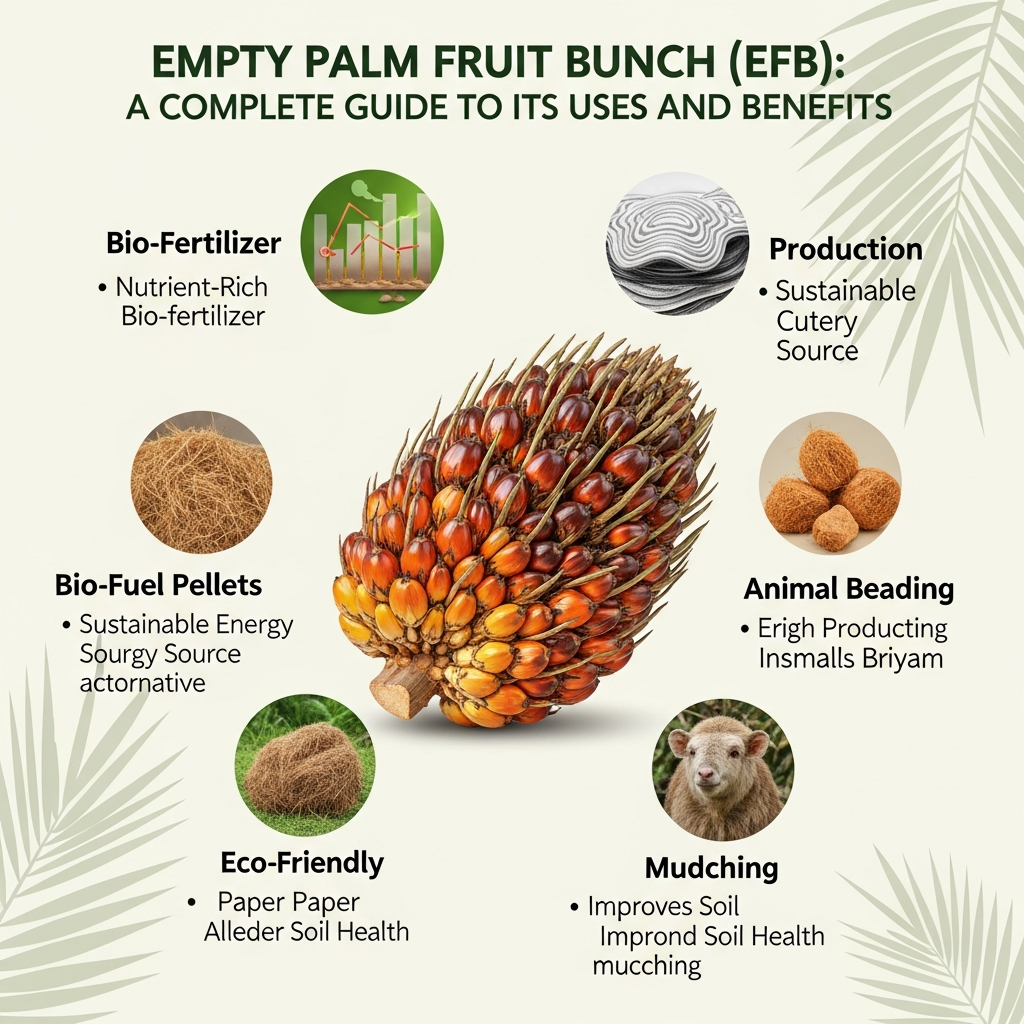
The versatility of the Empty Palm Fruit Bunch allows it to be used in numerous industries. Its fibrous nature and organic composition make it an ideal raw material for both energy production and material science. Let’s explore some of its most impactful applications.
1. Biofuel and Renewable Energy Generation
One of the most significant uses of EFB is as a source of renewable energy. It can be processed into several forms of biofuel:
- Direct Biomass Fuel: Shredded EFB is used as a solid fuel in industrial boilers to generate steam and electricity, often powering the palm oil mills themselves and reducing their reliance on fossil fuels.
- Pellets and Briquettes: By drying and compressing the EFB, manufacturers create high-density pellets or briquettes. This process removes moisture and increases the energy value, making the fuel easier to transport and store.
- Bio-oil and Syngas: Through advanced thermal processes like pyrolysis and gasification, the Empty Palm Fruit Bunch can be converted into bio-oil (a liquid fuel) or syngas, further expanding its energy potential. As highlighted by the Internationaal Agentschap voor Hernieuwbare Energie (IRENA), biomass is a cornerstone of global decarbonization efforts.
2. Organic Composting and Soil Conditioning
The high organic content of the Empty Palm Fruit Bunch makes it an excellent material for composting. When properly composted, EFB decomposes into a nutrient-rich, dark organic fertilizer. This compost is highly beneficial for agriculture.
Using EFB compost improves soil structure, enhances water retention capacity, and replenishes essential nutrients. This reduces the need for chemical fertilizers, promoting more sustainable farming practices. Research published in journals like the Sustainability Journal confirms that EFB compost significantly enhances crop yields and soil health.

3. Sustainable Pulp and Paper Production
The global demand for paper continues to rise, putting pressure on forest resources. The fibers from the Empty Palm Fruit Bunch offer a viable, non-wood alternative for pulp production. EFB fiber has properties suitable for making various paper products, including printing paper, writing paper, and packaging materials.
Utilizing EFB for pulp reduces deforestation and provides a more sustainable lifecycle for paper products. This aligns with a growing consumer and corporate demand for products with a smaller environmental footprint. Various studies have explored the techno-economics of pulping non-wood fibers like EFB, proving its commercial viability.
4. Eco-Friendly Fiberboard and Composite Materials
The strong fibers within the EFB can be extracted and used to manufacture medium-density fiberboard (MDF), particleboard, and other composite materials. These boards are used in furniture, construction, and even the automotive industry for interior paneling.
By replacing wood or synthetic fibers with EFB fibers, manufacturers can produce more sustainable and often lighter composite materials. This application of the Empty Palm Fruit Bunch is a perfect example of industrial symbiosis, where the byproduct of one industry becomes the raw material for another.
The Incredible Benefits of Utilizing Empty Palm Fruit Bunch
The transformation of EFB from waste to resource delivers compelling environmental and economic advantages, contributing to a more sustainable and circular economy.
Environmental Advantages
- Waste Reduction: It directly tackles the massive waste problem at palm oil mills, preventing large-scale landfilling.
- Lower Greenhouse Gas Emissions: When left to decompose in open piles, EFB releases methane, a potent greenhouse gas. Processing it into fuel or compost prevents these emissions.
- Resource Conservation: Using EFB for paper and fiberboard reduces the need to harvest forests, preserving vital ecosystems.
Economic Opportunities
- New Revenue Streams: Palm oil mills can sell EFB to processing plants, creating an additional source of income from what was previously a cost center.
- Cost Savings: Using EFB as biofuel can significantly reduce a mill’s energy costs.
- Job Creation: The collection, transportation, and processing of the Empty Palm Fruit Bunch create new jobs in rural communities. This shift embodies the principles of a Circular Economy, where materials are kept in use, creating value and resilience.
How is the Empty Palm Fruit Bunch Processed?
The journey of an Empty Palm Fruit Bunch from a raw byproduct to a finished product involves several key steps. The initial high moisture content is the main challenge to overcome.
First, the raw EFB is often shredded to break down its bulky structure and increase its surface area. Next, it undergoes a pressing or dewatering process to squeeze out a significant portion of the water. Once the moisture is reduced, the EFB fiber is ready for further conversion, whether it’s being pelletized for fuel, composted, or pulped for paper.
Challenges and the Future of the Empty Palm Fruit Bunch
Despite its immense potential, the widespread adoption of EFB processing faces some hurdles. The high initial moisture content makes transportation inefficient and costly. Furthermore, the capital investment required for processing machinery like shredders, presses, and pelletizers can be substantial.
However, the future is bright. Ongoing research is focused on developing more efficient dewatering technologies and smaller-scale, decentralized processing units. As carbon taxes and sustainability mandates become more common, the economic case for investing in Empty Palm Fruit Bunch utilization will only grow stronger, solidifying its place in a green economy.
Conclusion: The Power of a Valuable Byproduct
The Empty Palm Fruit Bunch is a powerful testament to the principle that there is no such thing as “waste,” only untapped resources. By harnessing the potential of EFB, the palm oil industry can mitigate its environmental impact, create economic value, and contribute to a global shift towards renewable resources. From powering factories to enriching soil and building furniture, the applications of this versatile byproduct are a blueprint for sustainable innovation.
Makmur Amanah Sejahtera levert hoogwaardige palmolieproducten zoals palmpitexpeller, palmpitschil, ruwe palmolie, palmpitolie, enz. Neem contact met ons op via WhatsApp +6282140002198 of stuur ons een e-mail op admin@makmuramanah.co.id.
 Dutch
Dutch  Indonesian
  English
  Chinese
  Arabic
  Thai
Thai  Vietnamese
  Turkish