 by admin
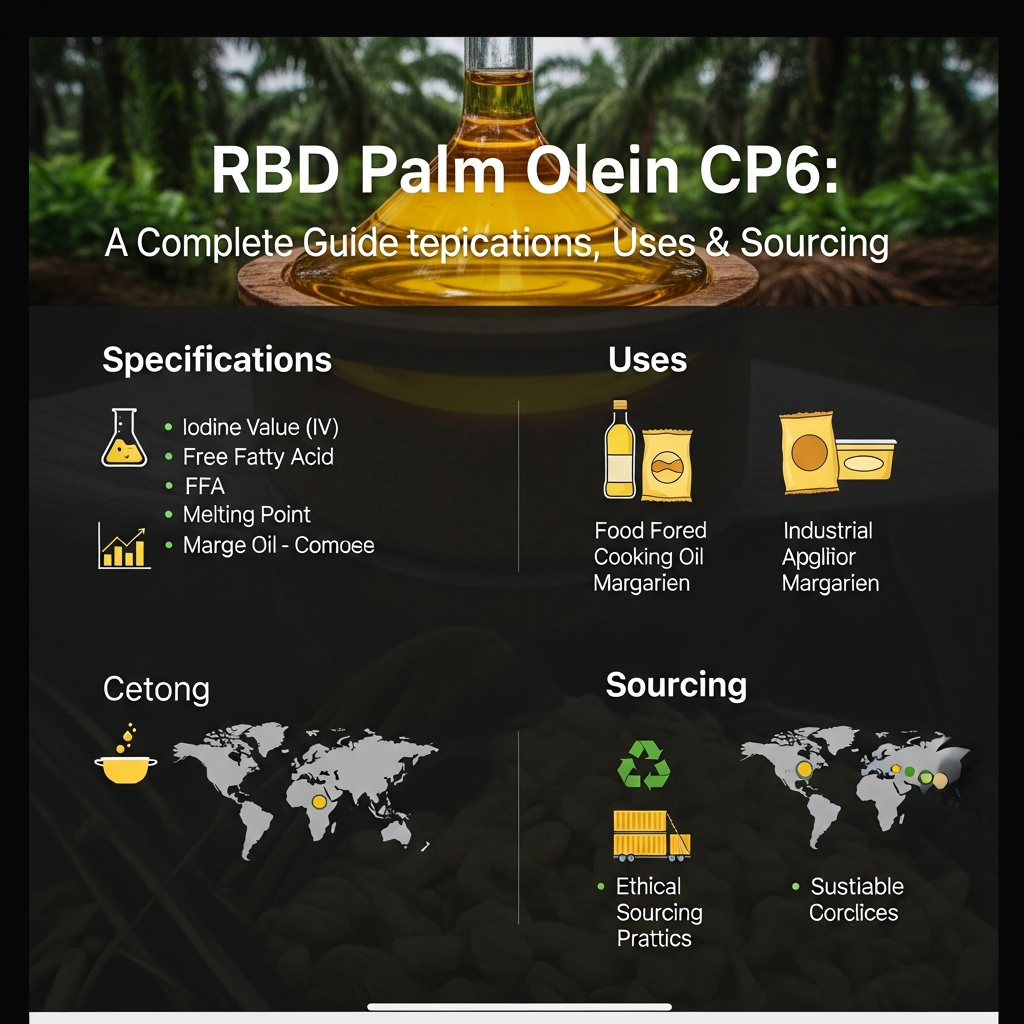
RBD Palm Olein CP6: Your 2025 Ultimate Guide to Specifications, Uses & Sourcing
Inhoudsopgave
- What Exactly is RBD Palm Olein CP6?
- Key Specifications of RBD Palm Olein CP6 You Must Know
- Top 5 Industrial Uses for RBD Palm Olein CP6
- The Journey from Palm Fruit to Pure RBD Palm Olein CP6
- How to Source High-Quality RBD Palm Olein CP6: A Buyer’s Guide
- Sustainability and Health: The Two Sides of Palm Olein
- Veelgestelde vragen
- Contact Us for High-Quality Palm Products
RBD Palm Olein CP6 is one of the most widely traded and versatile edible oils in the world. As the liquid fraction of Ruwe palmolie, its unique properties make it a staple in kitchens and manufacturing plants globally. Whether you’re a food manufacturer, a commodity trader, or a curious consumer, understanding this product is essential for making informed decisions.
This comprehensive guide for 2025 covers everything from technical specifications and primary uses to sourcing best practices and sustainability concerns. We will explore why RBD Palm Olein CP6 remains a dominant force in the global vegetable oil market.
What Exactly is RBD Palm Olein CP6?
Let’s break down the name. “RBD” stands for Refined, Bleached, and Deodorized, which is the purification process the oil undergoes. “Palm Olein” refers to the liquid fraction obtained from palm oil after a crystallization process. The final, and most crucial part, is “CP6.”
CP stands for Cloud Point, which is the temperature at which the oil starts to become cloudy or hazy. Therefore, a CP6 rating means the oil has a maximum cloud point of 6° Celsius. This low cloud point makes it highly resistant to solidifying in cooler climates, ensuring it remains liquid and easy to use.
Key Specifications of RBD Palm Olein CP6 You Must Know
To ensure quality and consistency, RBD Palm Olein CP6 must meet specific international standards. These parameters determine its suitability for various applications, especially in food production. Buyers and quality managers look closely at these details.

Here are the most critical specifications:
- Free Fatty Acids (FFA) (as % Palmitic): 0.1% Max
- Moisture & Impurities (M&I): 0.1% Max
- Iodine Value (Wijs): 56 Min
- Slip Melting Point: 24°C Max
- Cloud Point: 6°C Max
- Color (5.25″ Lovibond Cell): 3 Red Max
Each of these parameters plays a vital role. For instance, a low FFA indicates high-quality refining and better shelf stability, while the Iodine Value helps measure the degree of unsaturation. You can learn more about these oil quality metrics from authoritative sources like the ScienceDirect journal on Iodine Value.
Top 5 Industrial Uses for RBD Palm Olein CP6
De veelzijdigheid van RBD Palm Olein CP6 is its greatest strength. Its high stability at high temperatures, neutral taste, and smooth texture make it an indispensable ingredient across multiple industries.
- Premium Cooking & Frying Oil: With a high smoke point (around 235°C or 455°F), it’s perfect for deep-frying in restaurants and for industrial food production without breaking down quickly.
- Food Manufacturing: It serves as a key component in producing margarine, shortening, vanaspati, and various confectionery items like chocolates and ice cream.
- Instant Noodles: The vast majority of instant noodles are flash-fried in palm olein. This process dehydrates the noodles and gives them a longer shelf life.
- Bakery Products: From biscuits to cakes, this palm olein variant provides the necessary fat content for texture, moisture, and mouthfeel.
- Non-Food Applications: While primarily an edible oil, it is also used as a feedstock for producing biodiesel, soaps, detergents, and various cosmetic products.
The Journey from Palm Fruit to Pure RBD Palm Olein CP6
The production of high-grade RBD Palm Olein CP6 is a multi-stage process that demands precision and advanced technology. It begins with CPO extracted from the flesh of the Oliepalmfruitbos.
The CPO first undergoes physical refining to remove free fatty acids. Next, it is bleached with activated earth to remove pigments and impurities. The deodorization stage uses high-temperature steam under a vacuum to eliminate any residual odors and tastes. Finally, the RBD Palm Oil is cooled in a controlled manner in a process called “fractionation,” which separates the liquid olein from the solid stearin fraction, resulting in pure RBD Palm Olein CP6.
The journey from fruit to oil is a zero-waste endeavor. The process also utilizes the Palmpit to produce other high-value products. These include Palm Kernel Oil, a different type of edible oil, as well as Palm Kernel Expeller used in animal feed, and Palm Kernel Shell, an efficient biofuel.
How to Source High-Quality RBD Palm Olein CP6: A Buyer’s Guide
Sourcing this commodity requires careful consideration of suppliers, pricing, and logistics. For industrial buyers, securing a reliable supply chain is critical for uninterrupted production.

Key Sourcing Considerations:
- Supplier Verification: Always partner with reputable suppliers who can provide certificates of analysis (COA) for each shipment and hold certifications like ISO, HACCP, or Halal.
- Market Pricing: Palm oil prices are volatile and tied to global commodity markets. Keep an eye on benchmarks like the Bursa Malaysia Derivatives (BMD) to understand pricing trends.
- Packaging Options: RBD Palm Olein CP6 is shipped in various formats, including jerry cans, steel drums, and large flexitanks for bulk vessel shipments. Choose the option that best fits your volume and storage capabilities.
Sustainability and Health: The Two Sides of Palm Olein
No discussion about palm oil is complete without addressing sustainability. The industry has faced scrutiny for its environmental impact, particularly deforestation. However, significant progress has been made through certified sustainable palm oil initiatives.
Bij het sourcen RBD Palm Olein CP6, look for suppliers committed to RSPO standards. This ensures the oil comes from plantations that adhere to strict environmental and social criteria. For more information, you can visit the World Wildlife Fund (WWF) page on palm oil.
From a health perspective, palm olein is naturally free of trans fats, rich in Vitamin E (tocotrienols), and has a balanced fatty acid profile. Like any oil, it should be consumed in moderation as part of a balanced diet.
Veelgestelde vragen
What is the main difference between RBD Palm Olein CP6, CP8, and CP10?
The main difference is the cloud point. RBD Palm Olein CP6 has a maximum cloud point of 6°C, CP8 is 8°C, and CP10 is 10°C. CP6 is the highest quality and most suitable for temperate climates as it remains liquid at lower temperatures.
Is RBD Palm Olein CP6 a healthy oil?
It is a stable, trans-fat-free cooking oil rich in Vitamin E. When sourced from a quality refiner and used appropriately in a balanced diet, it is a perfectly healthy vegetable oil.
How should RBD Palm Olein CP6 be stored?
The oil should be stored in a cool, dry place away from direct sunlight and strong odors. Proper storage ensures it maintains its quality and extends its shelf life.
Contact Us for High-Quality Palm Products
Makmur Amanah Sejahtera levert hoogwaardige palmolieproducten zoals palmpitexpeller, palmpitschil, ruwe palmolie, palmpitolie, enz. Neem contact met ons op via WhatsApp +6282140002198 of stuur ons een e-mail op admin@makmuramanah.co.id.
 Dutch
Dutch  Indonesian
  English
  Chinese
  Arabic
  Thai
Thai  Vietnamese
  Turkish