 บน บน by admin
RBD Palm Olein CP8 vs CP10: The Ultimate 2025 Guide to 5 Key Differences
สารบัญ
When selecting the right cooking oil for commercial or industrial use, the details matter. The debate over RBD Palm Olein CP8 vs CP10 is a prime example, where a small difference in number signifies a major variation in performance and application. Understanding these nuances in the RBD Palm Olein CP8 vs CP10 discussion is crucial for quality control, product stability, and cost-effectiveness.
This guide will provide a definitive comparison, helping you make an informed decision for your specific needs, whether for large-scale frying, food manufacturing, or distribution.
What Exactly is RBD Palm Olein?
Before diving into the CP8 vs CP10 comparison, let’s break down the name. RBD Palm Olein stands for Refined, Bleached, and Deodorized Palm Olein. It is the liquid fraction obtained from the fractionation of น้ำมันปาล์มดิบ after a crystallization process at controlled temperatures. This entire process begins with harvesting the ช่อผลปาล์มน้ำมัน, which is the primary source.
From the same fruit, we also derive the valuable เมล็ดในปาล์ม, which is then processed into other popular products. It’s one of the world’s most popular cooking oils due to its versatility, stability at high temperatures, and cost-effectiveness. The “CP” number that follows, such as CP8 or CP10, refers to its Cloud Point, which is the most critical factor in this discussion.

Understanding Cloud Point (CP) in Cooking Oils
The Cloud Point is the temperature at which dissolved solids in an oil begin to form wax crystals, making the oil appear cloudy or hazy. A lower cloud point means the oil can remain clear and liquid at lower temperatures.
This is a vital parameter for products sold in colder climates or used in refrigerated applications. As explained by the Journal of Food Lipids, the cloud point directly impacts the oil’s stability and visual appeal under various storage conditions.
The Ultimate Breakdown: RBD Palm Olein CP8 vs CP10
While both are excellent cooking oils, the primary differences between CP8 and CP10 stem from their cloud point and the subsequent effects on their properties and applications. The core of the RBD Palm Olein CP8 vs CP10 discussion lies in these five areas.
Difference #1: Cloud Point and Temperature Stability
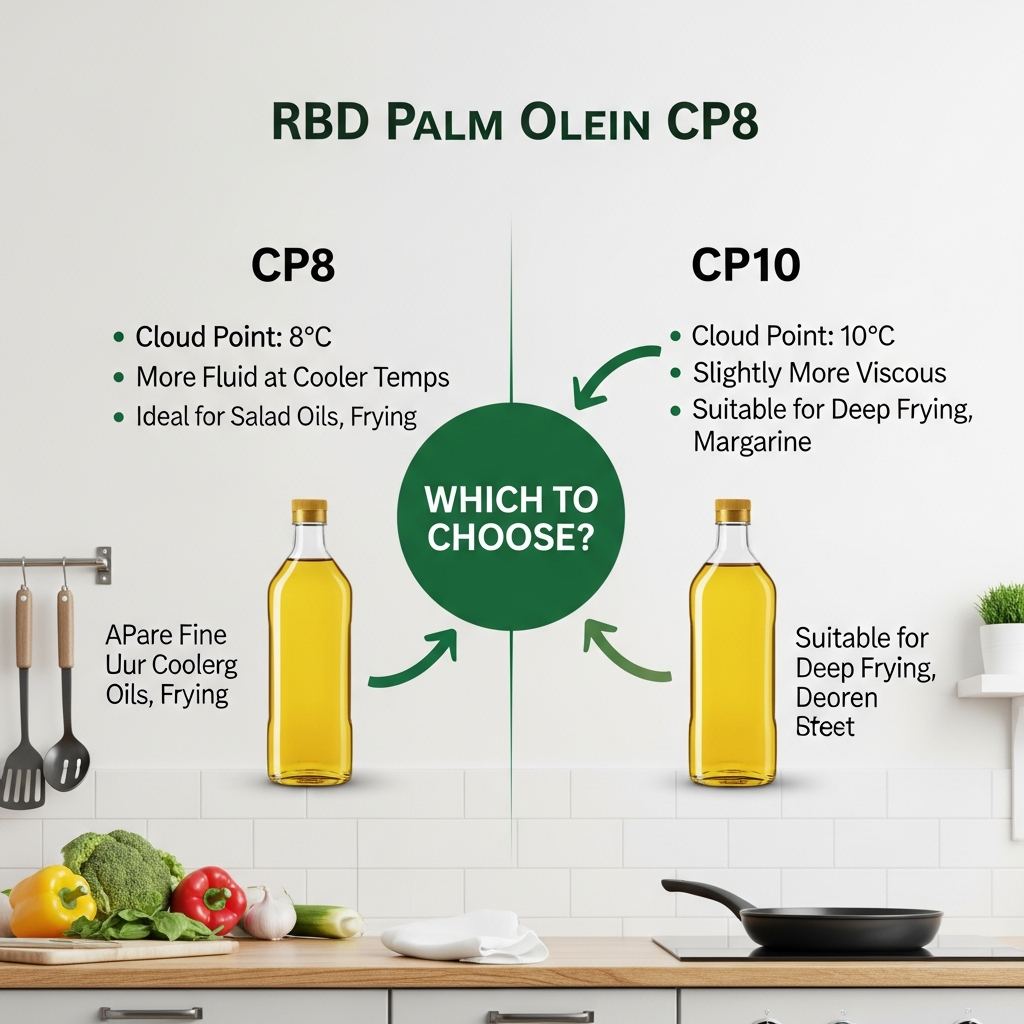
This is the most direct distinction. CP10 has a maximum cloud point of 10° Celsius (50° F), while CP8 has a maximum cloud point of 8° Celsius (46.4° F). This 2°C difference is significant.
CP8 will remain liquid and clear in cooler conditions where CP10 might start to solidify and look cloudy. This makes CP8 a premium choice for regions with temperate climates, ensuring the product remains aesthetically pleasing on shelves.
Difference #2: Iodine Value (IV) and Saturation Levels
The Iodine Value (IV) measures the degree of unsaturation in a fat or oil. A higher IV indicates more double bonds, meaning the oil is more unsaturated. CP8 typically has a higher IV (min. 58) compared to CP10 (min. 56).
This slight increase in unsaturation in CP8 contributes to its lower cloud point. While not a dramatic health difference, it’s a technical marker that distinguishes the two. For a deeper dive into IV, the American Oil Chemists’ Society (AOCS) provides extensive resources on lipid analysis.
Difference #3: Common Applications and Performance
The choice between RBD Palm Olein CP8 vs CP10 often comes down to the end-use.
- RBD Palm Olein CP10: This is the workhorse of the industry. Its slightly higher stability makes it a fantastic, all-purpose frying oil for noodles, chips, doughnuts, and more. It is widely used in warm and tropical climates where clouding is not a concern.
- RBD Palm Olein CP8: The lower cloud point makes CP8 more suitable for specialized applications. It’s often used for salad dressings, mayonnaise, and soft margarine, where maintaining liquidity at refrigeration temperatures is key. It’s also preferred as a frying oil in colder countries.

Difference #4: Processing and Fractionation
To achieve a lower cloud point, palm oil must undergo a more rigorous fractionation process, often called “winterization.” This process separates the olein (liquid) from the stearin (solid) fractions more precisely. Other parts of the palm fruit are also processed to create products like ปาล์มของเคอร์เนลน้ำมัน and high-protein animal feed such as ปาล์มของเคอร์เนล Expeller. Even the solid byproducts, like the ปาล์มเชลล์เคอร์เนล, are repurposed as an efficient biofuel.
CP8 is a “double fractionated” or “super olein,” meaning it has gone through this process twice or under more stringent conditions to remove more saturated fats. This extra step, as detailed by the คณะกรรมการน้ำมันปาล์มแห่งมาเลเซีย (MPOB), is what gives CP8 its premium quality but also adds to its cost.
Difference #5: Price and Market Availability
Due to the additional processing required, CP8 is generally more expensive than CP10. The yield of CP8 from crude palm oil is also lower than that of CP10, further contributing to the price difference.
Consequently, CP10 is more widely produced and available globally, making it the standard choice for many buyers. CP8 is considered a specialty product and may have more limited availability depending on the supplier.
RBD Palm Olein CP8 vs CP10: Which Should You Choose?
Making the right choice in the RBD Palm Olein CP8 vs CP10 dilemma is simple if you know your priorities.
Choose RBD Palm Olein CP8 if:
- You operate in a cooler climate where temperatures regularly drop below 10°C.
- Your product is a liquid, like salad dressing or marinade, that needs to avoid clouding.
- Your budget allows for a premium, higher-performance oil.
Choose RBD Palm Olein CP10 if:
- You need a cost-effective, high-stability oil for general or deep-frying.
- You are located in a tropical or warm climate.
- Your primary concern is performance at high temperatures rather than cold stability.
คำถามที่พบบ่อย (FAQ)
Is CP8 healthier than CP10?
CP8 is slightly more unsaturated than CP10, but the difference is marginal and unlikely to have a significant impact on health. Both are stable cooking oils, and the best choice depends on culinary application, not nutritional superiority.
In the RBD Palm Olein CP8 vs CP10 debate, can I use CP10 instead of CP8?
Yes, but with a caveat. For frying, CP10 is a perfect substitute. However, if you’re making a product that needs to stay liquid at cool temperatures, substituting CP10 for CP8 may result in a cloudy and less appealing final product.
What is Super Olein?
Super Olein is a term often used for palm olein with a lower cloud point and higher iodine value, which is achieved through double fractionation. CP8 is a type of Super Olein. More information can be found from industry authorities like the สภาน้ำมันปาล์มแห่งมาเลเซีย (MPOC).
คำตัดสินขั้นสุดท้าย
การ RBD Palm Olein CP8 vs CP10 comparison is not about which oil is better overall, but which is better for a specific job. The choice between RBD Palm Olein CP8 vs CP10 ultimately comes down to balancing cost, climate, and application. CP10 is the reliable, cost-effective global standard for frying, especially in warmer climates. CP8 is the premium, specialized solution for applications demanding superior cold stability.
By understanding their key differences in cloud point, processing, and application, you can optimize your product quality, manage costs, and deliver the consistency your customers expect in 2025 and beyond.
Makmur Amanah Sejahtera จำหน่ายผลิตภัณฑ์ปาล์มคุณภาพสูง เช่น เครื่องบีบเมล็ดในปาล์ม เปลือกเมล็ดในปาล์ม น้ำมันปาล์มดิบ น้ำมันเมล็ดในปาล์ม ฯลฯ กรุณาติดต่อเราได้ที่ WhatsApp +6282140002198 หรือส่งอีเมลถึงเราที่ admin@makmuramanah.co.id
 Thai
Thai  Indonesian
  English
  Chinese
  Dutch
Dutch  Arabic
  Vietnamese
  Turkish