 by admin
Empty Palm Fruit Bunch (EFB): Your Ultimate 2025 Guide to a Sustainable Powerhouse
İçindekiler
- What is an Empty Palm Fruit Bunch (EFB)?
- From Raw Waste to Valuable Resource: Processing Empty Palm Fruit Bunch (EFB)
- Top Uses and Applications of Empty Palm Fruit Bunch (EFB)
- The Incredible Benefits of Utilizing Empty Palm Fruit Bunch (EFB)
- Challenges and the Bright Future of EFB
- Conclusion: The Sustainable Future is Here
The palm oil industry, a giant in global agriculture, produces more than just its primary products like Ham Palm Yağı ve Hurma Çekirdeği Yağı. For every ton of oil, a significant amount of biomass is generated. Alongside valuable resources like the Palmiye Çekirdeği Kabuğu and the Palmiye Çekirdeği itself, the Boş Palmiye Meyve Demeti (EFB) stands out as one of the most abundant by-products. Once considered mere waste, this fibrous material is now recognized as a sustainable powerhouse, driving innovation in renewable energy, agriculture, and material science.
This guide explores the complete journey of the Empty Palm Fruit Bunch (EFB), from its origin in the mill to its diverse applications. We will uncover its uses, benefits, and why it’s becoming a key player in the global shift towards a circular economy. Let’s dive into the world of this remarkable resource.

What is an Empty Palm Fruit Bunch (EFB)?
An Empty Palm Fruit Bunch (EFB) is the fibrous residue left behind after the fresh palm fruits have been stripped from the Fresh Fruit Bunch (FFB), also known as the Yağ Palmiyesi Meyve Demeti, in the palm oil milling process. Essentially, it’s the “skeleton” of the fruit bunch. These bunches are large, bulky, and composed of lignocellulosic material, primarily cellulose, hemicellulose, and lignin.
Globally, the palm oil industry generates millions of tons of EFB annually. Initially, its disposal was a significant environmental challenge for mills due to its high moisture content (around 60-70%) and large volume, which made it prone to decomposition and releasing greenhouse gases.
However, this “waste” is incredibly rich in organic matter and potential energy. Understanding its composition is key to unlocking its value. The journey from a problematic leftover to a valuable commodity begins with effective processing.
From Raw Waste to Valuable Resource: Processing Empty Palm Fruit Bunch (EFB)
Transforming raw, wet Empty Palm Fruit Bunch (EFB) into a usable and stable material requires several key steps. The primary goal is to reduce its high moisture content and size to make it more efficient for transport, storage, and various applications.
Key Processing Steps:
- Shredding/Chipping: The large, bulky EFB is first fed into a shredder or chipper. This machine tears the bunches apart, breaking them down into a more manageable, shorter fiber, which significantly increases the surface area for drying.
- Dewatering/Pressing: The shredded EFB fiber then goes through a pressing process. A screw press is commonly used to squeeze out a substantial amount of water, reducing the moisture content from over 60% to a more manageable level.
- Drying: For applications requiring very low moisture, like biofuel pellets, the pressed fiber is further dried using industrial dryers. This final step makes the Empty Palm Fruit Bunch (EFB) an efficient and stable fuel source.
Top Uses and Applications of Empty Palm Fruit Bunch (EFB)
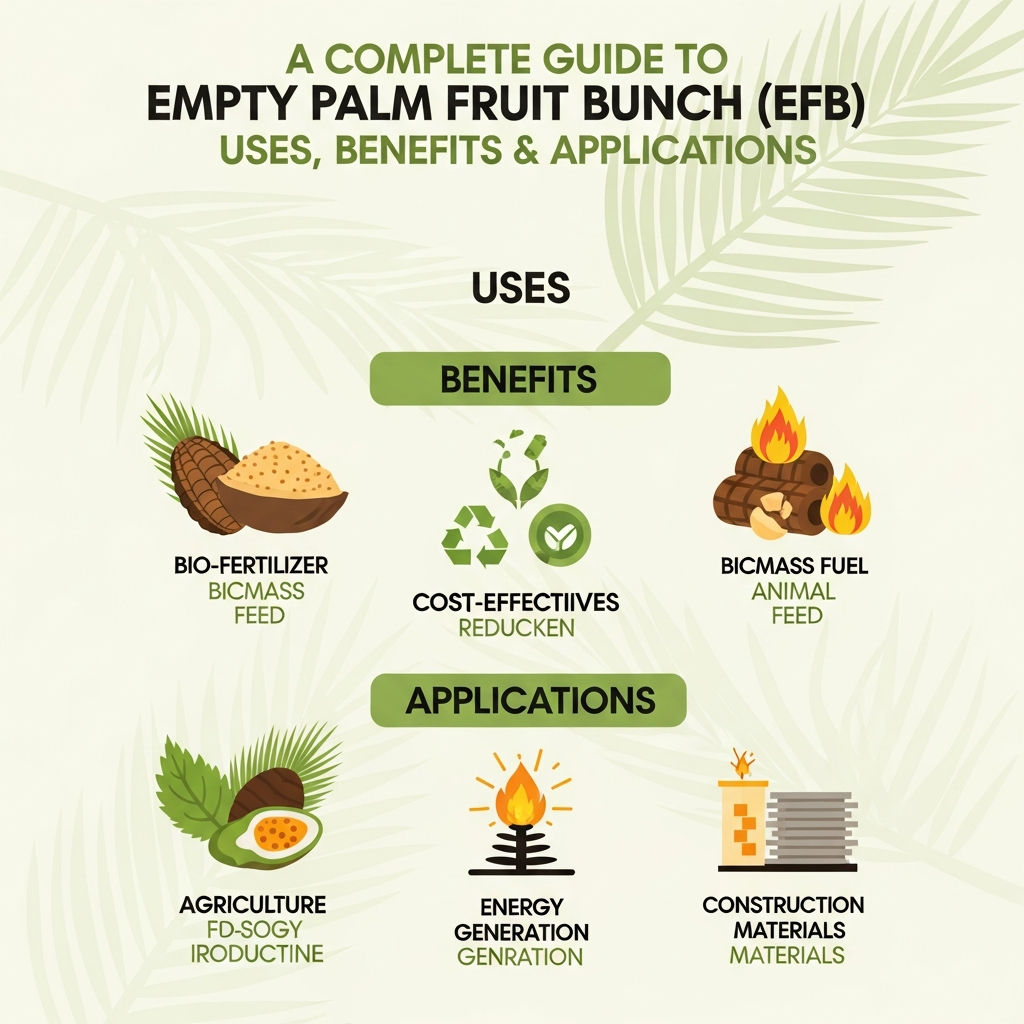
Once processed, the versatile EFB fiber can be used in a wide array of applications, turning an environmental liability into a significant asset. The utilization of Boş Palmiye Meyve Demeti (EFB) is a cornerstone of sustainability in the palm oil sector.
EFB as a Powerhouse for Renewable Energy
One of the most prominent uses of Empty Palm Fruit Bunch (EFB) is as a solid biofuel. Its high energy content makes it an excellent substitute for fossil fuels like coal. You can read more about the potential of such biomass in a detailed study published on ScienceDirect about biomass energy.
- Direct Combustion: Shredded EFB is used directly as fuel in boilers at palm oil mills and other industrial plants to generate steam and electricity.
- EFB Pellets & Briquettes: By drying and compressing the EFB fiber, high-density pellets or briquettes are created. These are easy to transport, store, and provide a consistent, clean-burning fuel source for industrial and even residential use.
Empty Palm Fruit Bunch (EFB) in Sustainable Agriculture
The organic and nutrient-rich nature of EFB makes it a fantastic resource for improving soil health and agricultural productivity.
- Compost and Organic Fertilizer: Composted EFB is a superb organic fertilizer, rich in potassium and other essential nutrients. It improves soil structure, water retention, and microbial activity, leading to healthier crops and reduced reliance on chemical fertilizers.
- Mulching: Spreading processed EFB fiber on the ground around crops acts as a natural mulch. This helps retain soil moisture, suppress weed growth, and regulate soil temperature, which is especially beneficial in tropical climates. The Gıda ve Tarım Örgütü (FAO) often highlights the importance of such sustainable farming practices.
EFB in Eco-Friendly Material Production
The strong lignocellulosic fibers in EFB are a valuable raw material for various manufacturing industries, promoting the creation of green products.
- Pulp and Paper: The fiber from an Empty Palm Fruit Bunch (EFB) can be processed into pulp for producing biodegradable paper and packaging materials.
- Medium-Density Fiberboard (MDF): EFB fibers are an excellent alternative to wood in the manufacturing of MDF boards for furniture and construction.
- Biocomposites: Researchers are actively developing biocomposites by blending EFB fibers with polymers to create strong, lightweight materials for automotive parts and consumer goods. A paper in the Polymers journal often features such innovative uses.
Other Innovative Applications
The versatility of the Empty Palm Fruit Bunch (EFB) continues to inspire new uses:
- Mushroom Cultivation: EFB serves as a highly effective and sterile substrate for growing edible mushrooms.
- Biochar Production: Through a process called pyrolysis, EFB can be converted into biochar, a form of charcoal that serves as a powerful soil amendment and carbon sequestration tool.
The Incredible Benefits of Utilizing Empty Palm Fruit Bunch (EFB)
Harnessing the power of EFB offers compelling environmental and economic advantages, paving the way for a more responsible palm oil industry.
Environmental Advantages
- Waste Reduction: It turns millions of tons of waste from landfills into valuable products.
- Reduced Carbon Footprint: Using EFB as a biofuel displaces fossil fuels, significantly cutting down greenhouse gas emissions.
- Promotes Circular Economy: It exemplifies the principles of a circular economy, where waste from one process becomes a resource for another.
Economic Advantages
- New Revenue Streams: Palm oil mills can sell processed EFB fiber, pellets, or compost, creating additional income. This diversification complements the sale of other valuable by-products, such as Hurma Çekirdeği Çıkarıcısı for animal feed.
- Energy Independence: By using EFB to power their own operations, mills can drastically reduce their energy costs and reliance on the grid.
- Job Creation: The collection, processing, and marketing of EFB and its derived products create new green jobs.
Challenges and the Bright Future of EFB
While the potential of Empty Palm Fruit Bunch (EFB) is immense, some challenges remain. These include the high costs of logistics and transportation due to its bulk, and the need for investment in efficient processing technology. However, with rising fossil fuel prices and a growing global demand for sustainable solutions, the business case for EFB is stronger than ever.
Ongoing research and technological advancements are continuously making EFB processing more efficient and cost-effective. The future will likely see even more innovative applications for the Boş Palmiye Meyve Demeti (EFB), solidifying its role as a key component of the bioeconomy.
Conclusion: The Sustainable Future is Here
The Empty Palm Fruit Bunch (EFB) is a testament to the power of innovation in turning waste into wealth. What was once a disposal headache for the palm oil industry is now a sought-after resource that fuels power plants, enriches soil, and builds eco-friendly materials. By fully embracing the potential of EFB, the palm oil industry can take a monumental step towards sustainability, circularity, and environmental responsibility, creating value from every part of the palm tree.
Makmur Amanah Sejahtera, Palmiye Çekirdeği Çıkarıcısı, Palmiye Çekirdeği Kabuğu, Ham Palmiye Yağı, Palmiye Çekirdeği Yağı vb. gibi yüksek kaliteli palmiye ürünleri sağlar. Lütfen +6282140002198 numaralı WhatsApp'tan bize ulaşın veya admin@makmuramanah.co.id adresinden bize e-posta gönderin.
 Turkish
  Indonesian
  English
  Chinese
  Dutch
Dutch  Arabic
  Thai
Thai  Vietnamese