 by admin
RBD Palm Olein CP8: The Ultimate 2025 Guide to Specs & Uses
İçindekiler
- What Exactly Is RBD Palm Olein CP8?
- A Family of High-Quality Palm Products
- Understanding Cloud Point: Why CP8 Is a Premium Choice
- Detailed Technical Specifications
- Top 4 Industrial Uses and Applications
- CP8 vs. CP10: A Head-to-Head Comparison
- Health, Nutrition, and Sustainability Insights
- Your Trusted Palm Olein Supplier
- Conclusion: Why Choose the CP8 Grade?
RBD Palm Olein CP8 stands as a premier choice in the global edible oils market, valued for its unique properties and versatility. As a highly refined and stable cooking oil, it serves countless applications, from household kitchens to large-scale industrial food production. This guide explores everything you need to know about this remarkable product.
Understanding the specifics of this cooking oil is crucial for buyers and manufacturers aiming for quality and consistency. We’ll delve into its specifications, primary uses, and the critical differences that set it apart from its close relative, CP10, ensuring you can make an informed decision for your needs.

What Exactly Is RBD Palm Olein CP8?
Let’s break down the name. “RBD” stands for Refined, Bleached, and Deodorized. This refers to the comprehensive purification process that Ham Palm Yağı undergoes to become a stable, bland, and light-colored oil suitable for consumption. The result is an oil free from impurities, with a neutral taste and smell that won’t interfere with the flavor of food.
“Palm Olein” is the liquid fraction obtained from fractionating palm oil after crystallization at controlled temperatures. This process separates the liquid olein from the solid stearin. The liquid portion, or olein, is the most widely used component for cooking oil. The term CP8 specifically refers to olein with a maximum cloud point of 8° Celsius.
A Family of High-Quality Palm Products
Palm oil is derived from the versatile oil palm tree, which provides a range of valuable products. The process starts with the Yağ Palmiyesi Meyve Demeti, from which the oil is extracted. The fruit’s nut, known as the Palmiye Çekirdeği, is also processed to produce high-quality Hurma Çekirdeği Yağı. Key by-products from this process include Hurma Çekirdeği Çıkarıcısı, widely used in animal feed, and Palmiye Çekirdeği Kabuğu, a popular and efficient biofuel.
Understanding Cloud Point: Why CP8 Is a Premium Choice
The “CP” in the name stands for Cloud Point, which is the most critical specification distinguishing different grades of palm olein. Cloud Point is the temperature at which the oil begins to appear cloudy or hazy due to the formation of wax or fat crystals. A lower cloud point is highly desirable, especially in temperate or cooler climates.
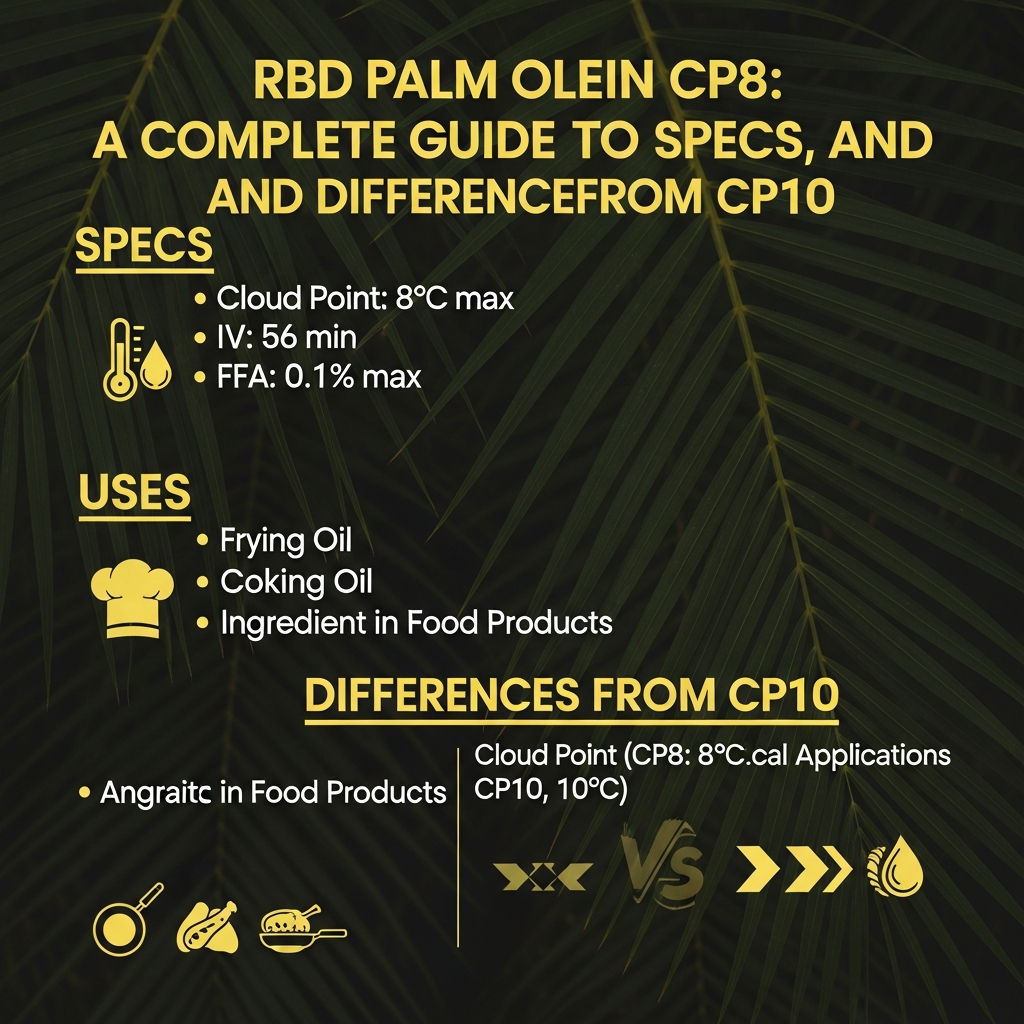
The key advantage of the CP8 grade is its low cloud point of 8°C. This means it remains clear and liquid at lower ambient temperatures compared to other grades like CP10 (which has a cloud point of 10°C). This property prevents the oil from solidifying or becoming cloudy on the shelf, ensuring better product appearance and consumer appeal. For a deeper scientific dive, you can explore the technical definition of Cloud Point on ScienceDirect.
Detailed Technical Specifications
Producers and buyers rely on a standard set of specifications to ensure quality and consistency. While slight variations can occur, the typical technical specifications for premium palm olein are as follows:
- Free Fatty Acid (FFA) (as % Palmitic): 0.1% Max
- Moisture & Impurities (M&I): 0.1% Max
- Iodine Value (IV) (Wijs): 57 Min
- Cloud Point (CP): 8°C Max
- Color (5.25” Lovibond cell): 3 Red Max
- Melting Point: 22-24°C Max
These parameters guarantee the oil’s purity, stability, and performance in various applications. The low FFA indicates minimal hydrolysis, while a high Iodine Value points to a higher degree of unsaturation. For official standards, organizations like the Malezya Palmiye Yağı Konseyi (MPOC) provide benchmark specifications.
Top 4 Industrial Uses and Applications
The superior quality and stability of this refined oil make it a preferred choice for a wide range of applications in the food industry.
1. Premium Cooking and Frying Oil
Its high smoke point and excellent thermal stability make it ideal for deep frying. It imparts a crisp texture to fried foods without absorbing into the product, making it a favorite for restaurants and snack manufacturers.
2. Manufacturing of Margarine and Spreads
The specific melting properties contribute to the desired consistency and mouthfeel in margarines, shortenings, and other vegetable ghee products.
3. Confectionery and Bakery
In the confectionery industry, it is used for cream fillings, coatings, and baked goods. Its neutral flavor profile ensures that the final product’s intended taste is not altered.
4. Production of Instant Noodles
A significant amount of palm olein is used for flash-frying instant noodles. This process pre-cooks the noodles and reduces their moisture content, extending shelf life and preparing them for quick cooking by the consumer.
CP8 vs. CP10: A Head-to-Head Comparison
The primary difference between CP8 and CP10 palm olein is the cloud point. While it may seem like a small variance of 2°C, it has significant implications for application and market preference.
Key Differences at a Glance:
- Cloud Point: CP8 has a maximum cloud point of 8°C, while CP10 has a maximum of 10°C.
- Performance in Cooler Climates: CP8 is the superior choice for countries with lower ambient temperatures, as it is less likely to solidify or become cloudy during storage and transportation.
- Processing: Achieving the lower cloud point for RBD Palm Olein CP8 requires more intensive fractionation (often double fractionation), making it a more refined product.
- Cost: Due to the extra processing step, CP8 is generally priced at a premium over CP10.
- Market Preference: European and Middle Eastern markets with cooler seasons often demand CP8, whereas CP10 is widely accepted in tropical regions of Asia and Africa.
Health, Nutrition, and Sustainability Insights
Nutritionally, palm olein is a balanced source of saturated and unsaturated fatty acids. It is naturally free of trans fats and is a rich source of Vitamin E (tocotrienols and tocopherols), which are powerful antioxidants. The Dünya Sağlık Örgütü (WHO) advises moderation in the consumption of all fats and oils as part of a balanced diet.
The sustainability of palm oil production is a critical global concern. Reputable suppliers are committed to sourcing from certified sustainable plantations that adhere to environmental and social standards set by organizations like the Roundtable on Sustainable Palm Oil (RSPO). When purchasing palm olein, it is essential to inquire about sustainability certifications to support responsible sourcing.
Your Trusted Palm Olein Supplier
Makmur Amanah Sejahtera, Palmiye Çekirdeği Çıkarıcısı, Palmiye Çekirdeği Kabuğu, Ham Palmiye Yağı, Palmiye Çekirdeği Yağı vb. gibi yüksek kaliteli palmiye ürünleri sağlar. Lütfen +6282140002198 numaralı WhatsApp'tan bize ulaşın veya admin@makmuramanah.co.id adresinden bize e-posta gönderin.
Conclusion: Why Choose the CP8 Grade?
RBD Palm Olein with a cloud point of 8°C is more than just a commodity; it’s a high-quality, versatile, and stable edible oil engineered for performance. Its key advantage—a low cloud point—makes it the ideal choice for markets in temperate climates and for applications where clarity and liquidity are paramount.
From providing a perfect crunch in fried foods to creating the ideal texture in spreads, its applications are vast. While it commands a premium over CP10, the investment ensures superior product quality, longer shelf stability, and better consumer satisfaction. When sourcing this product, always prioritize quality specifications and sustainable practices to get the best value. For an overview of edible oil chemistry, a journal like the Journal of the American Oil Chemists’ Society (JAOCS) offers extensive research.
 Turkish
  Indonesian
  English
  Chinese
  Dutch
Dutch  Arabic
  Thai
Thai  Vietnamese