
Table of Contents
- What is RBD Palm Olein?
- Understanding the “CP” Number in Palm Olein
- Key Differences: A Deep Dive into CP6, CP8, & CP10
- Quick Comparison Table: CP6 vs. CP8 vs. CP10
- Which Palm Olein is Right for Your Business?
- Beyond Olein: A Look at Other Palm Products
- Frequently Asked Questions (FAQ)
- The Final Verdict
Navigating the world of edible oils can be complex, especially when faced with technical specifications. If you’re a buyer, importer, or food manufacturer, understanding the nuances between different grades of RBD Palm Olein like CP6, CP8, and CP10 is crucial for making the right purchasing decision. Each grade offers unique properties tailored for different climates and applications.
This complete guide will break down everything you need to know. We’ll explore the science behind the “CP” numbers, compare their performance, and help you determine the most suitable and cost-effective option for your specific needs, ensuring product quality and stability.
What is RBD Palm Olein?
First, let’s clarify the terminology. RBD stands for Refined, Bleached, and Deodorized. This refers to the purification process that Crude Palm Oil (CPO), extracted from the pulp of the Oil Palm Fruit Bunch, undergoes to become a stable, versatile, and neutral-tasting cooking oil. Palm Olein is the liquid fraction obtained from fractionating palm oil after crystallization at controlled temperatures. It’s important not to confuse it with Palm Kernel Oil, which is extracted from the fruit’s kernel.
This refining process removes impurities, free fatty acids (FFA), and unwanted odors and colors. The result is one of the world’s most popular cooking oils, prized for its affordability, high smoke point, and resistance to oxidation. Its widespread use is documented by organizations like the Food and Agriculture Organization (FAO) of the United Nations.

A clear golden stream of RBD Palm Olein.
Understanding the “CP” Number in Palm Olein
The number that follows “CP” is the most critical specification in this comparison. “CP” stands for Cloud Point. In simple terms, the Cloud Point is the temperature (in Celsius) at which the oil starts to become cloudy or solidify. This is a vital parameter for product stability and appearance.
A lower Cloud Point means the oil can withstand colder temperatures before becoming hazy. This is particularly important for logistics, storage, and consumer appeal in non-tropical climates. An oil that solidifies on the shelf can be perceived as old or spoiled by consumers, even though it’s a natural process.
Key Differences: A Deep Dive into RBD Palm Olein CP6 vs CP8 & CP10
While all three are forms of RBD Palm Olein, their Cloud Point dictates their properties and best uses. Let’s analyze the core distinctions in the debate between RBD Palm Olein CP6, CP8, and CP10.
Cloud Point: The Defining Factor
- RBD Palm Olein CP10: This is the most common and widely traded grade. It has a maximum Cloud Point of 10°C. It’s perfect for tropical and temperate climates where ambient temperatures rarely drop below 10°C.
- RBD Palm Olein CP8: This grade is a “Super Olein” with a maximum Cloud Point of 8°C. It offers better cold stability than CP10, making it a versatile choice for regions with mild winters.
- RBD Palm Olein CP6: This is a premium “Super Olein” with the lowest Cloud Point, at a maximum of 6°C. It is specifically produced for colder climates to ensure the oil remains liquid and clear even at lower temperatures.
Iodine Value and Fatty Acid Composition
The Cloud Point is directly related to the oil’s fatty acid composition, which is measured by its Iodine Value (IV). The IV indicates the degree of unsaturation in the oil. A higher IV means more unsaturated fats, which results in a lower melting point.
CP6 has the highest Iodine Value, followed by CP8, and then CP10. This is achieved through a more intensive fractionation process that removes more of the saturated fats (like palmitic acid) and leaves a higher concentration of unsaturated fats (like oleic acid). You can learn more about the technical details of IV in scientific resources like ScienceDirect.
Applications and Performance
The choice between the different olein grades ultimately comes down to its intended use.
- CP10: Its higher saturated fat content makes it extremely stable at high temperatures. This makes it the go-to choice for heavy-duty industrial frying of products like instant noodles, potato chips, and donuts.
- CP8: This is an excellent all-purpose cooking oil. It balances good frying stability with better cold performance than CP10, making it suitable for general cooking and light frying in a wider range of countries.
- CP6: With its superior clarity at low temperatures, CP6 is ideal for use as a bottling cooking oil in cold countries. It’s also used in salad dressings, mayonnaise, and other applications where the liquid state is essential.

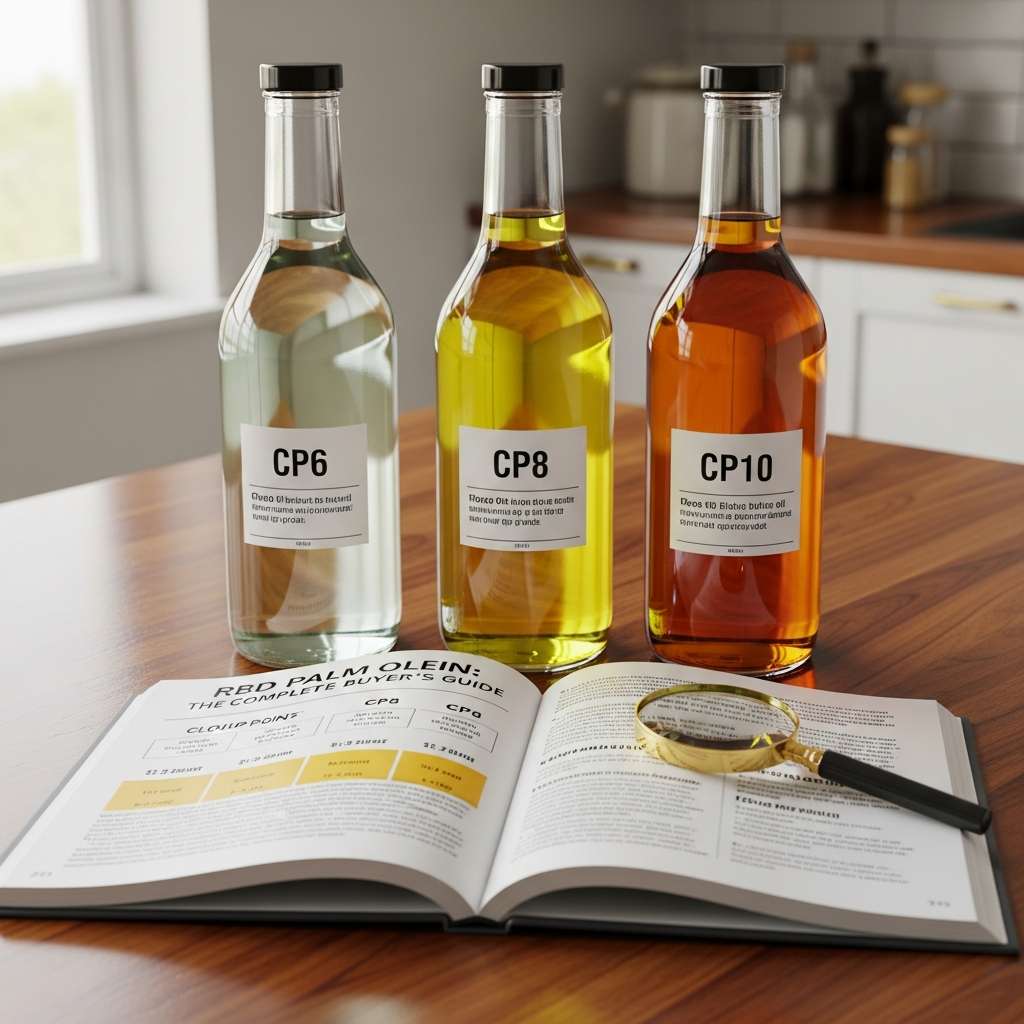
Slight variations in clarity between CP6, CP8, and CP10.
Quick Comparison Table: CP6 vs. CP8 vs. CP10
| Specification | RBD Palm Olein CP6 | RBD Palm Olein CP8 | RBD Palm Olein CP10 |
|---|---|---|---|
| Cloud Point (Max) | 6°C | 8°C | 10°C |
| Iodine Value (Min) | 60 | 58 | 56 |
| Best For | Cold climates, bottling, salad oils | Temperate climates, general cooking | Tropical climates, industrial frying |
| Cold Stability | Highest | Medium | Standard |
Which Palm Olein is Right for Your Business?
Making the final call in the RBD Palm Olein CP6 vs CP8 & CP10 selection process is a strategic business decision. Here’s a simple framework:
- For businesses in cold regions (Europe, North Asia, North America): CP6 is the safest bet to ensure your product remains liquid and appealing year-round.
- For businesses in temperate regions or those needing a versatile oil: CP8 offers a good balance of performance and cost.
- For businesses in tropical regions or the industrial frying sector: CP10 is the industry standard, providing unmatched heat stability and cost-effectiveness.
It is also important to consider pricing. Generally, the lower the Cloud Point, the more processing is required, making CP6 the most premium option, followed by CP8, and then CP10.
Beyond Olein: A Look at Other Palm Products
The oil palm is an incredibly efficient crop, providing more than just cooking oil. The milling and refining processes yield several other valuable products. For instance, the hard stone of the fruit contains the Palm Kernel, which is crushed to produce Palm Kernel Oil. After the oil is extracted, the remaining residue is processed into Palm Kernel Expeller, a protein-rich ingredient for animal feed. Even the shell of the kernel, known as the Palm Kernel Shell, is widely used as a clean and efficient biomass fuel.
Frequently Asked Questions (FAQ)
1. Is RBD Palm Olein healthy?
RBD Palm Olein is a balanced oil with 50% saturated and 50% unsaturated fatty acids. Like any fat or oil, it should be consumed in moderation as part of a balanced diet. The World Health Organization (WHO) provides guidelines on total fat intake for a healthy lifestyle.
2. Why is palm oil so common in food products?
Palm oil is incredibly efficient. The oil palm tree produces a significantly higher yield of oil per hectare than any other vegetable oil crop. This efficiency, combined with its functional properties, makes it a reliable and affordable ingredient for food manufacturers worldwide. Organizations like the WWF are actively working to promote sustainable palm oil production to mitigate its environmental impact.
3. Does the refining process remove nutrients?
The RBD process does remove some nutrients found in crude palm oil, such as carotenoids (which give it a red color). However, the primary purpose of refining is to create a stable, neutral oil suitable for a wide range of cooking applications, which it does very effectively.
The Final Verdict
The contest of RBD Palm Olein CP6 vs CP8 & CP10 doesn’t have a single winner—it has the right choice for the right context. The key differentiator is the Cloud Point, which dictates the oil’s performance in different temperatures.
By understanding that CP10 is the workhorse for industrial frying in warm climates, CP8 is the versatile all-rounder, and CP6 is the premium solution for cold climates, you can now make an informed decision that aligns with your product quality standards, supply chain, and customer expectations.
Makmur Amanah Sejahtera provides high-quality palm products such as Palm Kernel Expeller, Palm Kernel Shell, Crude Palm Oil, Palm Kernel Oil, etc. Kindly contact us at WhatsApp +6282140002198 or email us at admin@makmuramanah.co.id.Looking for High-Quality Palm Products?
 English
  Indonesian
  Chinese
  Arabic