
Table of Contents
- What is RBD Palm Olein? A Quick Overview
- The Critical Factor: Understanding Cloud Point (CP)
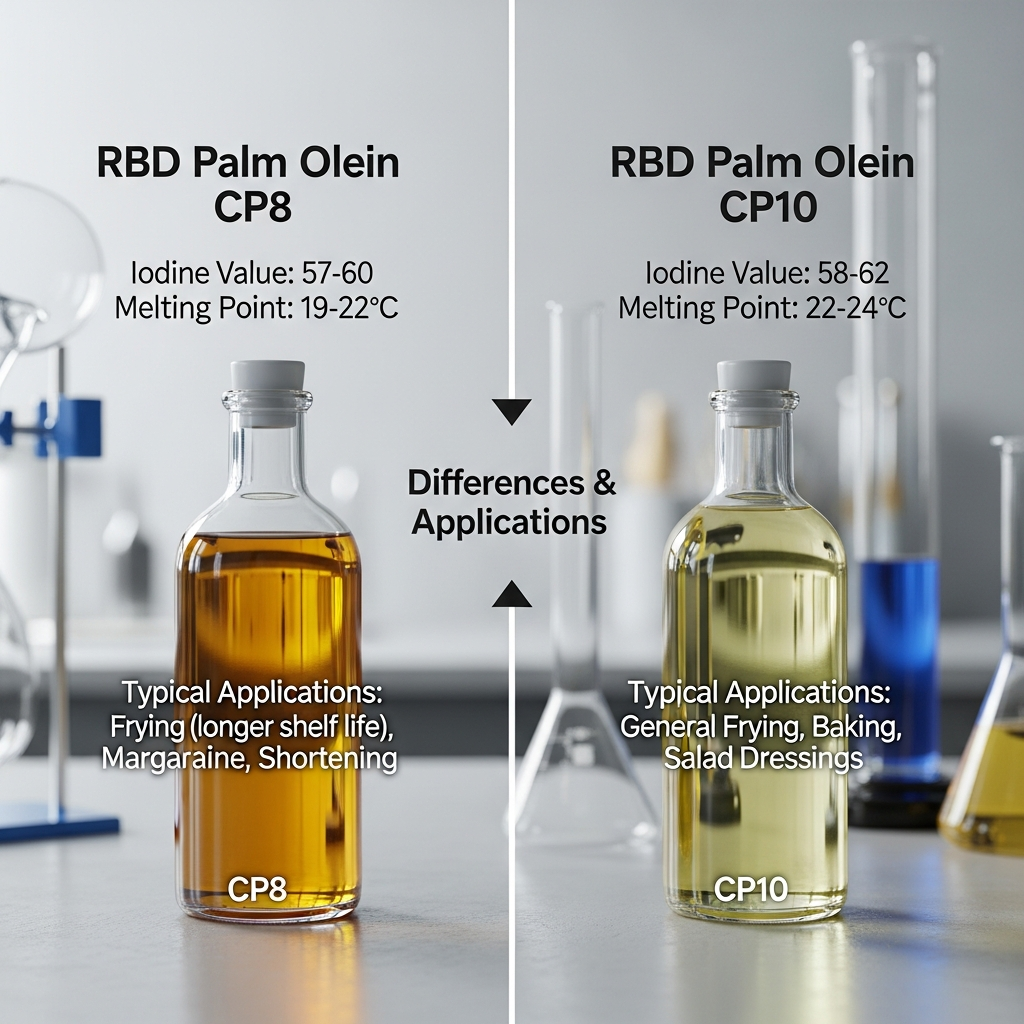
- Specifications Showdown: RBD Palm Olein CP8 vs CP10
- At a Glance: Comparison Table for RBD Palm Olein CP8 vs CP10
- Common Applications for RBD Palm Olein CP8
- Common Applications for RBD Palm Olein CP10
- Beyond Olein: Exploring Other Valuable Palm Products
- How to Choose Between CP8 and CP10?
- Conclusion: Final Verdict on the RBD Palm Olein CP8 vs CP10 Debate
When sourcing cooking oil for commercial or industrial use, the debate of RBD Palm Olein CP8 vs CP10 is a crucial one. While both are derived from the same source, their subtle differences in specifications have a significant impact on performance, application, and cost-effectiveness. This complete guide provides a comprehensive breakdown to help you make an informed decision for your specific needs.
What is RBD Palm Olein? A Quick Overview
Before diving into the CP8 vs CP10 comparison, let’s clarify what RBD Palm Olein is. The term “RBD” stands for Refined, Bleached, and Deodorized. It’s the liquid fraction obtained from the fractionation of palm oil, which originates from the fruit of the oil palm tree, specifically the Oil Palm Fruit Bunch. The journey begins with Crude Palm Oil (CPO), which is then put through a thorough refining process. This process removes impurities, color pigments, and odors, resulting in a stable, bland, and light-yellow edible oil.
RBD Palm Olein is one of the most widely consumed edible oils in the world due to its high stability, long shelf life, and competitive pricing. It is a versatile ingredient used in everything from deep-frying snacks to manufacturing margarine and confectionery.

The Critical Factor: Understanding Cloud Point (CP)
The number in “CP8” and “CP10” refers to the oil’s Cloud Point. This is the single most important specification in the RBD Palm Olein CP8 vs CP10 debate. The Cloud Point is the temperature at which the oil starts to become cloudy or hazy as certain fat components begin to crystallize.
Essentially:
- RBD Palm Olein CP10 has a maximum cloud point of 10° Celsius (50° F).
- RBD Palm Olein CP8 has a maximum cloud point of 8° Celsius (46.4° F).
This 2°C difference is significant. CP8 remains clear and liquid at lower temperatures than CP10, making it more suitable for use in temperate climates or in applications where clarity is essential even under slight refrigeration.
Specifications Showdown: RBD Palm Olein CP8 vs CP10
Beyond the cloud point, other technical specifications further differentiate these two popular oils. These parameters are critical for quality control and ensuring the oil performs as expected in its final application. For a deep dive into industry standards, the Palm Oil Refiners Association of Malaysia (PORAM) provides definitive specifications.
Cloud Point: The Defining Difference
As established, the core distinction in the RBD Palm Olein CP8 vs CP10 choice lies here. CP8 undergoes a more rigorous fractionation process (known as “double fractionation”) to remove more of the higher-melting point glycerides. This results in an oil that stays liquid at cooler temperatures, preventing solidification and ensuring flowability.
Iodine Value (IV)
Iodine Value (IV) measures the degree of unsaturation in the oil. A higher IV indicates a higher proportion of unsaturated fatty acids, which generally means the oil is more liquid.
- CP8 typically has a higher IV, often 58 or more.
- CP10 usually has an IV of 56 minimum.
This higher IV in CP8 correlates directly with its lower cloud point, as the higher level of unsaturation prevents the fatty acids from solidifying easily.
Free Fatty Acids (FFA) and Quality
Free Fatty Acids (FFA) content indicates the quality of the oil and its susceptibility to becoming rancid. A lower FFA is better. For both CP8 and CP10, the standard FFA level is extremely low, typically a maximum of 0.1%. This ensures excellent stability and a long shelf life, making both suitable for high-heat applications like frying. Research from journals like the Food Chemistry journal often highlights the stability of low-FFA oils.
At a Glance: Comparison Table for RBD Palm Olein CP8 vs CP10
| Specification | RBD Palm Olein CP8 | RBD Palm Olein CP10 |
|---|---|---|
| Cloud Point (Max) | 8° C | 10° C |
| Iodine Value (Min) | 58 | 56 |
| Free Fatty Acids (FFA) % (Max) | 0.1% | 0.1% |
| Moisture & Impurities (Max) | 0.1% | 0.1% |
| Primary Application | Premium cooking/frying oil in temperate climates, salad oils. | General purpose cooking/frying oil, especially in tropical climates. |
| Cost | Generally higher | More economical |
Common Applications for RBD Palm Olein CP8
Thanks to its lower cloud point, CP8 is the preferred choice in cooler regions and for specialized applications where maintaining liquidity is paramount.
- Premium Bottled Cooking Oil: In countries with colder seasons, CP8 ensures the oil doesn’t solidify on the shelf.
- Salad Dressings and Mayonnaise: Its ability to stay liquid even under partial refrigeration makes it an ideal base.
- Confectionery Coatings: Used where a liquid, sprayable fat is needed.

Common Applications for RBD Palm Olein CP10
RBD Palm Olein CP10 is the global workhorse. Its slightly higher cloud point is not an issue in tropical climates or for applications involving heat. Its cost-effectiveness makes it the most widely used variant of palm olein.
- Industrial Deep-Frying: Perfect for mass production of instant noodles, potato chips, donuts, and other snacks. Its high smoke point and stability are key advantages, as noted by organizations like the Food and Agriculture Organization (FAO).
- General Cooking Oil: The most common bottled cooking oil in Southeast Asia, Africa, and the Middle East.
- Margarine and Shortening Production: Used as a key component in fat blends.
Beyond Olein: Exploring Other Valuable Palm Products
While the RBD Palm Olein CP8 vs CP10 choice is critical for cooking oil applications, the palm fruit is a source of many other valuable materials. After the oil is extracted from the fruit’s flesh, the inner nut contains the Palm Kernel. This kernel is crushed to produce Palm Kernel Oil (PKO), an oil with a different fatty acid profile ideal for confectionery and oleochemicals. The leftover solid material is processed into Palm Kernel Expeller, a nutrient-rich ingredient for animal feed. Even the hard casing, the Palm Kernel Shell, is highly valued as a clean and efficient biomass fuel.
How to Choose Between CP8 and CP10?
Making the right selection in the RBD Palm Olein CP8 vs CP10 debate comes down to three primary factors:
- Climate and Storage: If your final product will be sold or used in a region with temperatures that regularly drop below 10°C, CP8 is the safer, more reliable choice to avoid solidification issues.
- Application: Is the oil for industrial frying or for a salad dressing? For high-heat, continuous frying, the cost-benefit of CP10 is clear. For applications requiring cold stability, CP8 is non-negotiable.
- Cost: The double fractionation process makes CP8 more expensive to produce than CP10. If your application and climate do not require the lower cloud point, CP10 offers a significant cost advantage. Food manufacturers can learn more about commodity pricing from sources like The Grocer.
Conclusion: Final Verdict on the RBD Palm Olein CP8 vs CP10 Debate
The RBD Palm Olein CP8 vs CP10 discussion is not about which oil is “better,” but which is “fitter” for the purpose. Both are high-quality, stable, and versatile oils. The defining factor is the Cloud Point.
Choose RBD Palm Olein CP8 for its superior cold stability, making it ideal for temperate climates and specialized liquid applications. Opt for RBD Palm Olein CP10 when you need a reliable, cost-effective workhorse for general cooking and industrial frying, especially in warmer regions. By understanding these key differences, you can optimize both product performance and your bottom line.
Makmur Amanah Sejahtera provides high-quality palm products such as Palm Kernel Expeller, Palm Kernel Shell, Crude Palm Oil, Palm Kernel Oil, etc. Kindly contact us at WhatsApp +6282140002198 or email us at admin@makmuramanah.co.id.Looking for High-Quality Palm Products?
 English
  Indonesian
  Chinese
  Arabic