 by admin
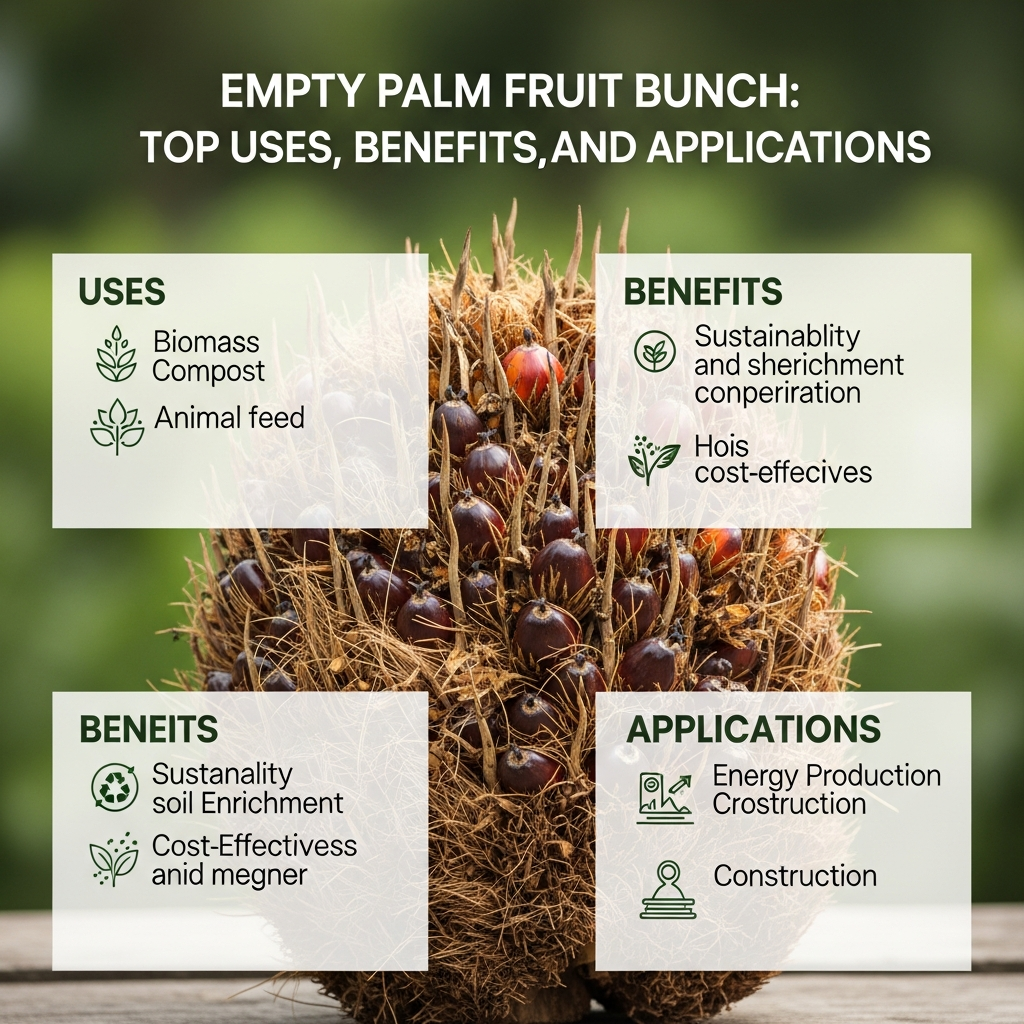
Empty Palm Fruit Bunch: Top 5 Ultimate Uses & Benefits in 2025
İçindekiler
In the vast world of agriculture, what was once considered waste is now being recognized as a valuable resource. A prime example of this transformation is the Empty Palm Fruit Bunch (EPFB), a byproduct of the palm oil industry. Instead of being discarded, this fibrous material is revolutionizing sectors from renewable energy to sustainable farming, turning a disposal problem into a golden opportunity for innovation.
This guide explores the top uses, benefits, and applications of the empty palm fruit bunch, showcasing how it contributes to a circular economy. We will delve into its role in generating power, enriching soil, and even creating next-generation materials that can shape a more sustainable future.

What Is an Empty Palm Fruit Bunch?
An Empty Palm Fruit Bunch is the biomass that remains after the fresh fruitlets have been stripped from the Yağ Palmiyesi Meyve Demeti (OPFB) in the palm oil milling process. For every ton of Ham Palm Yağı produced, a significant amount of solid waste is generated alongside valuable co-products like the Palmiye Çekirdeği, daha sonra işlenir Hurma Çekirdeği Yağı.
Composed primarily of cellulose, hemicellulose, and lignin, this material is rich in potassium and other nutrients. Historically, managing the sheer volume of this byproduct was a major challenge for mills. Today, however, the unique properties of the empty palm fruit bunch have made it a sought-after commodity.
Top 5 Ultimate Uses for Empty Palm Fruit Bunch
The versatility of EPFB allows it to be used in numerous innovative applications. Its fibrous structure and chemical composition make it suitable for both energy generation and agricultural enhancement. Let’s explore the most impactful uses of this incredible resource.
1. A Powerhouse for Biofuel and Renewable Energy
One of the most significant applications of the empty palm fruit bunch is as a source of renewable energy. Its high calorific value makes it an excellent solid biofuel, similar in application to Palmiye Çekirdeği Kabuğu, for powering boilers in palm oil mills and other industrial plants, reducing the reliance on fossil fuels.
Beyond direct combustion, EPFB can be processed into higher-value energy products like bio-pellets, bio-char, and bio-oil through processes like pyrolysis. Furthermore, research highlighted by journals like ScienceDirect shows its potential for conversion into bioethanol, contributing to a cleaner transportation sector. This positions the empty palm fruit bunch as a key player in the global bioenergy landscape.
2. Nutrient-Rich Compost and Soil Conditioner
The agricultural benefits of EPFB are immense. When composted, the empty palm fruit bunch breaks down into a dark, nutrient-dense organic material perfect for improving soil health. It is particularly rich in potassium (K), a vital macronutrient for plant growth, flowering, and fruiting.
Using this compost helps improve soil structure, increases water retention capacity, and enhances microbial activity. This leads to healthier crops and higher yields, all while reducing the need for synthetic chemical fertilizers. This approach to utilizing byproducts is common in the palm industry, where materials like Hurma Çekirdeği Çıkarıcısı are also repurposed as high-protein animal feed.

3. Sustainable Mulching in Modern Agriculture
In its raw, shredded form, the empty palm fruit bunch serves as an excellent organic mulch. Spreading it around the base of palm trees or other crops helps conserve soil moisture by reducing evaporation, suppresses weed growth, and regulates soil temperature.
As the mulch slowly decomposes, it releases nutrients directly into the soil, providing a steady supply of nourishment to the plants. This method is both cost-effective and environmentally friendly, making it a popular practice in large-scale plantations seeking sustainable management solutions.
4. An Alternative Source for Pulp and Paper
The high fiber content of the empty palm fruit bunch makes it a viable raw material for the pulp and paper industry. As global demand for paper products continues to rise, finding alternatives to traditional wood sources is crucial for forest conservation.
According to research from institutions like the Technical Association of the Pulp and Paper Industry (TAPPI), the fiber characteristics of EPFB are suitable for producing various grades of paper and cardboard. This innovative use helps reduce deforestation and adds significant value to agricultural residue.
5. Building Blocks for Advanced Materials
Geleceğin empty palm fruit bunch is incredibly exciting, with ongoing research into its use for advanced materials. Its strong natural fibers can be used to manufacture medium-density fiberboard (MDF), particleboard, and other composite panels for furniture and construction.
Scientists are also exploring its potential in creating bioplastics, automotive components, and geotextiles. As documented in journals like Polimerler, these bio-composites offer a lightweight, sustainable, and biodegradable alternative to petroleum-based products, paving the way for a greener manufacturing industry.
The Overarching Benefits of Using Empty Palm Fruit Bunch
Utilizing EPFB offers a trifecta of benefits that span environmental, economic, and agricultural domains.
- Environmental: It drastically reduces landfill waste from palm oil mills, curbs methane emissions from decomposition, and provides a renewable substitute for fossil fuels and wood, helping to combat climate change.
- Economic: It creates new revenue streams for the palm oil industry through “waste-to-wealth” initiatives. The production of energy, compost, and biomaterials generates jobs and fosters economic growth in rural areas.
- Agricultural: The return of organic matter to the soil improves long-term fertility and sustainability, leading to more resilient and productive farming systems.
Challenges and Future Outlook for the Empty Palm Fruit Bunch
Despite its vast potential, the widespread use of the empty palm fruit bunch faces some hurdles. These include high moisture content, which requires dewatering for efficient transport and combustion, as well as logistical challenges in collecting and processing the bulky material.
However, continuous advancements in technology are making these processes more efficient and cost-effective. As the world pushes for a circular economy, the demand for sustainable materials and energy sources will only grow. A report from the Uluslararası Yenilenebilir Enerji Ajansı (IRENA) often emphasizes the role of biomass like EPFB in the global energy transition.
Conclusion: From Waste to Wealth
Bu Empty Palm Fruit Bunch is a powerful testament to the potential hidden within agricultural byproducts. No longer just a waste management issue, it has emerged as a cornerstone of sustainability in the palm oil industry and beyond. From lighting up homes with clean energy to nurturing the soil for future harvests, its applications are as diverse as they are impactful.
By embracing the full potential of resources like the empty palm fruit bunch, we can move closer to a more resilient, resourceful, and environmentally conscious world. Its journey from a discarded stalk to a valuable commodity is a compelling story of innovation and a blueprint for the future of sustainable industry.
Makmur Amanah Sejahtera, Palmiye Çekirdeği Çıkarıcısı, Palmiye Çekirdeği Kabuğu, Ham Palmiye Yağı, Palmiye Çekirdeği Yağı vb. gibi yüksek kaliteli palmiye ürünleri sağlar. Lütfen +6282140002198 numaralı WhatsApp'tan bize ulaşın veya admin@makmuramanah.co.id adresinden bize e-posta gönderin.
 Turkish
  Indonesian
  English
  Chinese
  Dutch
Dutch  Arabic
  Thai
Thai  Vietnamese