10 Ultimate Uses of Empty Palm Fruit Bunch (EFB)
10 Ultimate Uses of Empty Palm Fruit Bunch (EFB) You Need to Know
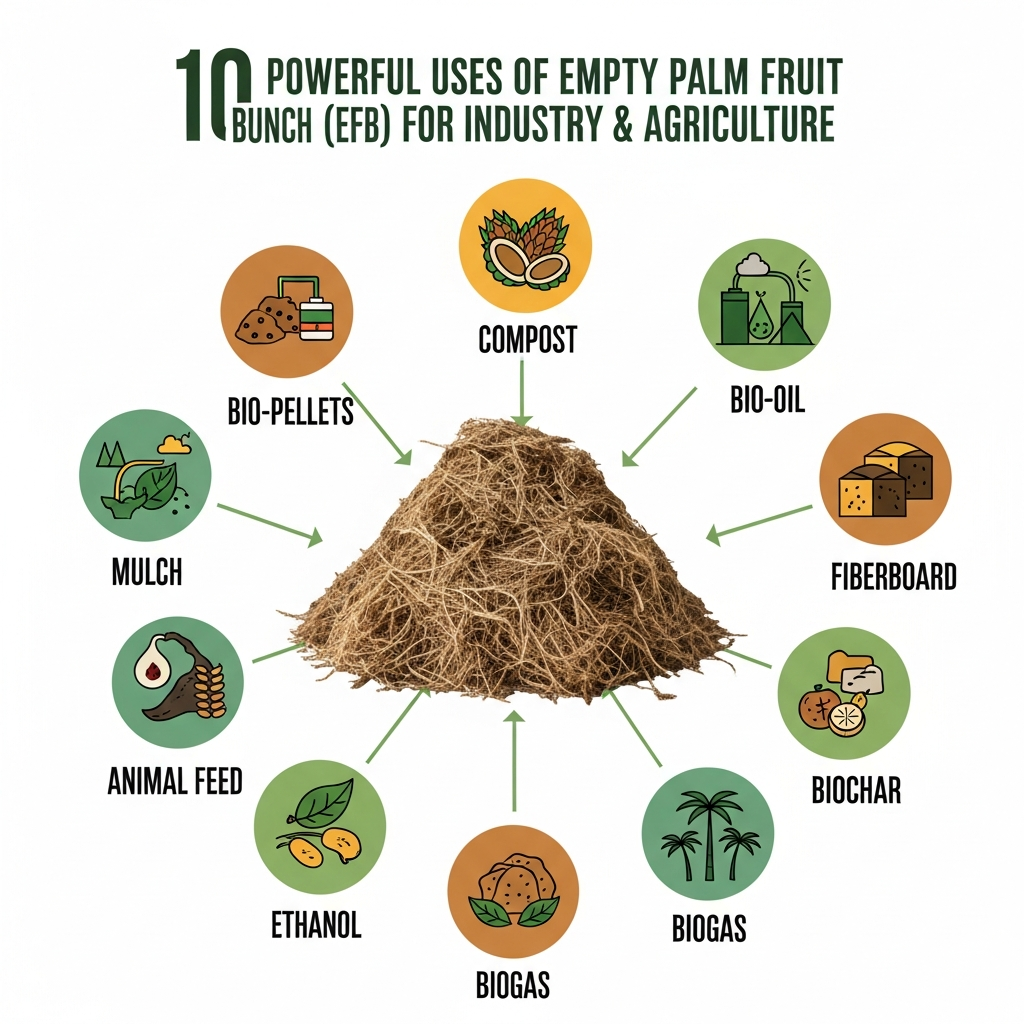
The palm oil industry, while vital for producing products like Dầu cọ thô Và Dầu Hạt Cọ, also generates significant biomass. The main component, the Chùm quả cọ dầu, yields the valuable fruit from which oil is extracted, leaving behind what’s known as the empty palm fruit bunch (EFB). But what if this “waste” is actually a valuable resource? This article explores the top 10 uses of empty palm fruit bunch, transforming a potential environmental problem into a powerhouse for both industry and agriculture. Alongside the EFB, the process also yields the hard Hạt cọ, another useful byproduct. Understanding these applications is key to creating a more sustainable and circular economy.

Mục lục
- 1. Biofuel and Renewable Energy
- 2. Organic Compost and Fertilizer
- 3. Pulp and Paper Production
- 4. Agricultural Mulching
- 5. Fiberboard and Particleboard
- 6. Biocomposite and Bioplastic Materials
- 7. Animal Feed Supplement
- 8. Mushroom Cultivation Medium
- 9. Activated Carbon Production
- 10. Erosion Control Mats
1. Biofuel and Renewable Energy
One of the most significant applications for EFB is in generating renewable energy. EFB has a high calorific value, making it an excellent source for biofuels. It can be processed into various forms:
- Pellets and Briquettes: EFB is shredded, dried, and compressed into dense pellets or briquettes. These are used as a clean-burning solid fuel in industrial boilers, much like other biomass resources such as Palm Vỏ Hạt Nhân, replacing coal and reducing greenhouse gas emissions.
- Biogas: Through anaerobic digestion, EFB can be broken down by microorganisms to produce methane-rich biogas, which can be used for electricity generation or heating.
This application directly supports the global shift towards cleaner energy sources. A study published in the Journal of Renewable and Sustainable Energy Reviews highlights the vast potential of palm oil biomass as a sustainable energy resource.
2. Organic Compost and Fertilizer
Raw EFB is rich in organic matter and essential nutrients, particularly potassium (K). When composted, it decomposes into a dark, nutrient-dense material that significantly improves soil health. Farmers use EFB compost to enhance soil structure, improve water retention, and provide a slow-release source of nutrients for crops.
This is one of the most direct agricultural uses of empty palm fruit bunch, helping to reduce the reliance on chemical fertilizers and promote organic farming practices. It closes the nutrient loop, returning vital elements back to the soil they came from.
3. Pulp and Paper Production
The long, fibrous nature of EFB makes it a viable alternative to wood for producing pulp and paper. This non-wood fiber source can help reduce deforestation by providing a sustainable raw material for the paper industry. The process involves turning the EFB fiber into pulp, which is then bleached and processed into various paper products.

4. Agricultural Mulching
Shredded EFB serves as an excellent organic mulch for plantations and farms. Spreading a layer of EFB around the base of plants helps to:
- Retain Soil Moisture: It reduces evaporation from the soil surface, which is crucial in hot climates.
- Suppress Weed Growth: The mulch layer blocks sunlight, preventing weed seeds from germinating.
- Regulate Soil Temperature: It insulates the soil, keeping it cooler during the day and warmer at night.
As it slowly decomposes, the mulch also adds organic matter back into the soil, further enriching it.
5. Fiberboard and Particleboard
The strong fibers in EFB can be bonded together with resin under heat and pressure to create medium-density fiberboard (MDF) and particleboard. These engineered wood products are widely used in furniture manufacturing and construction. This application is one of the most important industrial uses for EFB, adding value to what was once considered waste. Research from the Polymers journal often explores the development of such composite materials from natural fibers.
6. Biocomposite and Bioplastic Materials
In the world of advanced materials, EFB fibers are being used as a reinforcing agent in biocomposites. These materials combine natural fibers with a polymer matrix to create strong, lightweight products. Applications range from automotive interior parts to biodegradable packaging, offering an eco-friendly alternative to traditional plastics. This is one of the more innovative applications of EFB, driving green technology forward.
7. Animal Feed Supplement
While raw EFB is not highly digestible, it can be processed and treated to become a valuable source of roughage for ruminant livestock like cattle and goats. Treatments such as fermentation or steam processing help break down the tough lignocellulosic structure, improving its nutritional value and digestibility. It can supplement traditional animal feed, especially when mixed with other nutrient-rich byproducts like Palm Ép Hạt Nhân to create a more balanced ration.
8. Mushroom Cultivation Medium
The nutrient-rich, organic composition of EFB makes it an ideal substrate for growing mushrooms. After being composted and sterilized, EFB can be used to cultivate various edible mushroom species, such as oyster mushrooms. This provides an additional revenue stream for farmers and contributes to food security.
9. Activated Carbon Production
Through a process called pyrolysis and activation, EFB can be converted into activated carbon. This material has an incredibly porous structure with a large surface area, making it highly effective at adsorbing impurities. Activated carbon from EFB is used in water purification filters, air purifiers, and various industrial filtration processes, as detailed by environmental agencies like the EPA.
10. Erosion Control Mats
EFB fibers can be woven into biodegradable mats. These mats are placed on steep slopes, riverbanks, or construction sites to prevent soil erosion. They stabilize the soil while allowing vegetation to grow through them. As the mats naturally decompose over time, they add organic matter to the soil, further strengthening it. This environmentally friendly solution is one of the most practical and effective uses of this biomass, supported by organizations like the Natural Resources Conservation Service (NRCS).
Nguồn cung cấp sản phẩm cọ chất lượng cao của bạn
Makmur Amanah Sejahtera cung cấp các sản phẩm từ cọ chất lượng cao như Máy ép nhân cọ, Vỏ nhân cọ, Dầu cọ thô, Dầu nhân cọ, v.v. Vui lòng liên hệ với chúng tôi qua WhatsApp +6282140002198 hoặc gửi email cho chúng tôi theo địa chỉ admin@makmuramanah.co.id.
Conclusion: From Waste to Wealth
The journey of the empty palm fruit bunch from a discarded byproduct to a valuable resource is a powerful example of innovation in sustainability. The many uses of empty palm fruit bunch—from generating clean energy and enriching soil to creating building materials and advanced biocomposites—demonstrate its incredible versatility. By embracing these applications, we can reduce waste, create economic value, and build a more sustainable future for both industry and agriculture.
 Vietnamese
  Indonesian
  English
  Chinese
  Dutch
Dutch  Arabic
  Thai
Thai  Turkish