Coconut Shell Charcoal: The Ultimate 2025 Guide to Its Benefits
Mục lục
- What Is Coconut Shell Charcoal?
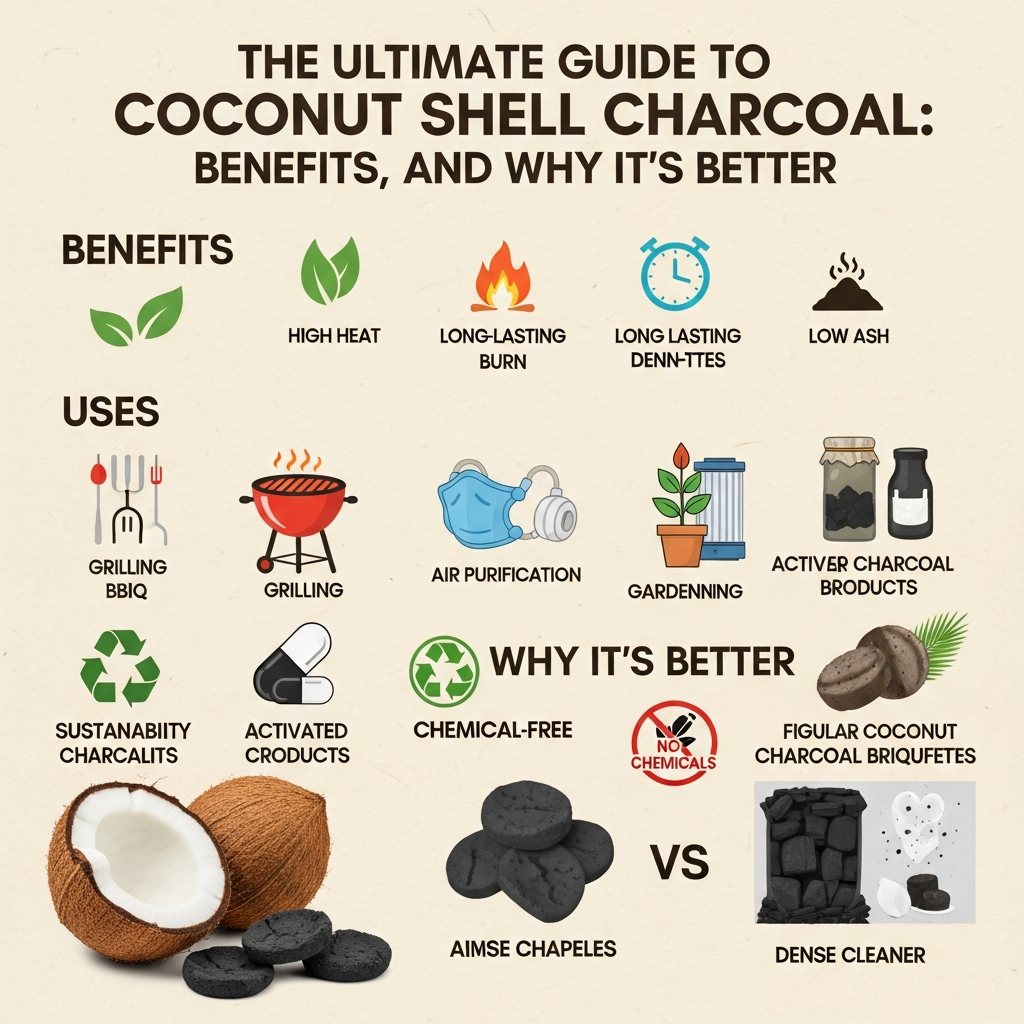
- 5 Incredible Benefits of Coconut Shell Charcoal
- Beyond the Grill: Common Uses for Coconut Shell Charcoal
- Coconut Shell Charcoal vs. Traditional Charcoal
- How to Choose the Best Coconut Shell Charcoal for 2025
- Những câu hỏi thường gặp
When you think of charcoal, the first thing that probably comes to mind is a summer barbecue. But what if there was a better, cleaner, and more sustainable option? Enter coconut shell charcoal, a remarkable innovation that’s changing the game for grilling enthusiasts and eco-conscious consumers alike. This guide explores everything you need to know about this amazing fuel source.
What Is Coconut Shell Charcoal?
Coconut shell charcoal is a type of charcoal produced from the hard, woody shells of coconuts. These shells, often discarded as waste from the coconut processing industry, are carbonized through a controlled burning process in a kiln with limited oxygen. This process, known as pyrolysis, transforms the organic material into pure carbon.
The result is a highly dense and efficient fuel source. Unlike traditional wood charcoal, which contributes to deforestation, coconut shell charcoal repurposes agricultural waste, making it an incredibly sustainable choice. Its unique composition gives it properties that are superior to many other forms of charcoal on the market.
This sustainable approach is common in tropical agriculture. For instance, the palm oil industry utilizes every part of the palm fruit. The fleshy part is processed into Dầu cọ thô, while the hard center, the Hạt cọ, yields valuable Dầu Hạt Cọ. Even the byproducts, such as the leftover meal known as Palm Ép Hạt Nhân and the tough Palm Vỏ Hạt Nhân, are repurposed for biofuel and animal feed. Similarly, even the Chùm quả cọ dầu is used, showcasing a full-circle, zero-waste philosophy that coconut shell charcoal production shares.

5 Incredible Benefits of Coconut Shell Charcoal
Why make the switch? The advantages are clear, ranging from environmental impact to grilling performance. This isn’t just another charcoal; it’s a significant upgrade.
1. It’s Eco-Friendly and Sustainable
The number one benefit is its sustainability. Since it’s made from a byproduct of the coconut industry, it doesn’t require cutting down any trees. This helps combat deforestation and promotes a circular economy. A study published in the Biomass and Bioenergy journal frequently highlights the value of using agricultural waste for energy production.
2. Burns Hotter and for Longer
Coconut shell charcoal has a higher carbon content and density than most wood charcoals. This means it burns significantly hotter and more consistently, providing a stable cooking temperature for extended periods. You’ll use less charcoal per grilling session, saving you money in the long run.
3. Produces Minimal Smoke and Ash
Tired of thick, acrid smoke and a mountain of ash after your BBQ? Because coconut shell charcoal is natural and contains very few impurities, it produces almost no smoke and leaves behind only about 2-4% of its original weight in ash. This makes for a cleaner cooking experience and a much easier cleanup.
4. Completely Natural and Chemical-Free
High-quality coconut charcoal is made without the use of chemical additives, binders, or fillers that are often found in conventional briquettes. This means no unwanted chemical flavors are transferred to your food, allowing the natural taste of your ingredients to shine through. You get a pure, clean burn every time.
5. Incredible Versatility
While perfect for grilling, the applications for this product go much further. Its porous nature makes it an excellent base for activated carbon, which is used in filters for water and air purification. We’ll dive deeper into its many uses below.
Beyond the Grill: Common Uses for Coconut Shell Charcoal
The unique properties of coconut shell charcoal make it useful in a surprising number of applications far beyond the barbecue.
- Grilling and Barbecuing: Its primary use, prized for high, consistent heat and low smoke. Perfect for searing steaks or slow-cooking ribs. For more tips on grilling, check out our guide to Perfect Grilling Techniques.
- Activated Carbon for Filtration: After being “activated,” it becomes incredibly porous and effective at adsorbing impurities. It’s a key component in many home water filters and air purifiers. Research from the National Center for Biotechnology Information (NCBI) details its effectiveness.
- Horticulture (Biochar): When added to soil, it acts as biochar, improving drainage, retaining nutrients, and fostering beneficial microbial growth. It’s a fantastic, organic way to boost your garden’s health.
- Odor Absorption: Place a small bag of coconut charcoal in your fridge, closet, or gym bag to naturally absorb unwanted odors without using chemical sprays.

Coconut Shell Charcoal vs. Traditional Charcoal
Here’s a quick breakdown of how coconut shell charcoal stacks up against traditional lump charcoal and standard briquettes.
| Đặc trưng | Coconut Shell Charcoal | Traditional Lumpwood | Standard Briquettes |
|---|---|---|---|
| Source | Renewable (Coconut Waste) | Wood (Potential Deforestation) | Wood Scraps, Sawdust, Binders |
| Heat Output | Very High & Consistent | High but Inconsistent | Medium & Consistent |
| Burn Time | Long | Fast | Medium |
| Ash Content | Very Low (2-4%) | Low-Medium (5-8%) | High (15-20%) |
| Smoke | Minimal | Varies | Can be high (additives) |
| Environmental Impact | Positive (Uses Waste) | Negative | Neutral to Negative |
How to Choose the Best Coconut Shell Charcoal for 2025
With its growing popularity, more brands are appearing on the market. To ensure you get a high-quality product, look for brands that are labeled “100% natural” or “100% coconut shells.” Avoid products with a long list of ingredients, as this can indicate the presence of fillers. Reading reviews on grilling forums or retail sites like those recommended by AmazingRibs.com can also provide valuable insight.
Những câu hỏi thường gặp
1. Does using coconut shell charcoal make my food taste like coconut?
No, not at all! The carbonization process removes all the coconut oils and flavors, leaving behind a pure carbon fuel. It provides a very neutral heat source that won’t interfere with the flavor of your food, unlike some mesquite or hickory charcoals.
2. Is it more expensive than regular charcoal?
The upfront cost per bag can sometimes be slightly higher. However, because coconut shell charcoal burns longer and hotter, you often use less of it per cooking session. This efficiency can make it more economical in the long run.
3. How do I light it?
You can light it just like any other charcoal. A chimney starter is the most effective and chemical-free method. Avoid using lighter fluid, as it can introduce chemical tastes and defeats the purpose of using such a clean, natural product. The Environmental Protection Agency (EPA) warns against inhaling fumes from burning chemicals, making a chimney a safer choice.
Making the switch to coconut shell charcoal is a simple choice that offers massive benefits. You get a superior grilling performance with a hotter, longer, and cleaner burn, all while making a positive impact on the environment. It’s a win-win for your taste buds and the planet.
Makmur Amanah Sejahtera cung cấp các sản phẩm từ cọ chất lượng cao như Máy ép nhân cọ, Vỏ nhân cọ, Dầu cọ thô, Dầu nhân cọ, v.v. Vui lòng liên hệ với chúng tôi qua WhatsApp +6282140002198 hoặc gửi email cho chúng tôi theo địa chỉ admin@makmuramanah.co.id.
 Vietnamese
  Indonesian
  English
  Chinese
  Dutch
Dutch  Arabic
  Thai
Thai  Turkish