
目录
- What Exactly is an Empty Palm Fruit Bunch?
- 9+ Ultimate Uses of the Empty Palm Fruit Bunch
- 1. A Powerhouse for Renewable Energy
- 2. Nutrient-Rich Organic Fertilizer and Compost
- 3. Sustainable Source for Pulp and Paper
- 4. Natural Agricultural Mulch
- 5. Substrate for Mushroom Cultivation
- 6. Building Blocks for Fiberboard and Furniture
- 7. A Roughage Source for Animal Feed
- 8. Eco-Friendly Erosion Control
- 9. Advanced Biochar Production
- 您值得信赖的高品质棕榈产品供应商
- Conclusion: The Future is in the Bunch
In the vast world of agriculture, the palm oil industry is a giant. But what happens after the valuable oil is extracted? For years, the leftover fibrous material was seen as waste. However, the humble 空棕榈果串 (EFB), the core component of the 油棕果串, is now being recognized as a powerhouse of potential, transforming from a disposal problem into a sustainable solution for dozens of industries.
This article dives deep into the incredible versatility of this agricultural biomass. We’ll explore over nine surprising and beneficial uses that showcase why the Empty Palm Fruit Bunch is a key player in the circular economy. Get ready to be amazed by what this “waste” product can do.
What Exactly is an Empty Palm Fruit Bunch?
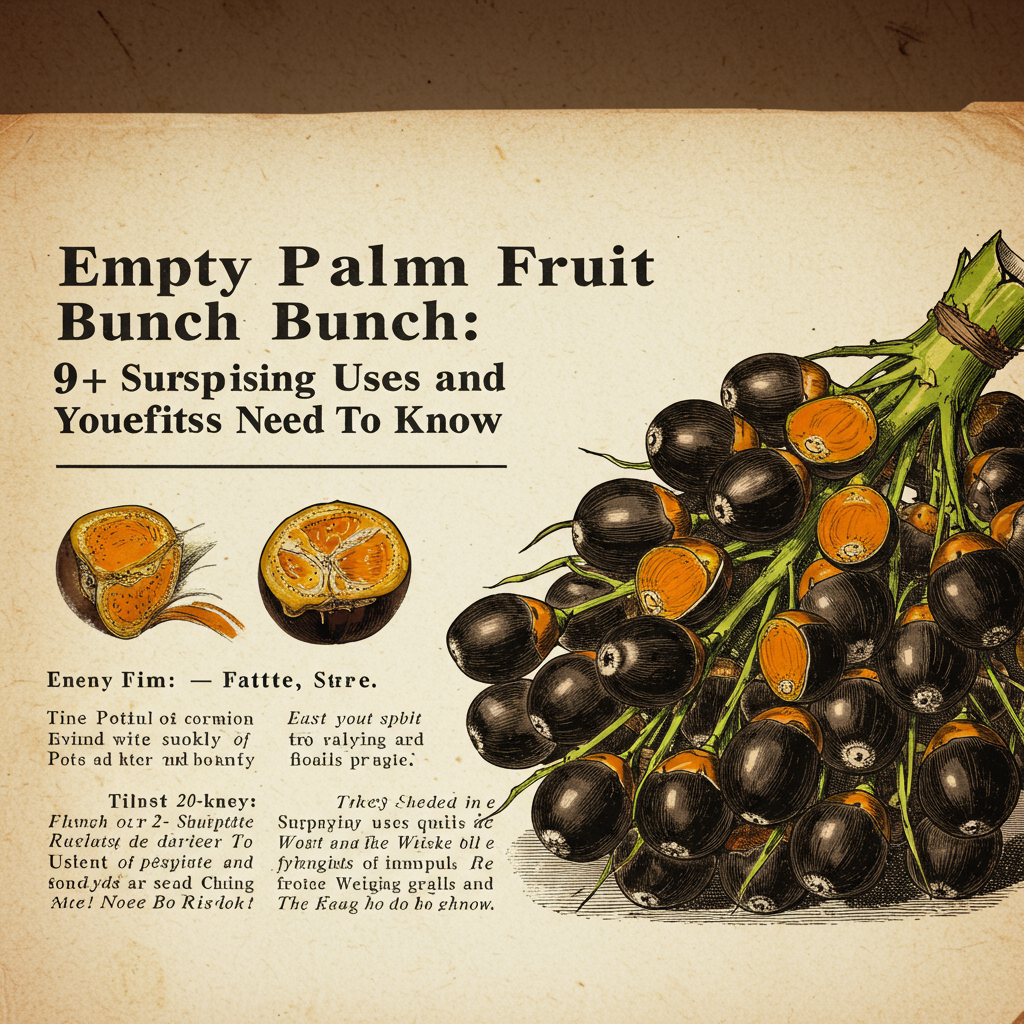
An Empty Palm Fruit Bunch is the fibrous stalk left over after the palm fruits have been removed to produce 粗棕榈油. The process also separates the valuable 棕榈仁, leaving the fibrous bunch behind. These bunches, which look like large, woody pom-poms, are a major byproduct of the palm oil milling process. For every ton of crude palm oil produced, approximately 1.1 tons of EFB are generated, making it an abundant and readily available resource.

9+ Ultimate Uses of the Empty Palm Fruit Bunch
From powering homes to feeding animals, the applications for EFB are growing every day. Let’s explore the most impactful and surprising uses that are making waves in sustainability circles.
1. A Powerhouse for Renewable Energy
One of the most significant uses for the 空棕榈果串 is as a biomass fuel. Instead of relying on fossil fuels, many palm oil mills now use EFB to fire boilers, generating steam and electricity to power their own operations. This creates a self-sustaining, closed-loop energy system that dramatically reduces the mill’s carbon footprint.
The EFB can also be processed into pellets or briquettes, creating a dense, transportable biofuel, similar to how other biomass like the 棕榈仁壳 is used. The energy potential of the 空棕榈果串 is a key factor in its growing popularity. According to a study in the Journal of Energy Conversion and Management, EFB is a promising fuel source for clean energy generation in Southeast Asia.
2. Nutrient-Rich Organic Fertilizer and Compost
Raw EFB is rich in organic matter and essential nutrients like potassium (K). When composted, it breaks down into a dark, crumbly material that is perfect for improving soil structure and fertility. Applying this compost back to the palm plantations helps return nutrients to the soil, reducing the need for chemical fertilizers.
This practice not only saves costs but also enhances soil health, promoting better water retention and microbial activity. This method of recycling an 空棕榈果串 directly contributes to more sustainable agriculture practices within the industry.
3. Sustainable Source for Pulp and Paper
The world’s demand for paper is immense, often contributing to deforestation. The fiber from the 空棕榈果串 provides a viable, tree-free alternative for pulp and paper production. The long, strong fibers are well-suited for creating various paper products, from writing paper to packaging materials.
Utilizing EFB reduces pressure on natural forests and makes use of a byproduct that would otherwise be discarded. Research from organizations like the 美国纸浆和造纸工业技术协会(TAPPI) continues to explore and optimize this sustainable process.
4. Natural Agricultural Mulch
In its raw or shredded form, EFB makes an excellent mulching material. Spreading it around the base of trees or on garden beds helps suppress weed growth, conserve soil moisture by reducing evaporation, and regulate soil temperature. As the 空棕榈果串 slowly decomposes, it releases valuable organic matter back into the soil.

5. Substrate for Mushroom Cultivation
Here’s a truly surprising use: growing food! The sterilized and composted fibers of the Empty Palm Fruit Bunch serve as a perfect substrate for cultivating edible mushrooms, particularly oyster mushrooms. The EFB provides the necessary nutrients and structure for the mushroom mycelium to thrive, turning a waste product into a source of nutritious food.
6. Building Blocks for Fiberboard and Furniture
The strong fibers in EFB can be mixed with a binding agent and pressed under high heat and pressure to create medium-density fiberboard (MDF) and particleboard. These boards are used extensively in the furniture and construction industries. This innovative use of the 空棕榈果串 creates value-added products and reduces the need to harvest wood.
7. A Roughage Source for Animal Feed
While not as nutrient-dense as other feeds, processed EFB can be used as a source of roughage for ruminant animals like cattle and goats. It can be blended with more nutrient-dense byproducts like 棕榈仁压榨机 to create a balanced feed. After undergoing treatments like fermentation or steam processing to improve its digestibility, the 空棕榈果串 can supplement animal diets, especially during dry seasons when other forage is scarce. Other derivatives like 棕榈仁油 also play a role in the wider animal feed industry.
8. Eco-Friendly Erosion Control
The fibrous nature of EFB makes it ideal for creating biodegradable mats and logs used for erosion control. Placed on steep slopes, riverbanks, or construction sites, these EFB-based geotextiles help stabilize the soil, slow down water runoff, and promote the re-establishment of vegetation. They offer an organic, effective solution to a significant environmental problem.
9. Advanced Biochar Production
One of the most exciting modern uses for the 空棕榈果串 is in creating biochar through a process called pyrolysis. Biochar is a charcoal-like substance that is incredibly effective at improving soil health and sequestering carbon. When added to soil, it can remain stable for centuries, locking away carbon that would have otherwise been released into the atmosphere. According to the Intergovernmental Panel on Climate Change (IPCC), biochar is a recognized strategy for carbon sequestration.
您值得信赖的高品质棕榈产品供应商
正在寻找高品质的棕榈产品?
Makmur Amanah Sejahtera 提供高品质的棕榈产品,例如棕榈仁压榨料、棕榈仁壳、原棕榈油、棕榈仁油等。请通过 WhatsApp +6282140002198 或发送电子邮件至 admin@makmuramanah.co.id 与我们联系。.
Conclusion: The Future is in the Bunch
The journey of the 空棕榈果串 from a waste product to a valuable resource is a powerful example of innovation in sustainability. Its ability to generate clean energy, enrich soils, create new materials, and even grow food showcases the immense potential of agricultural byproducts in a circular economy.
As industries continue to seek greener, more efficient solutions, the versatile 空棕榈果串 stands out as a symbol of ingenuity. The next time you think about the palm oil industry, remember that its most exciting product might just be the one that gets left behind.
 Chinese
  English
  Indonesian
  Arabic