
目录
目录
In the vast world of palm oil production, a significant amount of biomass is generated as a byproduct. While products like 粗棕榈油 get the most attention, the materials left behind are becoming increasingly valuable. One of the most abundant of these is the 油棕果串, also known as EFB. Once considered waste, this fibrous material is now a key resource for a sustainable circular economy.
This article explores the incredible potential locked within EFB, detailing what it is and its seven most valuable uses that are transforming industries from energy to agriculture.
什么是空棕榈果串(EFB)?
一个 空棕榈果串 is the leftover bunch after the fresh fruitlets have been stripped off for palm oil extraction. These bunches are a lignocellulosic material rich in fiber, potassium, and other nutrients. They are distinct from other byproducts like the 棕榈仁壳, which is the hard casing around the kernel.
For every ton of crude palm oil produced, approximately 1.2 tons of EFB are generated. With millions of tons produced annually, managing this biomass has become a critical environmental and logistical challenge, leading to innovative solutions to repurpose it effectively.

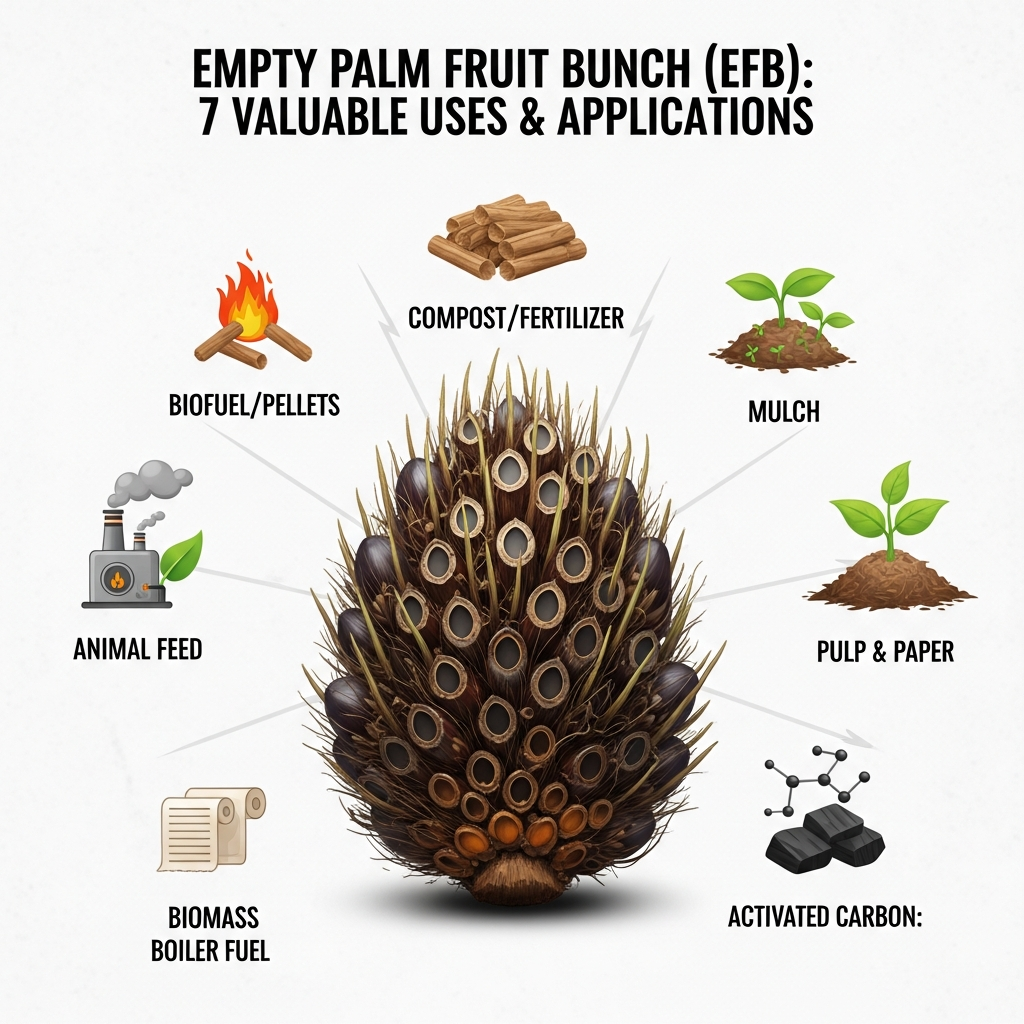
7 Ultimate Uses for EFB
From green energy to sustainable materials, the applications for EFB are both diverse and impactful. Here are seven of the most promising uses.
1. 生物燃料和可再生能源
EFB is a powerful source of biomass energy. It can be burned directly in boilers to generate steam and electricity for palm oil mills, reducing their reliance on fossil fuels. Furthermore, it can be processed into higher-value fuels like pellets, bio-oil, and biogas. According to the 国际可再生能源机构(IRENA), biomass like EFB is crucial for a global transition to renewable energy.
2. 有机堆肥和肥料
Due to its high organic matter and potassium content, EFB is an excellent raw material for compost. When shredded and composted, it transforms into a nutrient-rich soil conditioner that improves soil structure, water retention, and fertility. This compost is often used back in the palm plantations, creating a closed-loop system that recycles nutrients and reduces the need for chemical fertilizers.
3. 纸浆和造纸生产
The long, strong fibers within an 空棕榈果串 make it a viable alternative to wood for producing pulp and paper. This process helps reduce deforestation and offers a more sustainable paper source. The development of EFB-based paper products aligns with global efforts to find eco-friendly materials for packaging and printing.
4. Eco-Friendly Medium Density Fibreboard (MDF)
The fibers from EFB can be mixed with a resin and pressed under high temperature and pressure to create Medium Density Fibreboard (MDF). This EFB-based MDF is a sustainable building material used in furniture and interior paneling, offering a green alternative to traditional wood-based boards. Its production utilizes agricultural residue, locking carbon into durable products.

5. Effective Plantation Mulch
In its raw or shredded form, EFB serves as an excellent mulching material. Spreading it around the base of palm trees helps conserve soil moisture, suppress weed growth, and prevent erosion. As the mulch slowly decomposes, it releases nutrients back into the soil. This practice is highlighted by the FAO’s Soils Portal as a key technique for sustainable land management.
6. 生物基化学品的生产
Advanced biorefinery technologies can break down the cellulose in EFB to produce valuable bio-based chemicals. As detailed in studies on platforms like 科学直接, substances like ethanol and various organic acids can be extracted. These chemicals are used in food production, pharmaceuticals, and the manufacturing of bioplastics.
7. Sustainable Animal Feed Component
After treatment to improve its digestibility, EFB can be incorporated into feed for ruminant livestock. It serves as a good source of roughage, complementing other feed sources like 棕榈仁压榨机 (PKE). The entire value chain, from the 棕榈仁 itself to valuable oils like 棕榈仁油, contributes to a zero-waste ecosystem.
The Circular Economy in Action
The transformation of EFB from a waste product into a valuable resource is a perfect example of the circular economy. As technology advances, we can expect even more innovative applications to emerge. Utilizing every part of the palm harvest not only minimizes waste but also creates new economic opportunities and promotes a healthier planet.
您可持续棕榈产品的来源
正在寻找高品质的棕榈产品?
Makmur Amanah Sejahtera 提供高品质的棕榈产品,例如棕榈仁压榨料、棕榈仁壳、原棕榈油、棕榈仁油等。请通过 WhatsApp +6282140002198 或发送电子邮件至 admin@makmuramanah.co.id 与我们联系。.
结论
No longer just a byproduct, the 空棕榈果串 is a cornerstone of sustainability in the palm oil industry. Its seven powerful applications—from generating renewable energy and enriching soil to creating eco-friendly materials—showcase how agricultural “waste” can be one of our most valuable assets. By harnessing its potential, we move towards a more resourceful and environmentally responsible world.
 Chinese
  English
  Indonesian
  Arabic