
采购 GACC Approved PKE is the critical first step for any business looking to successfully import this valuable animal feed ingredient into China. Navigating the complex regulatory landscape can be daunting, but this guide provides the definitive roadmap to ensure compliance and profitability in 2026.
What is GACC Approved PKE and Why is it Crucial?
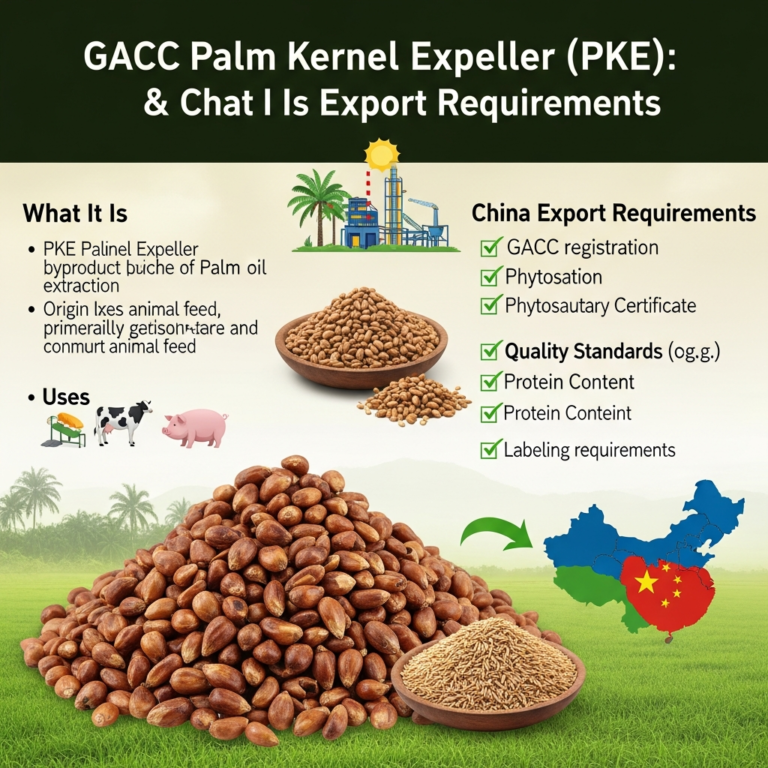
Palm Kernel Expeller (PKE) is a high-protein, high-fiber by-product of palm oil extraction. This makes it a valuable component in animal feed. However, not just any PKE can enter the lucrative Chinese market. It must be GACC Approved PKE.
GACC stands for the General Administration of Customs of the People’s Republic of China. This body is responsible for all import-export inspection and quarantine duties. GACC approval is a mandatory certification signifying that the overseas production facility and the final product meet China’s stringent safety standards. Without this approval, your shipment will be rejected at the port, leading to catastrophic financial losses.
[Image: High-quality, close-up shot of Palm Kernel Expeller, showing its texture and color. Title: High-Protein Palm Kernel Expeller (PKE). Alt Text: Close-up of GACC Approved PKE for animal feed.]
Understanding the GACC Approved PKE Mandate
For a product to be considered GACC Approved PKE, the exporting manufacturer must be registered and listed on GACC’s official database. This process, governed by regulations like Decree 248, is designed to ensure traceability and prevent the introduction of contaminants or diseases. It’s a non-negotiable requirement for market access.
Understanding this mandate is the key to successful sourcing and a core part of any import strategy involving PKE for the Chinese market.
The Difference Between PKE and PKM (Palm Kernel Meal)
While often used interchangeably, there can be slight differences. PKE is typically produced via mechanical extraction (expeller pressing), which leaves a higher residual oil content. Palm Kernel Meal (PKM) can sometimes refer to the product after solvent extraction, which has lower oil but higher protein. For GACC purposes, the specific production method must be declared and consistent with the approved registration.
Economic Impact on the Animal Feed Industry
China’s demand for animal feed is immense. According to research from leading industry publications, PKE is a cost-effective alternative to other feed ingredients like soybean meal. Securing a steady supply of GACC Approved PKE is a strategic advantage for Chinese feed mills and livestock producers, directly impacting food production costs and security.
For exporters, this represents a multi-billion dollar market opportunity. Furthermore, related products like 椰干粉 and even soil conditioners like 椰糠 are gaining traction, highlighting the diversity of agricultural exports.
The GACC Registration Process: A Step-by-Step Breakdown
Obtaining GACC registration for a PKE facility is a meticulous process. While exporters don’t handle this directly, understanding the steps is crucial for vetting suppliers. The responsibility lies with the producing facility in the origin country.
- Application Submission: The foreign PKE production facility submits an application through their country’s competent authority (like a ministry of agriculture) to the GACC. This includes detailed information about the company, production processes, and quality control systems.
- Technical Review: GACC experts review the submitted documentation. They scrutinize everything from raw material sourcing (棕榈仁压榨机 origins) to pest control measures and lab testing capabilities.
- Video or On-Site Audit: GACC may require a remote video inspection or, in some cases, an on-site audit of the production facility. They will verify that the practices described in the application are being followed rigorously.
- 审批和列入清单: If the facility passes the review and audit, it will be granted a registration number and added to the official GACC list of approved establishments. This list is publicly searchable and is the only true source of verification.
- Renewal: GACC registration is not permanent. It is typically valid for 5 years, after which the facility must undergo a renewal process to maintain its GACC Approved PKE status.
Sourcing High-Quality GACC Approved PKE: Your Checklist
As an importer, your primary task is to find a reliable supplier who is already on the GACC list. This is where due diligence is paramount. Finding a trustworthy source of GACC Approved PKE is the most critical part of the process.
How to Verify GACC Approval
Never take a supplier’s word for it. You must independently verify their status. Here’s how:
- 使用官方GACC数据库: The GACC maintains a public, searchable database of approved overseas food production facilities. You will need the supplier’s company name and, ideally, their registration number to perform a search. A direct link can usually be found through China’s official trade portals.
- Request the Registration Certificate: Ask the supplier for a copy of their official GACC registration certificate. Cross-reference the details on the certificate with the information in the online database.
- Check the Product Scope: Ensure the supplier’s GACC registration explicitly covers “Palm Kernel Expeller.” A registration for other products, like 棕榈仁壳, does not apply.
[Image: Infographic concept showing a flowchart. Title: The GACC PKE Import Journey: From Plantation to Port. Alt Text: Infographic detailing the sourcing and import process for GACC Approved PKE. It shows steps like: 1. Verify Supplier on GACC List, 2. Agree on Specs & Sign Contract, 3. Production & QC Testing, 4. Book Shipping & Prepare Docs, 5. China Customs Clearance, 6. Delivery to Feed Mill.]
Qualities of a Reliable PKE Supplier
- Proven Track Record: They should have a history of successfully exporting GACC Approved PKE to China.
- Strong Quality Control: They should provide comprehensive Certificates of Analysis (COA) for each batch, detailing nutritional values, moisture content, and aflatoxin levels.
- Logistical Expertise: They understand the specific packaging, labeling, and shipping requirements for China.
- 透明沟通: They are responsive and willing to provide all necessary documentation for your due diligence.
Key Documents and Compliance for Importing PKE to China
Once you have a verified supplier, the focus shifts to a perfect paper trail for each shipment. Missing or incorrect documents are the most common reasons for delays and rejections at Chinese ports.
Essential Shipping Documents
Your customs broker in China will need the following original documents:
- 提单(B/L): Must be clean and match all other documents precisely.
- 商业发票: Detailing the value, quantity, and description of the goods.
- 包装清单: Showing the weight and packing details.
- 原产地证书: Issued by the Chamber of Commerce in the origin country.
- 植物检疫证书: A critical document from the origin country’s plant protection authority, certifying the PKE is free from pests and diseases. This is a focus area for GACC inspectors.
- 分析证书(COA): As specified in the contract, detailing quality parameters.
Labeling and Packaging Requirements
Every bag or container of PKE must be labeled according to Chinese regulations. Labels must be in Standard Chinese and include key information such as the product name, GACC registration number of the manufacturer, net weight, production date, and shelf life. Failure to comply with labeling rules is a frequent cause of customs holds.
Common Pitfalls to Avoid When Importing GACC Approved PKE
Many importers, both new and experienced, can fall into traps that jeopardize their shipments. Awareness is the first step to avoidance when dealing with GACC Approved PKE.
Relying on a “Guaranteed” Certificate from a Trader
Some traders may offer a certificate without being the producer. The GACC registration is tied to the specific physical production facility. Always trace the product back to the GACC-listed manufacturer. This is why working with a trusted producer can streamline the process of securing authentic GACC Approved PKE.
Ignoring Aflatoxin and Contaminant Limits
China has very strict maximum residue limits (MRLs) for contaminants like aflatoxins. A 2021 study published in the Toxins journal highlights the global prevalence of mycotoxins in animal feed. Ensure your supplier provides a pre-shipment COA showing levels well within China’s limits. Random testing by GACC at the port is common.
Poor Contract and Payment Terms
Your contract should explicitly state that the shipment must comply with all Chinese import regulations and that the product must be from a specific GACC-registered facility. Use secure payment terms like a Letter of Credit (L/C) that ties payment to the presentation of compliant documents.
Comparing PKE Suppliers: Vetting for GACC Compliance
Choosing the right supplier is the most critical decision in the import process. Here is a comparison to help you evaluate potential partners.
| Factor | Ideal Supplier | Risky Supplier |
|---|---|---|
| GACC Status | Directly listed on the official GACC database with valid registration for PKE. | Not listed, registration has expired, or is registered for a different product. |
| Documentation | Proactively provides all required certificates and documentation. | Hesitant to provide certificates; documents have inconsistencies. |
| Product Quality | Consistent quality with COAs showing low moisture and aflatoxin levels. | Inconsistent quality; high moisture content leading to mold. |
| Experience | Multiple years of experience exporting PKE to China. Understands the process. | New to the Chinese market; unfamiliar with GACC and port procedures. |
[Image: A magnifying glass hovering over a certificate with the GACC logo. Title: Vetting GACC Supplier Documentation. Alt Text: Verifying documentation for a GACC Approved PKE supplier.]
The Logistics of Shipping PKE to Chinese Ports
Successfully navigating GACC is only half the battle; the other half is physical logistics. PKE is typically shipped in 20-foot or 40-foot containers. Bulk shipping is less common due to a higher risk of contamination and quality degradation.
Container vs. Bulk Shipping
Container shipping offers better protection against moisture and pests, preserving the quality of the PKE. It also simplifies logistics from the port to the end-user’s feed mill. While bulk shipping might seem cheaper per ton, the risks of demurrage, spoilage, and contamination often outweigh the initial savings.
Working with Freight Forwarders
An experienced freight forwarder who specializes in agricultural commodities for the Chinese market is invaluable. They can advise on the best shipping lines, handle booking, and coordinate with your customs broker in China. They should be familiar with the documentation requirements for industry-standard commodities like GACC Approved PKE.
Furthermore, it is wise to consult official resources like the USDA’s China Exporter Guide for a high-level overview of trade requirements.
[Video: Embed a short, professional video from YouTube or Vimeo. Title: Understanding the GACC Decree 248 Registration Process. Description: A video explaining the key steps and requirements for a foreign food production facility to achieve GACC registration, highlighting the importance for importers.]
Makmur Amanah Sejahtera 我们提供高品质的棕榈产品,例如棕榈仁粕、棕榈仁壳、原棕榈油、棕榈仁油等。请通过 WhatsApp 联系我们。 +6282140002198 或发送电子邮件至 admin@makmuramanah.co.id.
常见问题解答 (FAQ)
1. What is the GACC?
The GACC is the General Administration of Customs of the People’s Republic of China. It’s the government agency responsible for customs, inspections, and quarantine for all goods entering or leaving China, including animal feed like GACC Approved PKE.
2. How long is GACC registration valid for?
GACC registration for overseas feed manufacturers is typically valid for five years. The facility must apply for renewal before the expiration date to continue exporting to China without interruption and maintain their GACC Approved PKE status.
3. Can I import PKE from a non-approved facility?
No. It is strictly prohibited. Any shipment of PKE from a facility not listed on the official GACC registration list will be rejected at the Chinese port. This is an absolute requirement for importing GACC Approved PKE, with no exceptions.
4. What are the most important quality factors for PKE for China?
Beyond nutritional content (protein, fat, fiber), the most critical factors are low moisture content (typically under 12%) to prevent mold, and very low levels of aflatoxins, which must meet China’s stringent import standards for GACC Approved PKE.
5. Where can I find the official list of GACC approved PKE suppliers?
The official list is maintained by GACC and is accessible through their online query system. You can access it via the “CiferQuery” GACC portal or consult with a specialized customs broker in China for assistance in navigating the database.
Conclusion: Your Partner for GACC Approved PKE in 2026
The Chinese market offers immense opportunities, but it demands diligence, especially when it comes to regulatory compliance. Sourcing and importing GACC Approved PKE is a complex but manageable process when you are armed with the right knowledge and partners.
By thoroughly vetting suppliers, ensuring impeccable documentation, and understanding the logistical nuances, you can build a resilient and profitable supply chain. Remember to always verify your supplier’s status on the official GACC database and prioritize quality and compliance above all else. This guide provides the framework, but a reliable partner turns that framework into success.
As you plan your 2026 import strategy, make sure you are working with producers who have a proven track record of delivering high-quality, compliant GACC Approved PKE.
[Image: A modern container ship on the ocean, heading towards a bustling port. Title: Global Logistics for PKE Shipments. Alt Text: A container ship transporting GACC Approved PKE to a port in China under a GACC agreement.]
 Chinese
  English
  Indonesian
  Arabic