
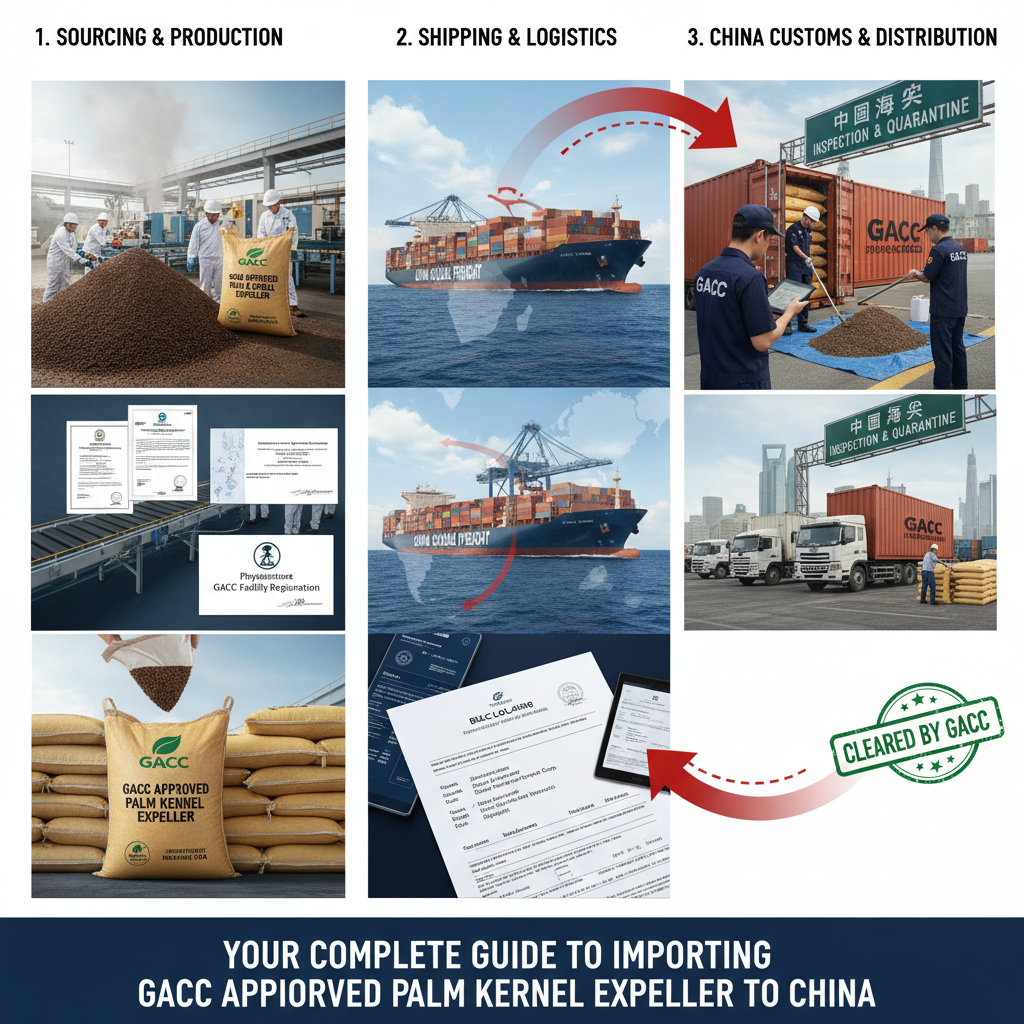
Importing GACC Approved Palm Kernel Expeller to China: A Complete Guide
Importing GACC Approved Palm Kernel Expeller to China is a critical process for global feed suppliers. However, navigating the complex regulations set by the General Administration of Customs of the People’s Republic of China (GACC) can be a significant hurdle.
Without a clear strategy, you risk costly delays, shipment rejections, and lost business opportunities. This guide provides the definitive 2026 roadmap to ensure your Palm Kernel Expeller (PKE) meets all GACC requirements for successful market entry.
As China’s demand for high-quality animal feed grows, understanding these regulations is a necessity. GACC Decrees 248 and 249 have completely reshaped the landscape for overseas food and feed producers. According to a USDA GAIN Report, these decrees require that all foreign enterprises involved in the production, processing, and storage of products exported to China must be registered with GACC. This article demystifies the entire process, providing a step-by-step blueprint for success.
[Image: Infographic: The 7-Step GACC registration process for PKE. | alt: Infographic detailing the 7 steps for importing GACC approved Palm Kernel Expeller to China in 2026. | title: GACC Registration Process for Palm Kernel Expeller]
What is GACC and Why Is It Critical for PKE Imports?
Understanding the GACC framework is the first step in your export journey. GACC is the unified administrative body that oversees all import-export commodity inspection, food safety, and quarantine for the People’s Republic of China. Its authority is absolute when it comes to market access for products like GACC approved Palm Kernel Expeller.
For Palm Kernel Expeller (PKE), a vital ingredient in animal feed, GACC approval is non-negotiable. It serves as a guarantee to Chinese authorities that your product meets rigorous safety, quality, and traceability standards. Without a valid GACC registration number, your shipment will be turned away at the port—no exceptions.
From AQSIQ to GACC: Understanding the 2018 Regulatory Shift
Veterans of the export industry will remember the former regulatory body, AQSIQ (General Administration of Quality Supervision, Inspection and Quarantine). In 2018, a major government restructuring integrated AQSIQ’s responsibilities into the newly formed GACC.
This consolidation streamlined oversight but also introduced a more digitized and stringent registration system. The new system places greater emphasis on the accountability of the overseas producers themselves.
The Role of GACC Decree 248 and 249 for Animal Feed
The two most critical regulations for PKE exporters are GACC Decree 248 and Decree 249, both effective since January 1, 2022.
- Decree 248: This regulation outlines the management provisions for registering overseas producers of imported foods. It classifies products into risk categories, placing feed materials like PKE in a category requiring official recommendation and registration by the exporting country’s competent authority.
- Decree 249: This decree details the food safety control measures, covering everything from packaging and labeling to transport and storage. It reinforces the “one enterprise, one code” principle, meaning each facility must have its own unique GACC registration number.
Prerequisites for Importing GACC Approved Palm Kernel Expeller to China
Before beginning the application, you must confirm your facility’s eligibility. GACC approval is contingent on both national-level agreements and facility-specific standards. This is a crucial checkpoint to avoid wasting time and resources on an application that is destined to fail from the start.
Furthermore, your internal quality management systems must be robust. You’ll need to demonstrate a comprehensive system for traceability, hazard control, and sanitation that aligns with international standards like HACCP or ISO 22000. It is this documented proof of quality that GACC auditors will scrutinize for your GACC approved Palm Kernel Expeller.
Essential Country-Level Agreements
First and foremost, your exporting country must have an established protocol for animal feed exports with China. Your nation’s competent authority (e.g., the Ministry of Agriculture) must have a formal inspection and quarantine agreement with GACC. Without this overarching agreement, individual facility applications will not be considered. You can verify your country’s status through your local trade or agricultural ministry.
Facility & Production Standards Checklist
Your production facility will be evaluated against a strict set of criteria. Ensure you meet these requirements:
- A legally established and approved entity in your home country.
- An effective food safety and sanitation control system (e.g., HACCP).
- A comprehensive traceability system from raw material to finished product.
- Clearly defined processes to prevent contamination and cross-contamination.
- Proper storage facilities that protect PKE from pests, moisture, and degradation.
- A dedicated quality control team and a lab for testing.
[Image: A high-quality photo of light-brown Palm Kernel Expeller in a clean pile. | alt: High-quality Palm Kernel Expeller ready for GACC inspection. | title: Premium Palm Kernel Expeller (PKE)]
The 7-Step GACC Registration Process for PKE Exporters in 2026
The path to importing GACC approved Palm Kernel Expeller to China is a structured, multi-step process managed through a digital platform. Follow these steps methodically to ensure a smooth application. This process demands attention to detail at every stage.
- Competent Authority Submission: Your company does not apply directly to GACC. You must first apply to your country’s designated competent authority. They will review your eligibility and, if approved, recommend your facility to GACC.
- Account Creation on CIFER: Once recommended, your competent authority will help you create an account on GACC’s “China Import Food Enterprise Registration” (CIFER) system. This is the single window for all application activities.
- Application Form Completion: Fill out the detailed application form in CIFER. This includes extensive information about your facility, production processes, quality control measures, and traceability systems. Be prepared to provide precise data.
- Document Upload: You will be required to upload a comprehensive package of supporting documents. This typically includes your business license, production permits, HACCP/ISO certifications, flow charts, and floor plans.
- GACC Review & Audit: GACC officials will review your submitted application and documents. They may request additional information. For a product like PKE, they will almost certainly conduct a remote video audit or, in some cases, an on-site inspection.
- Approval & Number Issuance: If your facility passes the audit, GACC will grant approval and issue a unique 18-digit registration number for your specific production facility.
- Public Listing: Your company, facility address, and approved registration number will be published on the official GACC database, making your status publicly verifiable by importers and customs officials.
Handling The GACC Audit: What to Expect
The GACC audit, whether virtual or in-person, is the most intensive part of the process. Auditors will meticulously cross-reference the documents you submitted with the reality on your factory floor. They will interview key personnel, review records, and inspect production lines. Complete transparency and preparedness are essential to passing.
Essential Documentation for Importing GACC Approved Palm Kernel Expeller to China
Beyond GACC registration, each shipment requires a precise set of documents to clear Chinese customs. Missing or incorrect paperwork is one of the most common reasons for costly port delays. You must ensure your documentation is flawless for every single consignment of GACC approved Palm Kernel Expeller.
Key documents generally include:
- 商业发票: Details the transaction between exporter and importer.
- 包装清单: Itemizes the contents, weight, and volume of the shipment.
- 提单(B/L): The contract of carriage issued by the shipping line.
- Certificate of Origin (CO): Verifies the country where the PKE was produced.
- 植物检疫证书: Issued by your country’s competent authority, this certifies the PKE is free from specified pests and diseases. This is a critical quarantine document.
- 分析证书(COA): Details the product’s specifications (e.g., protein, fiber, moisture content), confirming it meets quality standards.
- Non-GMO Declaration: A statement certifying the product is not derived from genetically modified organisms, if applicable.
- GACC注册号: This must be clearly printed on all relevant documents and on the product packaging itself.
Comparison: PKE vs. Other Feed Ingredients
Different feed ingredients may have slightly different requirements. Understanding these nuances is key for diversified exporters. Here is a simplified comparison:
| 特征 | 棕榈仁压榨机 | 椰干粉 |
|---|---|---|
| 主要用途 | Ruminant feed (cattle), poultry, swine | Ruminant feed, swine, aquaculture |
| GACC Risk Category | Medium-High (Requires official recommendation) | Medium-High (Requires official recommendation) |
| Key Testing Parameter | Aflatoxin, crude protein, fiber | Aflatoxin, protein, oil content |
| Internal Link | View Our PKE Products | View Our Copra Meal Products |
Customs Clearance for Importing GACC Approved Palm Kernel Expeller to China
Once your GACC-registered PKE arrives at a Chinese port, it enters the final phase: customs clearance. This involves document verification, physical inspection, and product sampling. Adhering to GACC’s strict labeling and packaging standards is vital for a smooth process.
In contrast to other commodities like 棕榈仁壳 (for biomass) or 椰糠 (a growing medium), feed ingredients undergo much more intense scrutiny due to their role in the food chain. Any deviation from the rules can trigger alarms.
GACC-Compliant Labeling Requirements for PKE Bags
Each bag or container of PKE must be labeled correctly in simplified Chinese. The label must be clear, durable, and contain the following information:
- Product Name: Palm Kernel Expeller
- Country of Origin
- Producer’s Name and Address
- The GACC Registration Number of the production facility
- Net Weight
- Production Date and Batch Number
- Shelf Life or Expiry Date
Common Reasons for Customs Delays and Rejections
To avoid problems, be aware of common pitfalls. According to leading industry publication FeedNavigator, a significant portion of rejections stem from preventable errors:
- Mismatched Information: Discrepancies between the invoice, B/L, and phytosanitary certificate.
- Incorrect or Missing GACC Number: The number on the packaging must exactly match the registered number.
- Failed Lab Tests: Product samples failing tests for contaminants. A scientific study highlights the importance of controlling aflatoxins in feed ingredients.
- Pest Infestation: Any sign of live insects or pests will result in immediate rejection or mandatory fumigation.
Makmur Amanah Sejahtera 我们提供优质的棕榈产品,例如棕榈仁粕、棕榈仁壳、原棕榈油、棕榈仁油等。请联系我们。 WhatsApp +6282140002198 或发送电子邮件至 admin@makmuramanah.co.id.
[Image: A customs officer in a Chinese port inspecting a shipment of agricultural goods. | alt: A customs officer inspecting a shipment, a key step in importing GACC approved Palm Kernel Expeller to China. | title: Chinese Customs Inspection for PKE Imports]
常见问题解答 (FAQ)
How long is a GACC registration for PKE valid?
A GACC registration for feed materials like Palm Kernel Expeller is valid for five years. You must apply for renewal three to six months before expiration to ensure continuous market access and avoid any interruption.
Can I import PKE to China without GACC approval?
No. It is impossible to legally import Palm Kernel Expeller into China for commercial use without a valid GACC registration for the production facility. Any attempt will result in the shipment being rejected or destroyed at the port.
How do I check if a PKE supplier is GACC registered?
You can verify a supplier’s status by searching their registration number or company name on the official GACC database. This public query is a crucial due diligence step and can be accessed via the CIFER system’s public query page.
What is the difference between Palm Kernel Expeller and Palm Kernel Cake?
Both are by-products of palm kernel oil extraction. Palm Kernel Expeller (PKE) is from mechanical pressing and has more residual oil (8-12%). Palm Kernel Cake (PKC) is from solvent extraction and has lower oil content (1-3%).
Are there specific Chinese ports designated for PKE imports?
While many major Chinese ports handle agricultural imports, some have more experience and specialized facilities for inspecting bulk feed ingredients. It is wise to work with an importer or logistics partner familiar with ports like Tianjin, Shanghai, and Guangzhou.
Your Partner in GACC-Compliant PKE Exports
Successfully importing GACC Approved Palm Kernel Expeller to China in 2026 requires diligence, precision, and a deep understanding of the regulatory environment. From ensuring facility eligibility and preparing for the GACC audit to perfecting documentation and labeling, each step is critical.
Following this guide helps you navigate the complexities and position your business for success in one of the world’s most valuable feed markets. Ultimately, partnering with an experienced, GACC-compliant supplier is the most effective strategy.
A reliable partner provides high-quality PKE and understands the export process, ensuring a smooth, predictable supply chain. The process of importing GACC approved Palm Kernel Expeller to China is complex, but with the right knowledge and partners, it is entirely achievable.
[Video Embed: A short, professional video titled “From Plantation to Port: How We Ensure GACC-Compliance for Our PKE” | alt: Video explaining the GACC compliance process for PKE. | title: GACC Compliant PKE Production Process]

 Chinese
  English
  Indonesian
  Arabic