
目录
- 什么是空棕榈果串(EFB)?
11+ Ultimate Profitable Uses for Empty Palm Fruit Bunch
- 1. High-Value Biofuel and Bioenergy
2. 有机堆肥和肥料
3. 纸浆和造纸生产
4. 中密度纤维板(MDF)
5. 可持续动物饲料
6. 农业覆盖
7. 蘑菇栽培基质
8. Biochar for Soil Amendment
9. Eco-Friendly Acoustic Panels
10. Bioplastics and Composites
11. Potash Extraction
Bonus: Biodegradable Landfill Cover
The palm oil industry, while vital to many economies, generates enormous amounts of biomass waste. For decades, the primary challenge has been managing the leftover 空棕榈果串 (EFB). Once considered a nuisance, this fibrous material is now being recognized as a valuable resource with a surprising number of profitable applications. This guide explores the ultimate uses that are transforming agricultural waste into wealth.
什么是空棕榈果串(EFB)?
一个 空棕榈果串 is the biomass that remains after the fresh fruit bunches (FFB) have been stripped of their palm fruits in the milling process to extract 粗棕榈油. The fruits contain the 棕榈仁, which is later processed for 棕榈仁油. These bunches are bulky, moist, and fibrous, composed mainly of cellulose, hemicellulose, and lignin. A single palm oil mill can produce thousands of tons of EFB daily, creating a significant disposal challenge.
However, this “waste” is rich in nutrients and organic material. With the rise of the circular economy and sustainable technology, innovators are finding incredible ways to repurpose every last strand of the 空棕榈果串, turning an environmental liability into a profitable asset.

11+ Ultimate Profitable Uses for Empty Palm Fruit Bunch
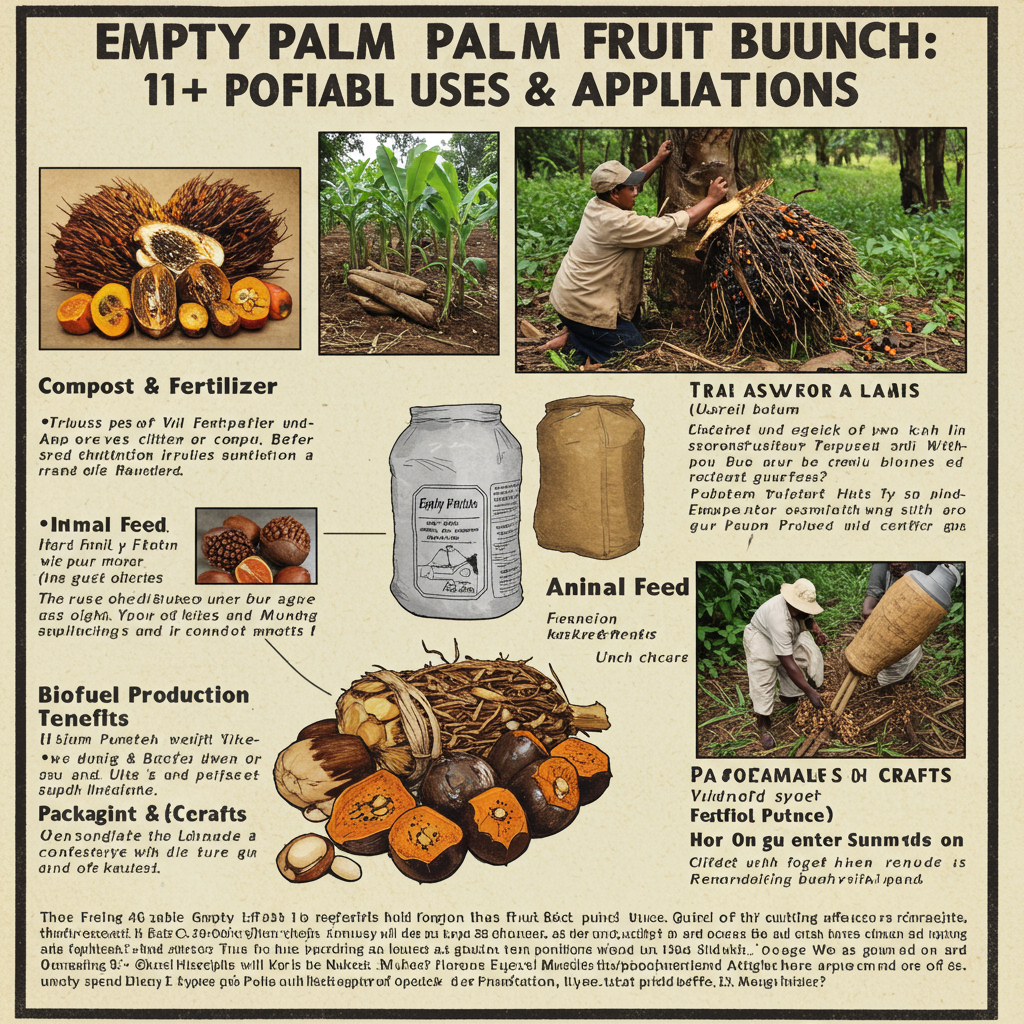
From energy to agriculture, the applications for EFB are diverse and growing. Here are over eleven proven ways this humble byproduct, the 空棕榈果串, is making a significant impact.
1. High-Value Biofuel and Bioenergy
One of the most profitable uses for an 空棕榈果串 is in energy generation. The raw EFB can be processed into various forms of biofuel, such as pellets and briquettes. These have high calorific value and serve as a clean, renewable alternative to coal in industrial boilers, similar to other biomass like 棕榈仁壳. Furthermore, advanced processes like gasification can convert EFB into synthesis gas (syngas) for electricity generation. For more on biomass energy, you can review findings from the 国际可再生能源机构(IRENA).
2. 有机堆肥和肥料
The nutrient-rich composition of the 空棕榈果串 makes it ideal for composting. EFB is naturally rich in potassium (K) and other essential plant nutrients. Through composting, the raw bunches are broken down into a dark, nutrient-dense organic fertilizer. This compost improves soil structure, enhances water retention, and reduces the need for chemical fertilizers in oil palm plantations, creating a perfect closed-loop system.
3. 纸浆和造纸生产
The high cellulose content in an 空棕榈果串 makes it a viable raw material for the pulp and paper industry. It serves as a sustainable alternative to wood fiber, helping to reduce deforestation. While the fiber length is shorter than that of wood, it is suitable for producing various paper products, including writing paper, cardboard, and newsprint.
4. 中密度纤维板(MDF)
The fibers from EFB can be mixed with a resin and hot-pressed to create Medium-Density Fibreboard (MDF). This engineered wood product is widely used in furniture manufacturing and construction. Using an 空棕榈果串 for MDF provides a sustainable material source and adds value to agricultural residue.

5. 可持续动物饲料
Although the raw 空棕榈果串 has low digestibility, it can be processed into a nutritious animal feed for ruminants like cattle and goats. Processes such as steam treatment and fermentation break down the tough lignin and cellulose, making the nutrients more accessible. This offers a low-cost, sustainable source of roughage for livestock, often complementing other feed ingredients like 棕榈仁压榨机.
6. 农业覆盖
In its raw, shredded form, the 空棕榈果串 makes an excellent mulching material. Spreading it around the base of trees in plantations helps conserve soil moisture, suppress weed growth, and prevent soil erosion. As the mulch slowly decomposes, it releases valuable organic matter and potassium back into the soil.
7. 蘑菇栽培基质
The fibrous and nutrient-rich nature of EFB makes it an ideal substrate for growing various types of edible mushrooms, such as oyster mushrooms. After sterilization, the EFB is inoculated with mushroom spawn, providing a perfect medium for the mycelium to grow and fruit.
8. Biochar for Soil Amendment
Through a process called pyrolysis (heating in the absence of oxygen), an 空棕榈果串 can be converted into biochar. This stable, carbon-rich material is a powerful soil amendment. According to research published in journals like Soil and Tillage Research, biochar improves soil fertility, increases water-holding capacity, and sequesters carbon, helping to combat climate change.
9. Eco-Friendly Acoustic Panels
The porous and fibrous structure of EFB gives it excellent sound-absorbing properties. This has led to its development as a green material for acoustic insulation panels used in recording studios, offices, and homes. These panels offer a sustainable alternative to synthetic foam-based products.
10. Bioplastics and Composites
强韧的纤维 空棕榈果串 can be used as a reinforcing agent in bioplastics and polymer composites. These materials are being used in various industries, including automotive parts and consumer goods, to create lightweight, durable, and more environmentally friendly products. Research into these applications is ongoing and shows immense promise, as detailed in journals like the Journal of Polymers and the Environment.
11. Potash Extraction
After an 空棕榈果串 is incinerated for energy, the resulting ash is extremely rich in potassium oxide (potash). This potash can be extracted and processed into a high-grade potassium fertilizer, which is in high demand globally. This method captures value even from the final waste product of the energy generation cycle.
Bonus: Biodegradable Landfill Cover
In some regions, shredded EFB is used as a daily cover material for sanitary landfills. It helps control odors, deter pests, and manage leachate. As a biodegradable material, it is a more sustainable option than using soil or other synthetic materials.
环境和经济效益
Repurposing the 空棕榈果串 offers significant advantages. Environmentally, it reduces landfill waste, decreases greenhouse gas emissions from decomposition, and provides renewable alternatives to fossil fuels and wood. The economic potential of the 空棕榈果串 is just as compelling, as it creates new revenue streams for palm oil mills, generates employment, and fosters innovation in green technology.
Conclusion: The Future of EFB
这 空棕榈果串 is a prime example of the “waste-to-wealth” philosophy. What was once a costly disposal problem is now a valuable feedstock for a multitude of industries. As technology advances and the global focus on sustainability sharpens in 2025 and beyond, the list of profitable uses for EFB will only continue to grow, solidifying its role in a more circular and sustainable economy. The potential held within each bunch is a powerful reminder that in nature, there is no such thing as waste.
您值得信赖的棕榈产品供应商
正在寻找高品质的棕榈产品?
Makmur Amanah Sejahtera 提供高品质的棕榈产品,例如棕榈仁压榨料、棕榈仁壳、原棕榈油、棕榈仁油等。请通过 WhatsApp +6282140002198 或发送电子邮件至 admin@makmuramanah.co.id 与我们联系。.
 Chinese
  English
  Indonesian
  Arabic