The Ultimate Guide to Palm Kernel Expeller for Animal Feed (2025)
目录
- 什么是棕榈仁榨油机(PKE)?
- Nutritional Specifications of Palm Kernel Expeller for Animal Feed
- Primary Uses of Palm Kernel Expeller for Animal Feed in Livestock
- Benefits and Drawbacks of Using PKE
- Understanding Palm Kernel Expeller (PKE) Price & Market Trends for 2025
- How to Safely Incorporate PKE into Animal Diets
- Conclusion: Is PKE the Right Choice for Your Farm?
As the global demand for sustainable and cost-effective livestock nutrition continues to grow, farmers and feed manufacturers are increasingly seeking high-value alternative ingredients. One of the most prominent is Palm Kernel Expeller for animal feed (PKE), a valuable by-product of the palm oil industry that offers a powerful combination of protein, fiber, and energy. This ultimate 2025 guide explores everything you need to know about its uses, nutritional specs, and market price.
PKE, also known as Palm Kernel Cake (PKC), has become a staple ingredient in livestock rations worldwide, especially for ruminant diets. Its affordability and consistent availability make it a compelling alternative to traditional feedstuffs like soybean meal or corn. However, understanding its unique nutritional profile is the key to using this resource effectively and maximizing your returns.
什么是棕榈仁榨油机(PKE)?
Palm Kernel Expeller is the solid material left over after the oil has been mechanically extracted from the 棕榈仁, which is the seed of the oil palm fruit. The extraction process, known as expeller pressing, mechanically squeezes the valuable 棕榈油 out, leaving a dense, fiber-rich cake. This cake is then ground into a meal, creating the final 棕榈核榨油机 product used in feed formulations.
It’s crucial not to confuse PKE with other palm by-products. For instance, 棕榈壳 is the hard outer casing of the kernel and is primarily used as a biofuel. The unique composition of Palm Kernel Expeller for animal feed comes specifically from the seed’s endosperm, giving it a distinct and more valuable nutritional profile for livestock compared to other residues.

Nutritional Specifications of Palm Kernel Expeller for Animal Feed
The quality and exact nutritional content of PKE can vary based on the palm species, the efficiency of the oil extraction process, and the amount of shell remaining in the final product. However, a typical analysis provides a reliable baseline for professional feed formulation when sourcing high-quality Palm Kernel Expeller for animal feed.
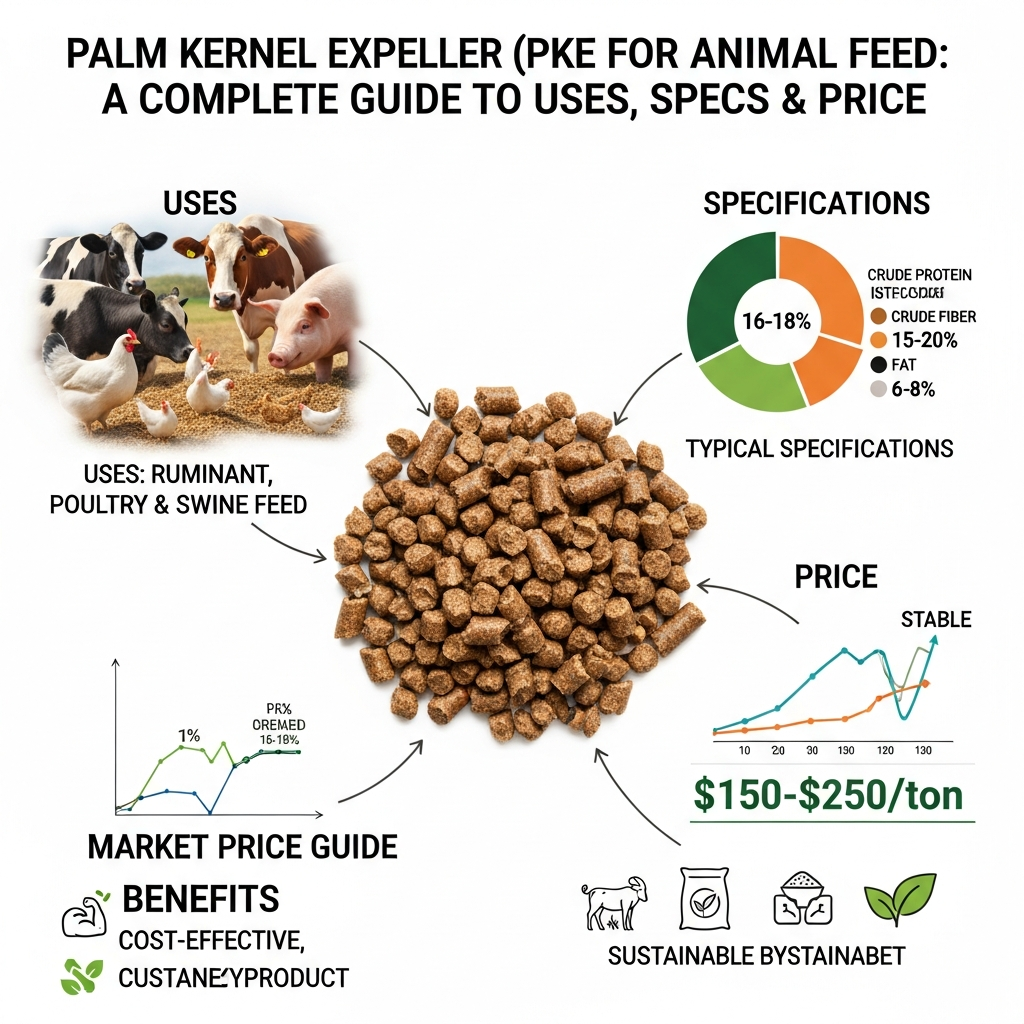
Here are the average nutritional specifications for a premium PKE product:
- 粗蛋白(CP): 14-18%
- 粗脂肪/油: 6-10%
- 粗纤维(CF): 15-22%
- Metabolizable Energy (ME): 7.5-8.5 MJ/kg
- 灰: 3-6%
- Moisture: < 10%
The high fiber content is one of its most defining features. While this can be a limiting factor for monogastric animals like poultry, it is extremely beneficial for ruminants. For a more detailed scientific breakdown, Feedipedia offers an extensive analysis of PKE’s nutritional values.
Primary Uses of Palm Kernel Expeller for Animal Feed in Livestock
PKE is a versatile ingredient, but its application is most successful when tailored to the specific digestive system of the animal. Its significant economic advantage makes this Palm Kernel Expeller for animal feed a popular choice in compound feeds across various livestock sectors.
反刍动物(牛、山羊、绵羊)的PKE
Ruminant nutrition is where Palm Kernel Expeller for animal feed truly excels. Its high concentration of digestible fiber makes it an ideal supplement for cattle (both dairy and beef), sheep, and goats. This fiber supports healthy rumen function and fermentation, acting as a valuable roughage extender and promoting gut health.
For dairy cows, PKE is known to increase milk fat content due to its beneficial residual oil and fiber profile. It serves as a cost-effective source of protein and energy, often replacing more expensive grains. As animal nutrition research shows, inclusion rates for cattle can safely range from 20% to as high as 50% in well-balanced total mixed rations (TMR).
PKE for Poultry (Broilers & Layers)
使用 Palm Kernel Expeller for animal feed in poultry diets is more challenging due to its high fiber and relatively low energy density. The presence of non-starch polysaccharides (NSPs) can hinder digestion in chickens. However, with modern feed technology and formulation strategies, its use is becoming more feasible and economical.
Feed formulators often limit the inclusion of PKE to 5-10% in broiler and layer diets. Its effectiveness can be significantly improved by adding feed enzymes that help break down the complex fibers, making more nutrients available to the bird and improving overall digestibility.
PKE for Swine & Other Monogastrics
Similar to poultry, the high fiber content limits the use of PKE in swine diets, particularly for young, growing pigs. The grittiness can also affect palatability if not processed correctly. Despite this, it can be successfully included at rates of 10-15% in the diets of gestating sows, where high fiber is beneficial for promoting satiety and maintaining excellent gut health.

Benefits and Drawbacks of Using PKE
Like any feed ingredient, PKE has a distinct set of pros and cons that every farm manager should consider before incorporating it into their feeding program.
Key Advantages
- 成本效益: It is generally cheaper than soybean meal and other traditional protein sources, helping to significantly lower overall feed costs.
- 高可用性: As a by-product of the massive palm oil industry, Palm Kernel Expeller for animal feed is widely available year-round.
- Excellent Fiber Source: It’s an ideal source of digestible fiber for ruminants, promoting gut health and proper rumen function.
- 可持续副产品: Using PKE reduces waste from the palm oil industry, contributing to a more circular and sustainable agricultural economy.
Potential Disadvantages
- Low Energy for Monogastrics: The high fiber content dilutes the energy density, making it less suitable for animals with high energy demands like broilers.
- 可变质量: Nutritional content can fluctuate. It is vital to work with trusted suppliers who can guarantee consistent specifications and low shell content.
- 适口性问题: Some lower-quality batches can be gritty, which may reduce feed intake if not properly mixed into a ration.
Understanding Palm Kernel Expeller (PKE) Price & Market Trends for 2025
价格 Palm Kernel Expeller for animal feed is influenced by several global economic factors. The market remains closely tied to the price of 毛棕榈油 (CPO), global shipping costs, and demand from major importing regions like Europe, New Zealand, and China.
An increase in CPO production often leads to a greater supply of PKE, which can put downward pressure on prices. Conversely, supply chain disruptions or a surge in demand for alternative protein meals can cause prices to rise. For up-to-date commodity pricing, resources like the IndexMundi 商品报告 offer valuable market insights.
How to Safely Incorporate PKE into Animal Diets
To maximize the benefits of PKE and avoid potential issues, follow these industry best practices:
- Consult a Nutritionist: Always work with a professional animal nutritionist to formulate a balanced diet that accounts for PKE’s unique profile.
- Start Gradually: Introduce PKE into the feed slowly over one to two weeks. This allows the animals’ digestive systems to adapt without causing stress.
- Ensure Proper Mixing: To overcome any palatability concerns, ensure the PKE is thoroughly mixed into a total mixed ration (TMR) or pelleted feed.
- Source from Reputable Suppliers: Purchase Palm Kernel Expeller for animal feed with guaranteed specifications for protein, fiber, and low shell content to ensure consistency and quality.
- Consider Enzymes for Monogastrics: If using PKE for poultry or swine, discuss adding fiber-degrading enzymes with your nutritionist to boost nutrient absorption and digestibility.
Conclusion: Is PKE the Right Choice for Your Farm?
Ultimately, Palm Kernel Expeller for animal feed is a highly effective and economical ingredient when used correctly and sourced from a reliable supplier. For ruminant operations, it presents a clear opportunity to reduce feed costs without sacrificing animal performance. For poultry and swine, its role is more nuanced but remains a viable, cost-saving option with careful formulation and modern feed additives.
By understanding its nutritional specifications, benefits, and limitations, you can make an informed decision and leverage this sustainable by-product to enhance your feeding strategy in 2025 and beyond. Just as PKE is a valuable part of the palm ecosystem, other by-products like 油棕果串 also contribute to a zero-waste approach in modern agriculture. Always prioritize quality to ensure the best results for your livestock.
Makmur Amanah Sejahtera 提供高品质的棕榈产品,如棕榈仁压榨机、棕榈仁壳、棕榈原油、棕榈仁油等。请通过 WhatsApp +6282140002198 与我们联系,或发送电子邮件至 admin@makmuramanah.co.id。