
Table of Contents
The palm oil industry, while vital for many economies, generates a significant amount of biomass waste. For years, the Oil Palm Fruit Bunch (often referred to as the Empty Palm Fruit Bunch or EFB) was considered a problematic byproduct. However, a shift towards a circular economy has transformed this “waste” into a valuable resource with a surprising number of applications. This guide explores the complete journey of the EFB from a mill byproduct to a cornerstone of sustainable innovation.
Understanding the potential held within the Empty Palm Fruit Bunch is key to unlocking more sustainable industrial and agricultural practices. This lignocellulosic material is poised to play an even bigger role in the green economy of the future.
What Is an Empty Palm Fruit Bunch?
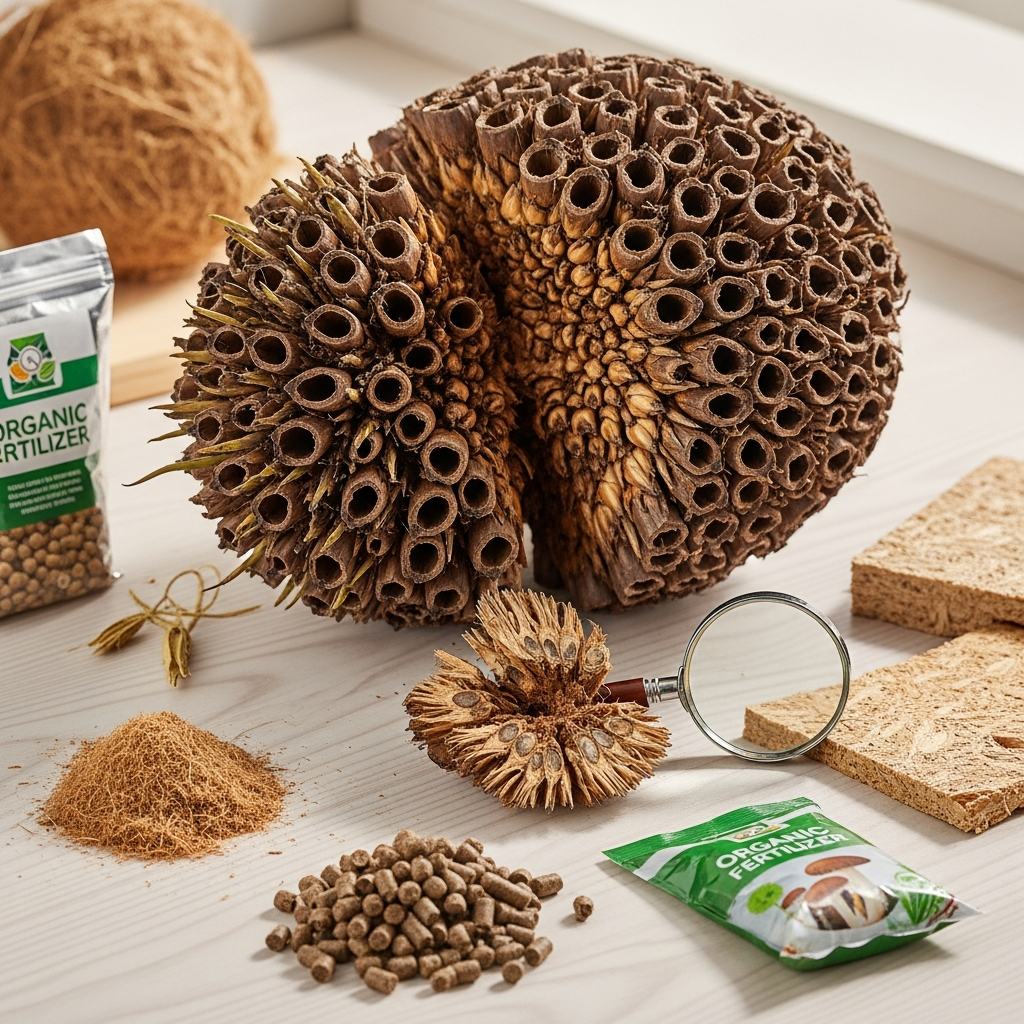
An Empty Palm Fruit Bunch is the fibrous stalk that remains after the palm fruits have been stripped off for oil extraction. These bunches consist primarily of cellulose, hemicellulose, and lignin. For every ton of Crude Palm Oil produced, approximately 1.1 tons of EFB are generated, making it the most abundant solid waste from the milling process. This is distinct from other valuable parts of the fruit, such as the Palm Kernel, which is used to produce Palm Kernel Oil.
Due to its high moisture content (around 60-70%) and tough texture, disposing of it has historically been a challenge. However, these same properties, when managed correctly, make it an incredibly versatile raw material for a wide range of value-added products.

Top 7+ Uses and Applications of Empty Palm Fruit Bunch
Innovation has paved the way for numerous applications, turning a disposal problem into a revenue opportunity. The versatility of the Empty Palm Fruit Bunch is a testament to the power of green technology and resourcefulness.
1. Biofuel and Renewable Energy
One of the most significant applications is in renewable energy. The Empty Palm Fruit Bunch can be used directly as a solid biomass fuel in boilers to generate steam and electricity for the mill itself, reducing reliance on fossil fuels. It can also be processed into higher-value fuels like:
- Pellets and Briquettes: Compressing dried EFB increases its density and energy value, making it easier to transport and use in industrial furnaces, much like Palm Kernel Shell, another popular biomass fuel.
- Bio-ethanol: Through enzymatic hydrolysis and fermentation, the cellulose in EFB can be converted into bio-ethanol, a promising green fuel.
This “waste-to-energy” approach is a critical component of sustainable palm oil production. For more in-depth research, you can explore studies on its bioenergy potential in this article from the Energies journal.

2. Composting and Soil Conditioning
Raw EFB is rich in potassium and other organic matter, making it an excellent soil conditioner. When composted, the Empty Palm Fruit Bunch decomposes into a nutrient-rich, humus-like material. This compost improves soil structure, enhances water retention, and promotes healthy microbial activity.
Applying this compost back to the palm plantations helps close the nutrient loop, reducing the need for chemical fertilizers and improving long-term soil health. This practice is a cornerstone of sustainable agriculture.
3. Pulp and Paper Production
The high fiber content of the Empty Palm Fruit Bunch makes it a viable alternative to wood for producing pulp and paper. While the process requires specific pulping and bleaching techniques, it offers a way to reduce deforestation. The resulting paper is suitable for packaging materials, writing paper, and other paper products.
Research continues to optimize this process, making EFB an increasingly attractive raw material for the paper industry. This study on ScienceDirect delves into the potential of EFB for pulp production.
4. Production of Biocomposites and Bioplastics
EFB fibers serve as an excellent natural reinforcement material for polymer composites. These “wood-plastic composites” or biocomposites are durable, lightweight, and more environmentally friendly than traditional plastics. They are used in automotive interior parts, furniture, decking, and consumer goods.
Furthermore, the cellulose extracted from the Empty Palm Fruit Bunch can be a feedstock for producing biodegradable plastics, offering a powerful solution to plastic pollution.
5. Sustainable Animal Feed
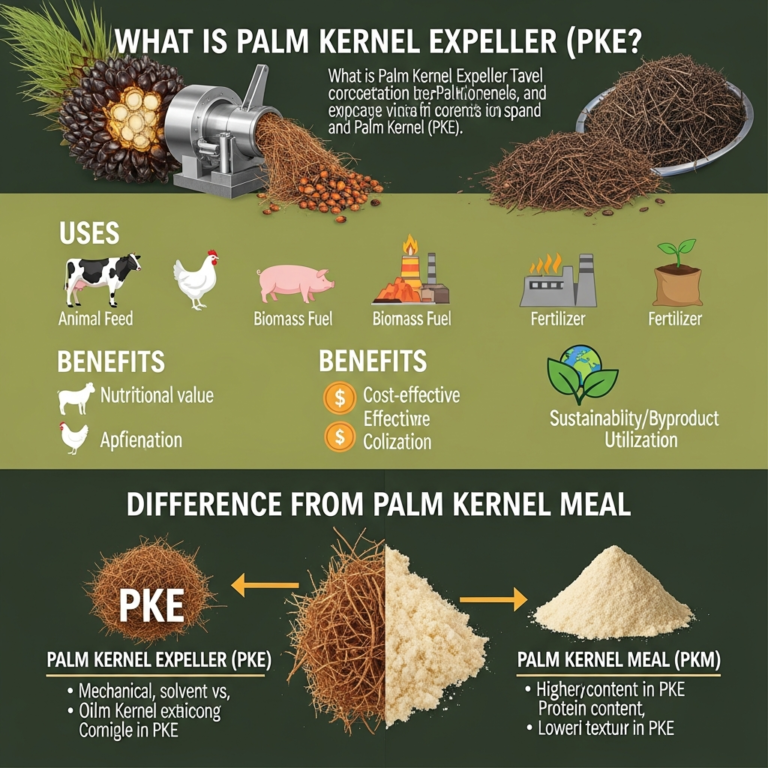
In its raw form, EFB is not easily digestible for most livestock. However, through treatments like steam processing and fermentation, its complex fibers can be broken down into more digestible components. The treated Empty Palm Fruit Bunch can then be used as a source of roughage in feed for ruminants like cattle and goats. This complements other feed products from the palm industry, such as the protein-rich Palm Kernel Expeller.
6. Mulching in Agriculture
Shredded EFB makes for an excellent mulching material. Spreading it around crops helps to conserve soil moisture by reducing evaporation, suppresses weed growth, and regulates soil temperature. As the mulch slowly decomposes, it releases valuable nutrients back into the soil, further enriching it over time.
7. Mushroom Cultivation Substrate
The fibrous, nutrient-rich nature of the Empty Palm Fruit Bunch makes it an ideal substrate for growing various types of edible mushrooms, particularly oyster mushrooms. The EFB is typically sterilized and then inoculated with mushroom spawn. This application provides an additional income stream for farmers and produces a high-value food product from a waste material.
Bonus Application: Activated Carbon Production
Through a process called pyrolysis, EFB can be converted into activated carbon. This highly porous material has a vast surface area, making it extremely effective for filtration and purification processes. It is used in water treatment, air purifiers, and various industrial applications. You can learn more about the diverse uses of activated carbon from this EPA overview.
The Environmental and Economic Impact of Utilizing Empty Palm Fruit Bunch
The proper utilization of the Empty Palm Fruit Bunch carries significant benefits. Environmentally, it reduces landfill waste, decreases greenhouse gas emissions from decomposition, and lowers the carbon footprint of palm oil mills. Economically, it creates new value chains, generates employment, and provides a diversified income source for producers.
This transformation from waste to wealth exemplifies the principles of a circular economy.
Challenges and Future Outlook for Empty Palm Fruit Bunch
Despite its potential, challenges remain. The high moisture content of fresh Empty Palm Fruit Bunch makes transportation and processing costly. Logistics and the need for significant capital investment in processing facilities can also be barriers. However, ongoing research is focused on developing more efficient and cost-effective conversion technologies.
The future looks bright, with a growing global demand for sustainable materials and renewable energy. As technology improves, the Empty Palm Fruit Bunch is set to become an even more crucial player in the bio-based economy.
Conclusion: From Waste to Wonder
The Empty Palm Fruit Bunch is a powerful example of how industrial byproducts can be repurposed into valuable assets. From generating clean energy and enriching soils to creating innovative materials, its applications are diverse and impactful. By embracing these uses, the palm oil industry can move towards a more sustainable, zero-waste model that benefits both the economy and the environment.
Makmur Amanah Sejahtera provides high-quality palm products such as Palm Kernel Expeller, Palm Kernel Shell, Crude Palm Oil, Palm Kernel Oil, etc. Kindly contact us at WhatsApp +6282140002198 or email us at admin@makmuramanah.co.id.Looking for High-Quality Palm Products?
 English
  Indonesian
  Chinese
  Arabic