目录
The palm oil industry, while vital for many economies, generates a significant amount of biomass waste. For years, the 油棕果串 (often referred to as the Empty Palm Fruit Bunch or EFB) was considered a problematic byproduct. However, a shift towards a circular economy has transformed this “waste” into a valuable resource with a surprising number of applications. This guide explores the complete journey of the EFB from a mill byproduct to a cornerstone of sustainable innovation.
Understanding the potential held within the 棕榈空果串 is key to unlocking more sustainable industrial and agricultural practices. This lignocellulosic material is poised to play an even bigger role in the green economy of the future.
什么是油棕空果串?
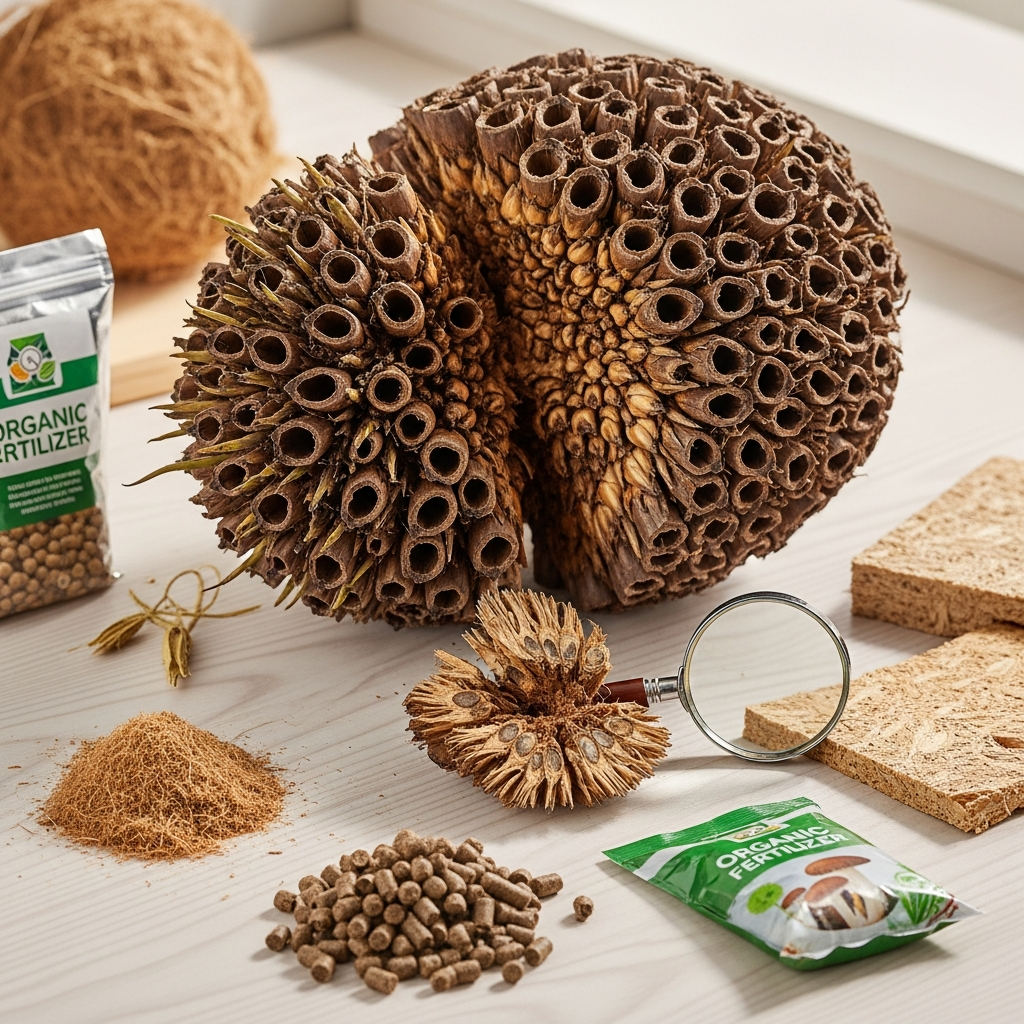
一个 棕榈空果串 is the fibrous stalk that remains after the palm fruits have been stripped off for oil extraction. These bunches consist primarily of cellulose, hemicellulose, and lignin. For every ton of 粗棕榈油 produced, approximately 1.1 tons of EFB are generated, making it the most abundant solid waste from the milling process. This is distinct from other valuable parts of the fruit, such as the 棕榈仁中提取有价值的产品,用于生产 棕榈仁油.
Due to its high moisture content (around 60-70%) and tough texture, disposing of it has historically been a challenge. However, these same properties, when managed correctly, make it an incredibly versatile raw material for a wide range of value-added products.

Top 7+ Uses and Applications of Empty Palm Fruit Bunch
Innovation has paved the way for numerous applications, turning a disposal problem into a revenue opportunity. The versatility of the 棕榈空果串 is a testament to the power of green technology and resourcefulness.
1. 生物燃料与可再生能源
One of the most significant applications is in renewable energy. The 棕榈空果串 can be used directly as a solid biomass fuel in boilers to generate steam and electricity for the mill itself, reducing reliance on fossil fuels. It can also be processed into higher-value fuels like:
- 颗粒和压块: Compressing dried EFB increases its density and energy value, making it easier to transport and use in industrial furnaces, much like 棕榈仁壳, another popular biomass fuel.
- 生物乙醇: Through enzymatic hydrolysis and fermentation, the cellulose in EFB can be converted into bio-ethanol, a promising green fuel.
This “waste-to-energy” approach is a critical component of sustainable palm oil production. For more in-depth research, you can explore studies on its bioenergy potential in this article from the Energies journal.

2. 堆肥与土壤调理
Raw EFB is rich in potassium and other organic matter, making it an excellent soil conditioner. When composted, the 棕榈空果串 decomposes into a nutrient-rich, humus-like material. This compost improves soil structure, enhances water retention, and promotes healthy microbial activity.
Applying this compost back to the palm plantations helps close the nutrient loop, reducing the need for chemical fertilizers and improving long-term soil health. This practice is a cornerstone of sustainable agriculture.
3. 纸浆与造纸生产
高纤维含量的 棕榈空果串 makes it a viable alternative to wood for producing pulp and paper. While the process requires specific pulping and bleaching techniques, it offers a way to reduce deforestation. The resulting paper is suitable for packaging materials, writing paper, and other paper products.
Research continues to optimize this process, making EFB an increasingly attractive raw material for the paper industry. This study on ScienceDirect delves into the potential of EFB for pulp production.
4. Production of Biocomposites and Bioplastics
EFB fibers serve as an excellent natural reinforcement material for polymer composites. These “wood-plastic composites” or biocomposites are durable, lightweight, and more environmentally friendly than traditional plastics. They are used in automotive interior parts, furniture, decking, and consumer goods.
Furthermore, the cellulose extracted from the 棕榈空果串 can be a feedstock for producing biodegradable plastics, offering a powerful solution to plastic pollution.
5. Sustainable Animal Feed
In its raw form, EFB is not easily digestible for most livestock. However, through treatments like steam processing and fermentation, its complex fibers can be broken down into more digestible components. The treated 棕榈空果串 can then be used as a source of roughage in feed for ruminants like cattle and goats. This complements other feed products from the palm industry, such as the protein-rich 棕榈仁压榨机.
6. Mulching in Agriculture
Shredded EFB makes for an excellent mulching material. Spreading it around crops helps to conserve soil moisture by reducing evaporation, suppresses weed growth, and regulates soil temperature. As the mulch slowly decomposes, it releases valuable nutrients back into the soil, further enriching it over time.
7. 蘑菇种植基质
The fibrous, nutrient-rich nature of the 棕榈空果串 makes it an ideal substrate for growing various types of edible mushrooms, particularly oyster mushrooms. The EFB is typically sterilized and then inoculated with mushroom spawn. This application provides an additional income stream for farmers and produces a high-value food product from a waste material.
Bonus Application: Activated Carbon Production
Through a process called pyrolysis, EFB can be converted into activated carbon. This highly porous material has a vast surface area, making it extremely effective for filtration and purification processes. It is used in water treatment, air purifiers, and various industrial applications. You can learn more about the diverse uses of activated carbon from this EPA overview.
The Environmental and Economic Impact of Utilizing Empty Palm Fruit Bunch
合理利用 棕榈空果串 carries significant benefits. Environmentally, it reduces landfill waste, decreases greenhouse gas emissions from decomposition, and lowers the carbon footprint of palm oil mills. Economically, it creates new value chains, generates employment, and provides a diversified income source for producers.
This transformation from waste to wealth exemplifies the principles of a circular economy.
Challenges and Future Outlook for Empty Palm Fruit Bunch
Despite its potential, challenges remain. The high moisture content of fresh 棕榈空果串 makes transportation and processing costly. Logistics and the need for significant capital investment in processing facilities can also be barriers. However, ongoing research is focused on developing more efficient and cost-effective conversion technologies.
The future looks bright, with a growing global demand for sustainable materials and renewable energy. As technology improves, the 棕榈空果串 is set to become an even more crucial player in the bio-based economy.
结语:化废为宝
这 棕榈空果串 is a powerful example of how industrial byproducts can be repurposed into valuable assets. From generating clean energy and enriching soils to creating innovative materials, its applications are diverse and impactful. By embracing these uses, the palm oil industry can move towards a more sustainable, zero-waste model that benefits both the economy and the environment.
Makmur Amanah Sejahtera 提供高品质的棕榈产品,例如棕榈仁压榨料、棕榈仁壳、原棕榈油、棕榈仁油等。请通过 WhatsApp +6282140002198 或发送电子邮件至 admin@makmuramanah.co.id 与我们联系。.正在寻找高品质的棕榈产品?